



ARTICLE CONTENTSOn this page 7 sections
Authority
Performance Objectives
By the end of the lesson, students should be able to:
- explain the meaning of authority;
- examine the sources of authority;
- distinguish between power and authority.
Meaning of Authority
Authority is the formal, legitimate, and legally recognized right of an individual, group, or institution to make decisions, give commands, and enforce obedience.
In a political system, authority is what makes power acceptable to the citizens. When a government possesses authority, the citizens obey its laws and policies voluntarily, not out of fear of physical force, but because they believe the government has the rightful power to rule. This voluntary compliance is based on the concept of legitimacy, which is the general acceptance of an administration’s right to govern.
Without authority, a state would rely entirely on force, coercion, and violence to maintain order. Authority ensures that governance is stable, peaceful, and structured. For example, when a traffic warden directs vehicles at an intersection, drivers obey the hand signals because the warden possesses the official authority to direct traffic. The drivers recognize this right and comply without the need for physical force.
Sources of Authority
Political scientists, particularly the German sociologist Max Weber, have classified the ways in which leaders and institutions acquire the right to rule. These pathways are known as the sources of authority.
The primary sources of authority in society include:
- Traditional Authority: This source of authority is rooted in long-established customs, cultures, and traditions. People obey traditional rulers because their families have historically held power, or because the culture dictates that they must be respected. In Nigeria, traditional authority is exercised by royal fathers such as the Sultan of Sokoto, the Oni of Ife, the Obi of Onitsha, and the Oba of Benin. This authority is usually hereditary and passed down through royal lineages.
- Charismatic Authority: This authority is derived from the exceptional personal qualities, charm, heroism, or magnetic personality of a leader. People obey a charismatic leader because they are inspired by the leader’s vision, oratorical skills, or perceived extraordinary abilities. Historical and political figures who commanded charismatic authority include Dr. Nnamdi Azikiwe, Chief Obafemi Awolowo, Nelson Mandela, and Mahatma Gandhi. This type of authority is highly personal and often dies with the leader unless it is institutionalized.
- Legal-Rational (Constitutional) Authority: This authority is derived from written laws, rules, and the constitution of a state. It is attached to the office or position rather than the individual holding it. When a person leaves office, they lose this authority. For example, the President of Nigeria, state governors, judges, and police officers exercise legal-rational authority. Their powers are clearly defined and limited by the Constitution of the Federal Republic of Nigeria.
- Delegated Authority: This is authority transferred from a higher official or body to a subordinate to perform specific duties on their behalf. For instance, the President delegates authority to Ministers to manage government ministries, and a school principal delegates authority to a vice-principal or a class prefect to maintain order.
The diagram below illustrates the relationship between these different sources of authority.
Symbols of Authority
Symbols of authority are physical objects, emblems, or instruments that represent the legal right of an individual or institution to exercise power. These symbols validate the legitimacy of the office holder and command respect from the public.
Common symbols of authority in Nigeria include:
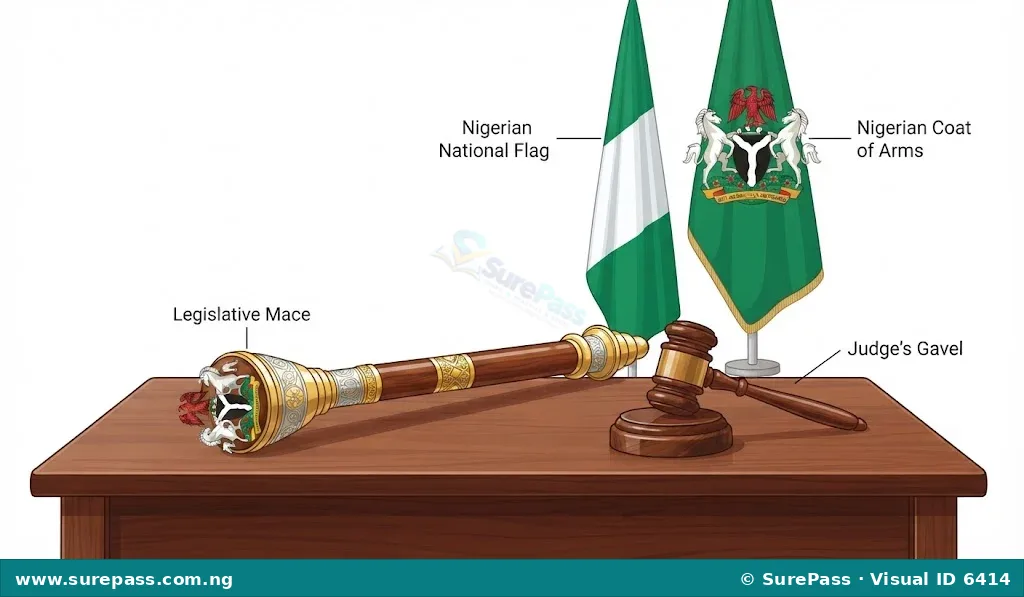
- The Mace: This is a highly decorated staff carried into the legislative chambers (such as the Senate, House of Representatives, and State Houses of Assembly). It represents the constitutional authority of the legislature to make laws. No formal legislative business can take place without the mace being present in the chamber.
- The Staff of Office: This is a decorated staff presented to traditional rulers (such as Kings, Emirs, and Obis) by the state government. It symbolizes the official recognition of their traditional authority by the state.
- The National Flag and Coat of Arms: These national symbols represent the sovereign authority of the Federal Republic of Nigeria. They are displayed in government offices, courtrooms, and official residences to show that actions taken there are backed by the authority of the state.
- The Constitution: The physical document of the constitution represents the supreme legal authority of the land. All public officers take an oath of office swearing to protect and defend it.
- The Gavel: A small wooden hammer used by judges in courtrooms and presiding officers in legislative houses to restore order and signal that a binding decision has been made.
Observe the visual representation of key symbols of authority below.
Difference Between Power and Authority
While power and authority are closely related political concepts, they are distinct in their application, acceptance, and legitimacy.
Power is the ability or capacity of an individual or group to influence, control, or force others to behave in a certain way, even against their will.
Power often relies on the possession of resources, physical strength, wealth, or weapons. It can be exercised without the consent of those being controlled. For example, an armed robber has the power to make a victim surrender their belongings, but the robber does not have the authority to do so.
In contrast, authority is the moral, legal, and recognized right to command. It is power that has been institutionalized and accepted as legitimate by the people. When a tax collector demands tax payment based on the law, they are exercising authority, which citizens recognize as a civic duty to obey.
The table below highlights the key differences between power and authority:
| Feature | Power | Authority |
|---|---|---|
| Definition | The capacity to force or influence others to obey commands. | The legal and recognized right to command and rule. |
| Legitimacy | Does not require legitimacy; can be illegal or unjust. | Must be legitimate, legal, and accepted by the people. |
| Basis | Based on physical force, coercion, wealth, or weapons. | Based on consent, laws, constitution, and tradition. |
| Nature | It is often personal, coercive, and can be seized by force. | It is institutional, official, and tied to an office or position. |
| Compliance | Obedience is often out of fear of punishment or pain. | Obedience is voluntary and based on respect for the law. |
| Scope | Broad and can be exercised arbitrarily without limits. | Limited by laws, regulations, and the constitution. |
Summary of Relationships
To understand how these concepts work together, political scientists often use the formula: Authority = Power + Legitimacy. Power is the raw capacity to act, while legitimacy is the moral right to act. When power is clothed in legitimacy, it becomes authority. Conversely, when a government loses its legitimacy, its authority declines, and it must rely increasingly on raw power and force to remain in control.





0 comments
Open the discussion when you need it. Comments stay collapsed until requested so the initial article remains light.