



ARTICLE CONTENTSOn this page 8 sections
Economic system: Communism
Performance Objectives
By the end of the lesson, students should be able to:
- explain the meaning of communism;
- discuss the characteristics of communism;
- analyse the types of communism;
- discuss the merits and demerits of communism;
- examine the relationship between communism and socialism.
Meaning of Communism
Communism is an economic and political system in which the means of production, distribution, and exchange are owned and controlled collectively by the community or the state, with the ultimate goal of establishing a classless and stateless society.
The modern theory of communism was developed in the nineteenth century by the German philosophers Karl Marx and Friedrich Engels. In their famous work, The Communist Manifesto (1848), they argued that human history is a history of class struggle between the exploiters (the bourgeoisie or capitalists) and the exploited (the proletariat or working class). Marx predicted that capitalism would eventually collapse through a proletarian revolution, leading to a system where private property is abolished and wealth is shared according to individual needs.
Under a fully realized communist system, there is no private ownership of land, factories, or machinery. Instead, these resources are held in common for the benefit of all members of society. Production is geared toward meeting human needs rather than generating private profit.
Characteristics of Communism
To understand how communism operates as an economic and political system, it is necessary to examine its core features. These features distinguish it from capitalist and mixed economic systems.
The main characteristics of communism are:
- Collective Ownership of the Means of Production: All major productive resources, such as land, mines, factories, banks, and transportation systems, are owned by the state or the community. Private individuals are not allowed to own these assets for personal profit.
- Abolition of Private Property: Private ownership of property that can generate wealth is prohibited. Only personal items, such as clothing and household goods, remain in private possession.
- Classless Society: Communism aims to eliminate social classes. Since there is no private ownership of the means of production, the division between the wealthy owners (capitalists) and the working class is removed, making all citizens equal status workers.
- Stateless and Moneyless Society: In pure communist theory, once class distinctions disappear, the state (government) will gradually “wither away” because there will be no need for a ruling apparatus to control class conflict. Money is also expected to be replaced by a system of direct distribution of goods.
- Central Economic Planning: The economy is directed by a central planning authority. This authority decides what goods to produce, how they should be produced, the quantities to be made, and the prices at which they will be distributed, rather than relying on market forces of demand and supply.
- Single-Party System: Historically, communist states have been ruled by a single political party, the Communist Party. No opposition parties are permitted, as the party is viewed as the representative of the working class.
- Distribution Based on Need: The ultimate guiding principle of a communist society is “from each according to his ability, to each according to his needs.” This means individuals contribute to society to the best of their talents and receive goods and services based on what they require to live.
Types of Communism
While the foundational ideas of communism come from Karl Marx, different leaders and theorists have adapted these ideas to suit the historical and social conditions of their respective countries. This has led to different variations of communism.
The major types of communism include:
- Classical Marxism: This is the original theoretical framework developed by Karl Marx and Friedrich Engels. It argues that capitalism must reach its peak of industrial development before the working class (proletariat) can successfully revolt and establish a communist society. It emphasizes that the transition must be international rather than confined to a single country.
- Marxism-Leninism: Developed by Vladimir Lenin, the leader of the Russian Revolution of 1917, this model adapted Marxism to the conditions of Russia. Lenin argued that a highly disciplined, centralized political party (the vanguard party) was necessary to lead the working class in overthrowing the capitalist state and to run the government during the transition to communism. This became the official ideology of the Soviet Union (USSR).
- Maoism: Formulated by Mao Zedong in China, this type of communism adapted Marxist theory to an agrarian (farming) society. Unlike Marx, who believed the industrial working class must lead the revolution, Mao argued that the peasantry (farmers) could serve as the primary revolutionary force to overthrow capitalism and imperialism.
- Council Communism: This is a democratic form of communism that emerged in Europe in the early twentieth century. It opposes both capitalism and the centralized state control seen in Marxism-Leninism. Instead, it advocates for workers’ councils, organized directly in factories and communities, to manage the economy and society without relying on a powerful political party.
Merits and Demerits of Communism
Like all economic and political systems, communism has distinct advantages and disadvantages that have been observed in both theory and historical practice.
Merits of Communism
The major advantages of communism are:
- Elimination of Exploitation: By removing private ownership of the means of production, the system prevents wealthy individuals from exploiting workers for personal gain.
- Social and Economic Equality: The system strives to bridge the gap between the rich and the poor, ensuring a more equitable distribution of wealth and resources among all citizens.
- Provision of Basic Needs: The state takes responsibility for providing essential social services, such as free education, healthcare, housing, and employment, to all members of society.
- Prevention of Unemployment: Under central planning, the government can allocate labor to various sectors of the economy, ensuring that every able-bodied citizen has a job.
- Rapid Industrialization: Centralized control allows the government to mobilize national resources quickly to build heavy industries, infrastructure, and public works without waiting for private investment.
Demerits of Communism
The major disadvantages of communism are:
- Suppression of Individual Initiative: Since individuals cannot own private businesses or accumulate personal wealth, there is little incentive for hard work, innovation, and entrepreneurship.
- Dictatorship and Authoritarianism: In practice, communist governments have often concentrated power in the hands of a few party leaders, leading to totalitarian regimes, the suppression of political opposition, and the abuse of human rights.
- Inefficient Resource Allocation: Central planning authorities often struggle to accurately determine the needs of millions of consumers. This frequently results in shortages of consumer goods, long queues, and surpluses of unwanted items.
- Loss of Personal Freedoms: Under communist rule, citizens often face severe restrictions on basic freedoms, including freedom of speech, press, religion, association, and movement.
- Absence of Consumer Choice: Because the state decides what is produced, consumers have limited options regarding the variety and quality of goods and services available in the market.
Relationship Between Communism and Socialism
Communism and socialism are closely related political and economic concepts, and they are often confused. However, in political science and Marxist theory, they represent different stages of societal development and have distinct operational features.
In Marxist theory, socialism is the transitional stage between capitalism and communism. During the socialist stage, the working class controls the state, and the means of production are owned by the public. However, wealth is still distributed based on individual contribution (work done) rather than need. Communism is the final, highest stage of development where the state, social classes, and money no longer exist, and distribution is based entirely on need.
The table below highlights the key differences between socialism and communism:
| Feature | Socialism | Communism |
|---|---|---|
| Ownership of Means of Production | State or public ownership, but some limited private ownership of small businesses may be allowed. | Strictly collective or state ownership; all private ownership of productive property is abolished. |
| Distribution of Wealth | Based on individual contribution: “From each according to his ability, to each according to his work.” | Based on individual need: “From each according to his ability, to each according to his needs.” |
| Social Classes | Class distinctions are minimized but may still exist in transition. | A completely classless society where social classes are entirely eliminated. |
| Role of the State | The state exists and plays an active role in managing the economy and society. | The state has “wither away,” leaving a self-governing, stateless community. |
| Political System | Can exist alongside democratic multi-party systems (democratic socialism) or single-party rule. | Historically associated with a single-party system ruled by the Communist Party. |
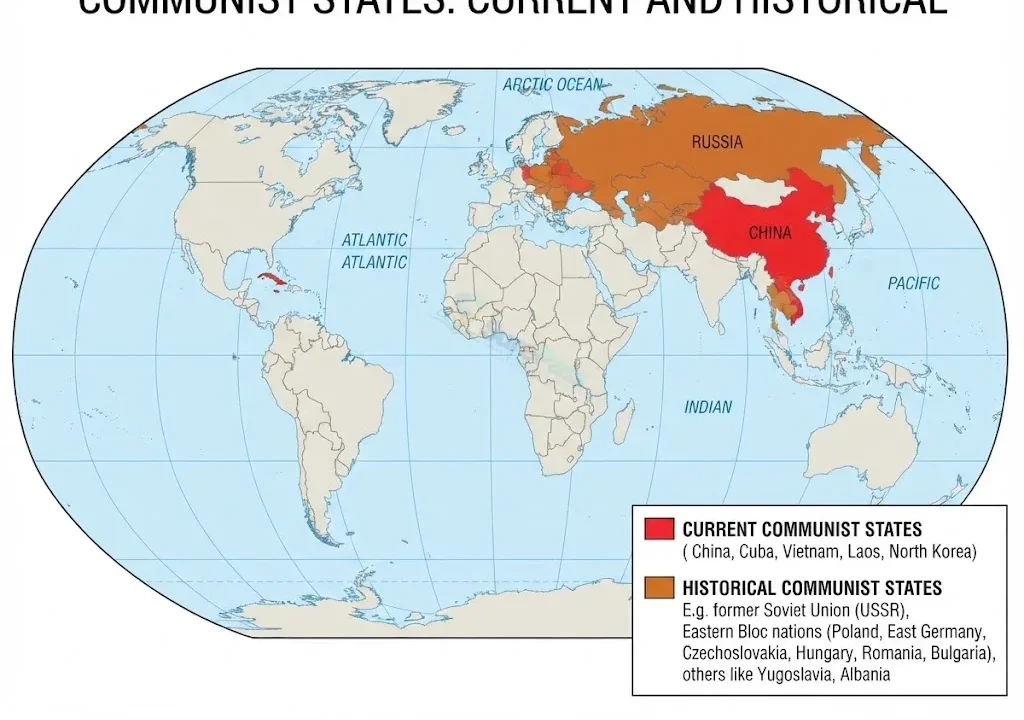
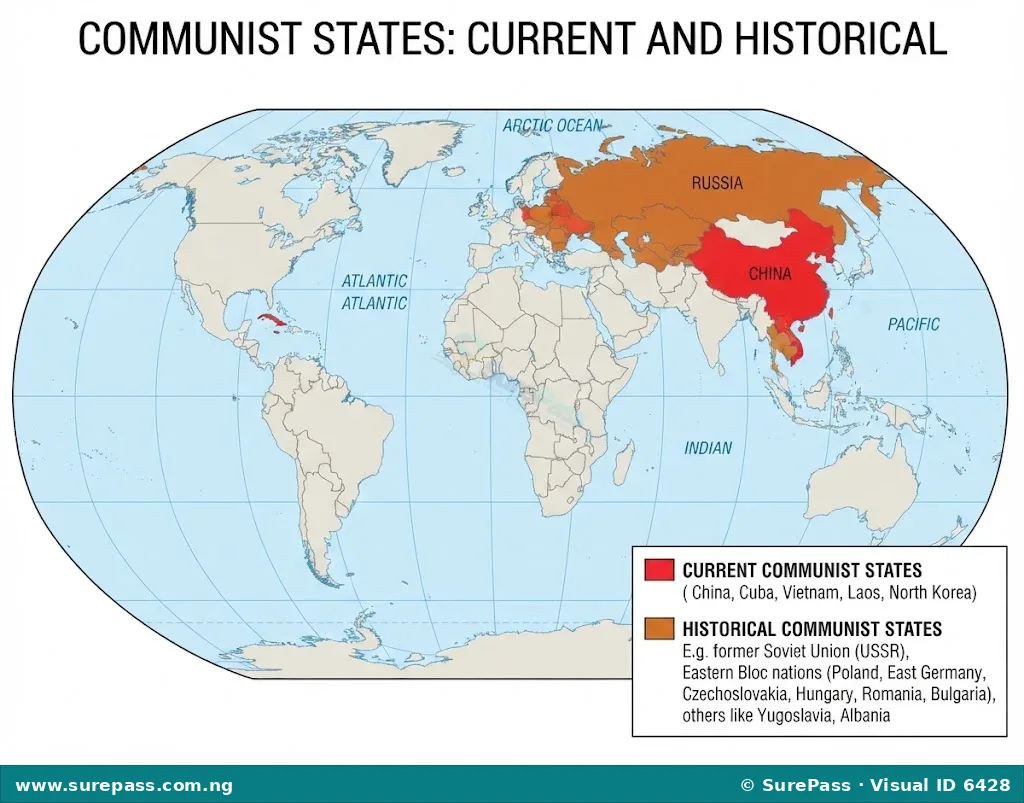
Observe the map below to identify regions of the world that adopted these systems historically and those that maintain them today.
Summary of Key Concepts
The key concepts discussed in this unit are:
- Communism is an economic and political system based on collective ownership of the means of production and the creation of a classless, stateless society.
- Karl Marx and Friedrich Engels are the primary theorists of modern communism, proposing that capitalism would be overthrown by a working-class revolution.
- Key characteristics include the abolition of private property, central economic planning, a single-party system, and distribution of goods based on need.
- The major types of communism are Classical Marxism, Marxism-Leninism, Maoism, and Council Communism.
- Merits include the elimination of exploitation and promotion of equality, while demerits include the loss of individual initiative, authoritarianism, and economic inefficiency.
- Socialism is the transitional stage where the state owns the means of production and distributes wealth based on work, whereas communism is the final stage where the state has withered away and distribution is based on need.





0 comments
Open the discussion when you need it. Comments stay collapsed until requested so the initial article remains light.