




ARTICLE CONTENTSOn this page 6 sections
Centralization and Decentralisation
Performance Objectives
By the end of the lesson, students should be able to:
- explain centralization and decentralisation;
- discuss forms of decentralization;
- examine the merits and demerits of decentralization;
- analyse the impacts of centralization and decentralisation on governance.
Meaning of Centralization and Decentralization
Centralization is a system of administration where power, authority and decision-making functions are concentrated in a single central source or a single central authority.
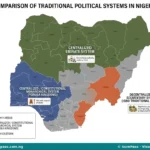
In a centralized system, the central authority retains absolute control over the entire territory. Lower levels of administration, such as regional offices or local departments, do not possess independent powers. Instead, they act as agents of the central authority, executing directives and policies passed down from the top. This administrative structure is common in unitary states, such as France and Great Britain, and was highly visible in Nigeria during periods of military rule, where the Supreme Military Council held supreme authority over the entire nation.
Decentralization is a system of administration where power, authority and decision-making functions are distributed or shared among various levels or tiers of government.
In a decentralized system, authority is legally or constitutionally dispersed from the center to sub-national units, such as states, regions, and local governments. These lower tiers of government are granted the autonomy to make decisions, raise revenue, and implement policies within their specified jurisdictions. This system is a defining feature of federalism, as seen in countries like Nigeria, the United States of America, and Canada, where the federal, state, and local governments share constitutional powers.
Forms of Decentralization
Decentralization can take different forms depending on the degree of authority transferred from the central government to lower levels. The primary forms of decentralization include:
- Deconcentration
- Delegation
- Devolution
Deconcentration
Deconcentration is the transfer of administrative responsibilities from central government ministries to field offices or regional branches without transferring actual decision-making power.
This is the weakest form of decentralization. The central authority retains full control over policy formulation and decision-making, while the regional branches merely carry out routine administrative duties. An example of deconcentration in Nigeria is the establishment of state branches of federal agencies, such as the Federal Road Safety Corps (FRSC) or the National Identity Management Commission (NIMC), which operate in various states but take direct orders from their national headquarters in Abuja.
Delegation
Delegation is the transfer of decision-making and administrative authority for specific tasks to semi-autonomous agencies or public corporations, which remain ultimately accountable to the central government.
Under delegation, the central government assigns specific functions to specialized bodies to ensure efficiency. However, the central government can withdraw or modify these delegated powers at any time. Examples of delegation in Nigeria include the assignment of electoral duties to the Independent National Electoral Commission (INEC), the regulation of telecommunications to the Nigerian Communications Commission (NCC), and the conduct of university matriculation examinations to the Joint Admissions and Matriculation Board (JAMB).
Devolution
Devolution is the constitutional transfer of political, administrative, and financial powers to sub-national levels of government that operate independently within their constitutional jurisdiction.
This is the strongest and most complete form of decentralization. The sub-national units, such as state and local governments, derive their powers directly from the constitution rather than from the central government. These units have the legal authority to elect their own leaders, make laws, levy taxes, and implement development projects. In Nigeria, devolution is reflected in the constitutional division of powers between the Federal Government (Exclusive Legislative List) and the State Governments (Concurrent Legislative List), as well as the creation of Local Government Areas as the third tier of government.
Merits and Demerits of Decentralization
Decentralization plays a significant role in modern governance. The main merits of decentralization include:
- Grassroots Development: It brings government closer to the people, allowing local authorities to identify and address the specific needs of rural and local communities.
- Reduction of Workload: It relieves the central government of minor administrative tasks, enabling national leaders to focus on critical national issues such as defense, foreign policy, and national economic planning.
- Popular Participation: It encourages citizens to participate actively in local politics, decision-making, and community development projects.
- Quick Decision-Making: It eliminates bureaucratic delays or red tape, as local officials can make and implement decisions quickly without waiting for approval from a distant central headquarters.
- Accommodation of Diversity: In heterogeneous societies with diverse ethnic, religious, and cultural groups, decentralization helps to reduce tension by giving different groups the autonomy to manage their local affairs.
- Leadership Training: It serves as a training ground for local politicians and administrators, preparing them for leadership roles at the state and national levels.
Despite its advantages, decentralization also presents several challenges. The main demerits of decentralization include:
- High Cost of Administration: It leads to the duplication of offices, personnel, and equipment across different levels of government, which increases the overall cost of governance.
- Threat to National Unity: Excessive decentralization can foster regionalism, ethnic loyalty, and rivalry, which may weaken national cohesion and, in extreme cases, lead to secessionist movements.
- Uneven Development: Different states or local governments possess varying levels of natural resources and revenue-generating capacity, which can lead to rapid development in some areas while others remain underdeveloped.
- Difficulty in Policy Uniformity: It makes it difficult for a country to maintain uniform laws, educational standards, or administrative policies across all regions.
- Weakness in Emergencies: During national crises, such as pandemics, natural disasters, or security threats, a decentralized system may struggle to coordinate a swift and unified national response.
- Local Elite Capture and Corruption: Power transferred to local levels can sometimes be hijacked by local elites or corrupt officials who divert public funds for personal gain, away from the supervision of central anti-corruption agencies.
Impacts of Centralization and Decentralization on Governance
The choice between centralization and decentralization significantly shapes how a country is governed. Both systems have distinct impacts on administrative efficiency, political stability, and citizen satisfaction.
Impacts of Centralization on Governance
The major impacts of centralization on governance include:
- Strong National Unity: Centralization fosters a sense of national identity and reduces ethnic or regional divisions by keeping all political power in a single center.
- Uniformity of Policies: It ensures that laws, policies, and public services are uniform throughout the country, preventing confusion and ensuring equal standards for all citizens.
- Swift Emergency Response: The central government can make rapid decisions and mobilize national resources quickly during emergencies without the need to consult or negotiate with regional leaders.
- Bureaucratic Delays: It often leads to administrative inefficiency, as local issues must be referred to the central headquarters for approval, resulting in long delays.
- Neglect of Local Needs: Centralized authorities may lack detailed knowledge of remote communities, leading to policies that do not address the actual needs of the grassroots.
- Risk of Authoritarianism: The concentration of power in a single authority increases the risk of dictatorship, as there are fewer institutional checks and balances to limit the abuse of power.
Impacts of Decentralization on Governance
The major impacts of decentralization on governance include:
- Democratic Consolidation: It strengthens democracy by distributing power and allowing citizens to hold local leaders directly accountable for their actions.
- Responsive and Flexible Administration: Local governments can quickly adapt national policies to suit local conditions, making governance more responsive and effective.
- Political Stability in Plural Societies: By granting autonomy to different ethnic or regional groups, decentralization reduces the fear of domination by one group, thereby promoting political stability.
- Coordination Challenges: It can lead to conflicts of interest and jurisdictional disputes between the central government and sub-national units, making national policy coordination difficult.
- Financial Instability: Sub-national units that lack adequate internal revenue sources may become financially crippled and unable to provide basic public services without central government bailouts.
Comparison of Centralization and Decentralization in Governance
The table below provides a comparative analysis of how centralization and decentralization impact key aspects of governance:
| Governance Indicator | Centralized System | Decentralized System |
|---|---|---|
| Decision-Making Speed | Fast and unified at the national level, but slow for local issues due to bureaucratic red tape. | Fast for local issues, but slow and complex for national policies due to consultation requirements. |
| Policy Uniformity | High; identical laws, standards, and public services apply across the entire country. | Low; laws, standards, and public services vary from one state or region to another. |
| Grassroots Representation | Low; local communities have limited influence on national decision-making. | High; local communities actively participate in choosing leaders and shaping local policies. |
| Cost of Governance | Lower; administrative costs are minimized by avoiding the duplication of offices and personnel. | Higher; significant financial resources are spent on maintaining multiple tiers of government. |
| National Unity and Stability | Promotes a single national identity, but may cause resentment among minority groups. | Reduces ethnic and regional tensions, but may encourage regional rivalry or secessionist tendencies. |



0 comments
Open the discussion when you need it. Comments stay collapsed until requested so the initial article remains light.