



ARTICLE CONTENTSOn this page 10 sections
Call to Service
Performance Objectives
By the end of the lesson, students should be able to:
- explain the meaning and types of service;
- discuss examples of persons who served in the Bible;
- enumerate the challenges associated with service;
- discuss the challenges associated with service;
- explain ways people are rewarded for their service;
- discuss how to live a life of service to God and humanity.
Memory Verse
But Ruth replied, “Don’t urge me to leave you or to turn back from you. Where you go I will go, and where you stay I will stay. Your people will be my people and your God my God.” (Ruth 1:16 KJV)
Bible Reading
The principal Bible passages supporting this lesson are:
- Genesis 37:12-36
- Genesis 39:7
- Genesis 41:37-57
- Ruth 1:7-18
- 1 Peter 2:18-25
Meaning and Types of Service
Service is the act of helping or doing work for someone or for a community. It involves using one’s time, skills, or resources to benefit others without necessarily expecting a direct payment in return.
In Christian Religious Studies, service often means dedicating one’s life and actions to God and to fellow human beings, following the example of Jesus Christ.
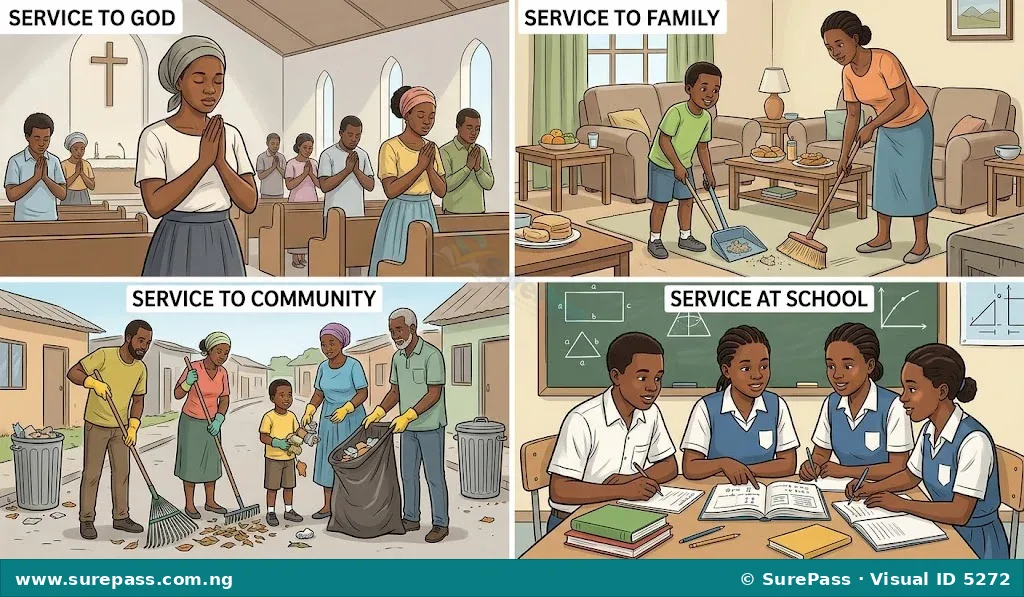
There are different types of service that people can offer. These include:
- Service to God: This involves worshipping God, obeying His commandments, sharing the Gospel, and using one’s talents to glorify Him.
- Service to Family: This includes helping parents with chores, caring for siblings, and supporting family members in need.
- Service to Community: This involves helping neighbours, participating in community development projects, and assisting those who are less fortunate.
- Service at School: This can be helping classmates, keeping the school environment clean, or participating in school activities that benefit others.
- Service to the Nation: This means being a good citizen, obeying laws, and contributing to the progress of the country.
Examples of Persons Who Served in the Bible
The Bible provides many examples of individuals who dedicated their lives to service, often facing challenges but ultimately receiving blessings.
Joseph Serves in Egypt
Joseph was one of Jacob’s twelve sons. His brothers were jealous of him and sold him into slavery in Egypt (Genesis 37:12-36). Despite this great injustice, Joseph remained faithful to God and served diligently wherever he was placed.
First, Joseph served in the house of Potiphar, an officer of Pharaoh. He managed Potiphar’s household so well that Potiphar put him in charge of everything he owned. Even when falsely accused and thrown into prison, Joseph continued to serve. He interpreted dreams for fellow prisoners, including Pharaoh’s chief cupbearer and baker.
Later, Pharaoh himself had troubling dreams. The cupbearer remembered Joseph and told Pharaoh about him. Joseph interpreted Pharaoh’s dreams, which foretold seven years of abundant harvest followed by seven years of severe famine. He also advised Pharaoh on how to prepare for the famine.
Impressed by Joseph’s wisdom and the Spirit of God in him, Pharaoh appointed Joseph as the second-in-command over all of Egypt (Genesis 41:37-43). Joseph faithfully served Egypt by managing the storage of grain during the years of plenty and distributing it during the famine, saving many lives, including those of his own family.
Ruth Serves Her Mother-in-Law
Ruth was a Moabite woman who married an Israelite man named Mahlon. After her husband and father-in-law died, Ruth’s mother-in-law, Naomi, decided to return to her homeland in Bethlehem. Naomi urged her two daughters-in-law, Orpah and Ruth, to return to their own families in Moab.
Orpah chose to stay in Moab, but Ruth refused to leave Naomi. Ruth declared her unwavering loyalty and commitment to Naomi, saying, “Where you go I will go, and where you stay I will stay. Your people will be my people and your God my God” (Ruth 1:16-18). This was a profound act of service and devotion.
Ruth left her own people and country to care for Naomi in a foreign land. She worked hard, gleaning in the fields to provide food for herself and Naomi. Her faithful service and kindness were noticed by Boaz, a wealthy relative of Naomi’s late husband. Boaz eventually married Ruth, and they had a son named Obed, who became the grandfather of King David. Through Ruth’s selfless service, she became an ancestor of Jesus Christ.
Lessons from the Service of Joseph and Ruth
The stories of Joseph and Ruth teach important lessons about service:
- Faithfulness: Both Joseph and Ruth remained faithful to God and to the people they served, even in difficult circumstances. Joseph served Potiphar and Pharaoh diligently, and Ruth remained loyal to Naomi.
- Diligence and Hard Work: Joseph worked hard in Potiphar’s house and in prison, and later as a ruler in Egypt. Ruth worked tirelessly in the fields to provide for Naomi.
- Obedience to God: Joseph always acknowledged God’s power and guidance. Ruth adopted Naomi’s God as her own and followed His ways.
- Selflessness: Ruth put Naomi’s needs before her own, leaving her home and people. Joseph, despite being wronged by his brothers, forgave them and used his position to save them.
- Humility: Joseph did not boast about his abilities but gave credit to God for interpreting dreams. Ruth humbly gleaned in the fields.
- God’s Reward: Both Joseph and Ruth were greatly rewarded for their faithful service. God elevated Joseph to a position of power and blessed Ruth with a new family and a place in the lineage of Christ.
Challenges Associated with Service
Serving God and humanity is not always easy. People who serve often face various challenges. Some of these challenges include:
- Seduction: This is the temptation to engage in immoral or sinful acts. Joseph faced this challenge when Potiphar’s wife tried to seduce him (Genesis 39:7). He resisted her advances, choosing to remain faithful to God and his master.
- Bribery and Corruption: These are temptations to use one’s position of service for personal gain, by accepting gifts or money to do wrong, or by acting unfairly. For example, a person in a position of authority might be tempted to accept a bribe to grant a favour to someone who does not deserve it, or to ignore a wrongdoing.
- Discouragement: Sometimes, people who serve may feel unappreciated, tired, or overwhelmed by the demands of their service.
- Unfair Treatment: Like Joseph, who was falsely accused and imprisoned, people who serve may sometimes face injustice or be treated unfairly by others.
- Sacrifice: Service often requires giving up personal comfort, time, or resources for the benefit of others.
Rewards for Service
Faithful service, especially to God and humanity, often brings significant rewards. These rewards can be both earthly and spiritual.
The story of Joseph clearly shows how God rewards faithful service. After years of slavery and imprisonment, Joseph was elevated by Pharaoh to become the second most powerful man in Egypt (Genesis 41:37-43). He was given authority, a new name, a wife, and a family. This was a direct reward for his faithfulness, diligence, and wisdom in serving God and his masters.
Other ways people are rewarded for their service include:
- Divine Favour and Blessings: God often blesses those who serve Him faithfully, providing for their needs and granting them success.
- Good Reputation: People who serve selflessly often earn the respect and admiration of others in their community.
- Inner Peace and Joy: There is a deep sense of satisfaction and happiness that comes from helping others and knowing one has made a positive difference.
- Opportunities for Growth: Service can open doors to new experiences, learning, and personal development.
- Eternal Rewards: The Bible teaches that God will reward His faithful servants in heaven.

Living a Life of Service to God and Humanity
Living a life of service means actively seeking opportunities to help others and to honour God in all actions. The Apostle Peter encourages believers to live a life of submission and good conduct, even when facing hardship (1 Peter 2:18-25). This passage teaches that suffering for doing good is commendable in God’s sight, just as Christ suffered for humanity.
To live a life of service, people can:
- Obey God’s Commandments: This is the foundation of all service to God.
- Serve with a Willing Heart: Offer help cheerfully and without grumbling.
- Use Talents for Good: Identify personal skills and use them to benefit others, whether it is singing in the choir, helping with school projects, or assisting the elderly.
- Show Kindness and Compassion: Be sensitive to the needs of others and offer practical help or encouragement.
- Forgive Others: Like Joseph, be willing to forgive those who have wronged you, showing God’s love.
- Be Patient and Persevering: Service can be challenging, so it requires patience and determination to continue doing good.
- Pray for Guidance: Ask God to show where and how to serve effectively.




0 comments
Open the discussion when you need it. Comments stay collapsed until requested so the initial article remains light.