


ARTICLE CONTENTSOn this page 7 sections
Adjustments in Income Statement
Performance Objectives
By the end of the lesson, students should be able to:
- state the importance of adjustment in income statement;
- identify the adjustments in income statement;
- discuss the effects of adjustments on income statement;
- prepare an income statement with adjustments.
Introduction to Income Statement Adjustments
The Income Statement, also known as the Profit and Loss Account, is a financial statement that shows a company’s revenues and expenses over a specific period, usually a quarter or a year. Its main purpose is to determine the net profit or loss for that period. For the Income Statement to present a true and fair view of a business’s financial performance, certain adjustments must be made to the figures initially recorded in the books of account.
These adjustments ensure that all revenues earned during the period are matched with all expenses incurred during the same period, regardless of when cash was received or paid. This principle is known as the accrual concept of accounting.
Importance of Adjustments in Income Statement
Adjustments are crucial for preparing accurate financial statements. Without them, the Income Statement would not reflect the true financial performance of a business. The importance of making adjustments includes:
- Accurate Profit or Loss Calculation: Adjustments ensure that all revenues earned and all expenses incurred within a specific accounting period are recognised. This leads to a more accurate calculation of net profit or loss for that period.
- Compliance with Accounting Principles: Adjustments help businesses comply with fundamental accounting principles such as the accrual concept and the matching principle. The accrual concept states that transactions should be recorded when they occur, not when cash is exchanged. The matching principle requires that expenses be matched with the revenues they helped to generate in the same accounting period.
- True and Fair View: Financial statements that include appropriate adjustments provide a true and fair view of the business’s financial performance and position. This is essential for decision-making by owners, investors, creditors, and other stakeholders.
- Reliable Decision Making: When financial statements are accurate, stakeholders can make informed decisions. For example, investors can decide whether to invest, and management can assess the profitability of operations.
- Prevention of Misleading Information: Ignoring adjustments can lead to overstated or understated profits, which can mislead users of financial statements about the actual performance of the business.
Common Adjustments in Income Statement
Several types of adjustments are commonly made before preparing the final Income Statement. These adjustments help to correctly allocate revenues and expenses to the proper accounting period.
Depreciation
Depreciation is the systematic allocation of the cost of a tangible fixed asset over its useful life. Fixed assets, such as buildings, machinery, vehicles, and furniture, lose value over time due to wear and tear, obsolescence, or usage.
The purpose of depreciation is to spread the cost of a fixed asset over the periods in which it is used and generates revenue. It is an expense that appears in the Income Statement, reducing the profit for the period. Depreciation does not involve a cash outflow in the current period; it is an accounting estimate.

Bad Debts and Provision for Doubtful Debts
When a business sells goods or services on credit, it creates debtors (also known as accounts receivable). These are customers who owe money to the business. Sometimes, a business may find that some of these debts will never be collected.
- Bad Debts: Bad debts are amounts owed to the business that are considered irrecoverable. These are specific debts that are known to be uncollectible and are written off as an expense in the Income Statement. For example, if a customer goes bankrupt, their debt becomes a bad debt.
- Provision for Doubtful Debts: A provision for doubtful debts is an estimate of the amount of current debtors that may become uncollectible in the future. Businesses create this provision because it is prudent to anticipate that not all credit sales will be recovered. This provision is an expense in the Income Statement, reflecting the estimated loss from uncollectible accounts. It ensures that the Income Statement reflects a more realistic profit figure by accounting for potential future losses from credit sales.
Prepayments (Prepaid Expenses)
Prepayments, also known as prepaid expenses, are expenses paid in advance for a future accounting period. This means that the cash has been paid, but the benefit or service has not yet been fully received or consumed within the current accounting period.
Examples of prepayments include prepaid rent, prepaid insurance, or prepaid advertising. If a business pays for a 12-month insurance policy on October 1st, only three months (October, November, December) of the insurance expense relate to the current year. The remaining nine months are a prepayment for the next year and must be adjusted out of the current year’s expenses in the Income Statement.
Accruals (Accrued Expenses)
Accruals, also known as accrued expenses, are expenses that have been incurred during the current accounting period but have not yet been paid for. This means the business has received the benefit or service, but the invoice or payment is due in a future period.
Examples of accruals include accrued salaries, accrued electricity bills, or accrued interest on a loan. If employees have worked in December but their salaries will be paid in January, the December salaries are an accrued expense for the current year. These expenses must be included in the current year’s Income Statement to accurately reflect the cost of operations for that period, even though cash has not yet been paid.
Effect of Adjustments on Income Statement Preparation
Each adjustment has a specific effect on the figures presented in the Income Statement, ultimately impacting the calculated net profit or loss.
- Depreciation:
- Effect: Increases expenses in the Income Statement.
- Impact on Profit: Reduces net profit.
- Example: If machinery depreciates by ₦50,000, this amount is added to the expenses, decreasing the profit by ₦50,000.
- Bad Debts:
- Effect: Increases expenses in the Income Statement.
- Impact on Profit: Reduces net profit.
- Example: If ₦10,000 of a customer’s debt is written off as bad, this ₦10,000 is recognised as an expense, reducing profit.
- Provision for Doubtful Debts:
- Effect: Increases expenses (or adjusts existing provision) in the Income Statement. An increase in provision reduces profit, while a decrease increases profit.
- Impact on Profit: Reduces net profit (if provision increases) or increases net profit (if provision decreases).
- Example: If a new provision of ₦20,000 is made for doubtful debts, this ₦20,000 is an expense, reducing profit.
- Prepayments (Prepaid Expenses):
- Effect: Decreases expenses in the Income Statement for the current period. The portion of the expense that relates to the future period is removed.
- Impact on Profit: Increases net profit.
- Example: If ₦120,000 was paid for 12 months of insurance on October 1st, only ₦30,000 (3/12 of ₦120,000) is the expense for the current year. The remaining ₦90,000 is removed from current expenses, increasing profit.
- Accruals (Accrued Expenses):
- Effect: Increases expenses in the Income Statement for the current period. The expense incurred but not yet paid is added.
- Impact on Profit: Reduces net profit.
- Example: If ₦15,000 of electricity bill was incurred in December but not yet paid, this ₦15,000 is added to expenses, reducing profit.
Preparing an Income Statement with Adjustments
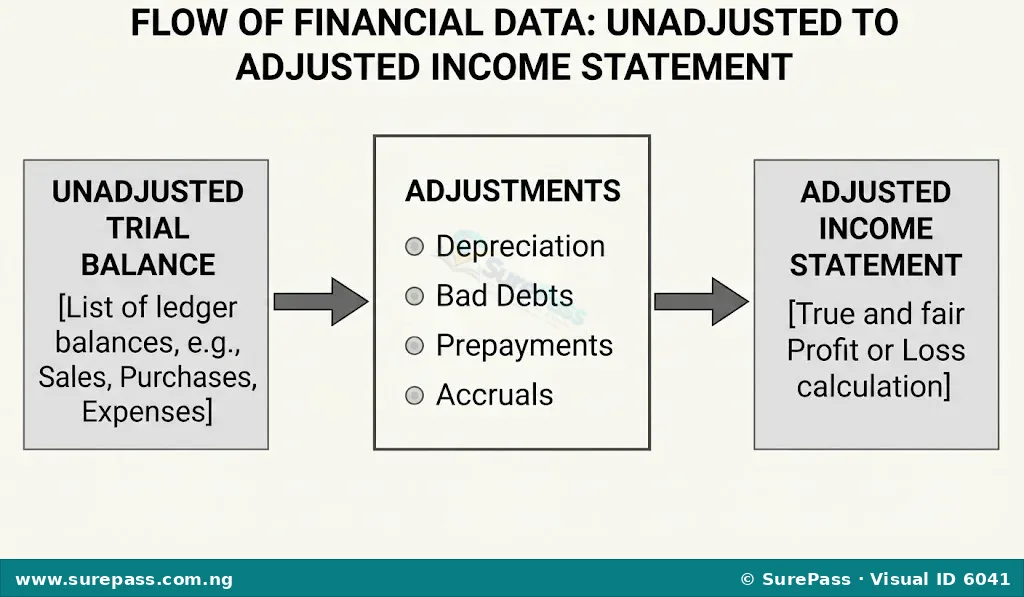
Preparing an Income Statement with adjustments involves taking the initial figures from the trial balance and then modifying them based on the additional information provided by the adjustments. The goal is to ensure that all revenues and expenses are correctly matched to the accounting period.
Steps for Preparing an Income Statement with Adjustments
- Start with the Trial Balance: Begin with the unadjusted trial balance, which lists all ledger account balances at the end of the period.
- Identify Adjustment Information: Review the additional information provided for adjustments (e.g., depreciation rates, bad debt estimates, prepaid amounts, accrued amounts).
- Calculate Adjustments: Determine the exact amounts for each adjustment.
- Apply Adjustments to Relevant Accounts:
- For expenses: Add accrued expenses, subtract prepaid expenses (the portion relating to the future), add depreciation, add bad debts, and adjust provision for doubtful debts.
- For revenues: Add accrued revenues (if any, though less common in SS1 adjustments focus), subtract unearned revenues (if any).
- Prepare the Adjusted Income Statement: Present the revenues and expenses in the standard Income Statement format, using the adjusted figures.
Worked Example: Preparing an Income Statement with Adjustments
The following trial balance was extracted from the books of Bola Enterprises as at 31st December 2023:
| Account | Debit (₦) | Credit (₦) |
|---|---|---|
| Sales | 500,000 | |
| Purchases | 250,000 | |
| Opening Stock | 60,000 | |
| Salaries | 80,000 | |
| Rent | 36,000 | |
| Insurance | 24,000 | |
| Debtors | 70,000 | |
| Creditors | 40,000 | |
| Cash | 10,000 | |
| Bank | 50,000 | |
| Capital | 240,000 | |
| Drawings | 10,000 | |
| Office Equipment | 150,000 | |
| Total | 690,000 | 690,000 |
Additional Information (Adjustments) as at 31st December 2023:
- Closing stock was valued at ₦75,000.
- Depreciation on Office Equipment is to be provided at 10% per annum.
- Salaries of ₦5,000 are accrued (outstanding) at year-end.
- Rent of ₦3,000 was prepaid at year-end.
- Insurance of ₦4,000 relates to the next accounting period.
- Provision for doubtful debts is to be created at 5% of debtors.
Required: Prepare the Income Statement for Bola Enterprises for the year ended 31st December 2023.
Calculations for Adjustments:
- Depreciation on Office Equipment: 10% of ₦150,000 = ₦15,000
- Accrued Salaries: ₦5,000 (add to salaries expense)
- Prepaid Rent: ₦3,000 (subtract from rent expense)
- Prepaid Insurance: ₦4,000 (subtract from insurance expense)
- Provision for Doubtful Debts: 5% of Debtors (₦70,000) = ₦3,500
Adjusted Expenses:
- Salaries: ₦80,000 (from trial balance) + ₦5,000 (accrued) = ₦85,000
- Rent: ₦36,000 (from trial balance) – ₦3,000 (prepaid) = ₦33,000
- Insurance: ₦24,000 (from trial balance) – ₦4,000 (prepaid) = ₦20,000
- Depreciation: ₦15,000
- Provision for Doubtful Debts: ₦3,500
Bola Enterprises
Income Statement
For the Year Ended 31st December 2023
| ₦ | ₦ | |
|---|---|---|
| Sales | 500,00 0 | |
| Less: Cost of Goods Sold | ||
| Opening Stock | 60,000 | |
| Add: Purchases | 250,000 | |
| 310,000 | ||
| Less: Closing Stock | (75,000) | |
| Cost of Goods Sold | (235,000) | |
| Gross Profit | 265,000 | |
| Less: Operating Expenses | ||
| Salaries (₦80,000 + ₦5,000) | 85,000 | |
| Rent (₦36,000 – ₦3,000) | 33,000 | |
| Insurance (₦24,000 – ₦4,000) | 20,000 | |
| Depreciation on Office Equipment | 15,000 | |
| Provision for Doubtful Debts | 3,500 | |
| Total Operating Expenses | (156,500) | |
| Net Profit | 108,500 |

0 comments
Open the discussion when you need it. Comments stay collapsed until requested so the initial article remains light.