



ARTICLE CONTENTSOn this page 11 sections
The Ledger
Performance Objectives
By the end of the lesson, students should be able to:
- explain the meaning and importance of ledger in accounting;
- differentiate the types of ledgers;
- classify different types of ledger accounts;
- describe the relationship between the ledger accounts and books of prime entry;
- draw a simple ledger account using the T- account structure;
- post entries from books of prime entry/journal to ledger accounts applying the rule of double entry;
- prepare and balance a simple ledger account accurately;
- interpret ledger accounts accurately.
Meaning of Ledger
A ledger is a principal book of accounts where all financial transactions of a business are recorded and summarised.
It contains individual accounts for assets, liabilities, capital, revenues, and expenses. Each account in the ledger shows all the transactions related to that specific item, allowing a business to see the total effect of these transactions.
Importance of the Ledger in Accounting
The ledger plays a crucial role in the accounting system for several reasons:
- Summarises Transactions: It brings together all transactions affecting a particular account in one place, providing a clear summary.
- Facilitates Financial Statements: The balances from ledger accounts are used to prepare important financial statements like the Trial Balance, Income Statement, and Statement of Financial Position.
- Aids Decision Making: By providing summarised financial information, the ledger helps business owners and managers make informed decisions.
- Ensures Accuracy: The double-entry system used in the ledger helps to check the accuracy of recorded transactions.
- Provides Historical Record: It serves as a permanent record of all financial activities of the business.
Types of Ledgers
Ledgers are typically organised into different types to manage the volume and nature of transactions efficiently. The main types of ledgers are:
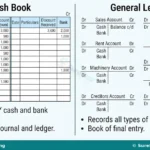
- General Ledger: This is the main ledger that contains all the accounts necessary to prepare financial statements. It includes accounts for assets, liabilities, capital, revenues, and expenses. It is also known as the nominal ledger or principal ledger.
- Sales Ledger: This ledger contains individual accounts for all credit customers (debtors) of the business. It records all sales made on credit to these customers and payments received from them. It is also known as the Debtors Ledger.
- Purchases Ledger: This ledger contains individual accounts for all credit suppliers (creditors) of the business. It records all purchases made on credit from these suppliers and payments made to them. It is also known as the Creditors Ledger.
The general ledger holds the control accounts (e.g., Sales Ledger Control Account, Purchases Ledger Control Account) which summarise the balances from the sales and purchases ledgers, ensuring the overall accounting equation remains balanced.
Classification of Ledger Accounts
Ledger accounts are classified into three main types based on the nature of the items they represent. This classification is important for applying the rules of double entry.
- Personal Accounts: These accounts relate to individuals, firms, or companies with whom the business has dealings. They represent debtors (customers who owe money to the business) and creditors (suppliers to whom the business owes money).
Examples of personal accounts include:
- Mr. Ade’s Account (a customer)
- Mrs. Bola’s Account (a supplier)
- ABC Ltd Account
- Real Accounts: These accounts relate to assets owned by the business. Assets are resources controlled by the business from which future economic benefits are expected. Real accounts are not closed at the end of the accounting period; their balances are carried forward to the next period.
Examples of real accounts include:
- Cash Account
- Bank Account
- Furniture Account
- Building Account
- Motor Vehicle Account
- Nominal Accounts: These accounts relate to expenses, losses, revenues, and gains of the business. They are temporary accounts that are closed at the end of each accounting period by transferring their balances to the Income Statement.
Examples of nominal accounts include:
- Salaries Account (expense)
- Rent Account (expense)
- Sales Account (revenue)
- Purchases Account (expense)
- Discount Received Account (gain)
Format and Structure of the Ledger (T-Account)
A ledger account is typically presented in a “T” shape, which is why it is often called a T-account. This format clearly separates the debit (left) side from the credit (right) side.
The basic structure of a T-account includes:
- Account Name: Placed at the top centre.
- Debit Side (Dr): The left side of the account, used for recording increases in assets and expenses, and decreases in liabilities, capital, and revenue.
- Credit Side (Cr): The right side of the account, used for recording increases in liabilities, capital, and revenue, and decreases in assets and expenses.
- Date Column: To record the date of the transaction.
- Particulars Column: To briefly describe the transaction.
- Folio Column: To reference the page number in the book of prime entry from which the entry was posted.
- Amount Column: To record the monetary value of the transaction.
Drawing a Simple Ledger Account
To draw a simple ledger account, follow these steps:
- Draw a large ‘T’ shape.
- Write the name of the account clearly at the top centre of the ‘T’.
- Label the left side ‘Dr’ (Debit) and the right side ‘Cr’ (Credit).
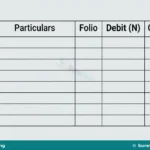
- On both the debit and credit sides, draw columns for ‘Date’, ‘Particulars’, ‘Folio’, and ‘Amount (₦)’.
Rules of Double Entry and Ledger Posting
The double-entry system is the fundamental principle of accounting. It states that every financial transaction has two aspects: a debit and a credit, and these two aspects must always be equal. For every debit, there must be a corresponding credit of an equal amount.
The rules for debiting and crediting different types of accounts are:
- Personal Accounts:
- Debit the receiver (the person or entity receiving a benefit).
- Credit the giver (the person or entity giving a benefit).
- Real Accounts:
- Debit what comes into the business (e.g., cash received, asset purchased).
- Credit what goes out of the business (e.g., cash paid, asset sold).
- Nominal Accounts:
- Debit all expenses and losses.
- Credit all revenues and gains.
Posting Entries from Books of Prime Entry to Ledger Accounts
Posting is the process of transferring entries from the books of prime entry (like the Cash Book, Sales Journal, Purchases Journal, or General Journal) to the respective ledger accounts. Each transaction recorded in a book of prime entry will result in at least one debit entry and one credit entry in the ledger.
The procedure for posting involves the following steps:
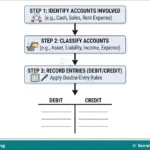
- Identify the two accounts affected by the transaction.
- Determine the type of each account (personal, real, or nominal).
- Apply the double-entry rules to decide which account to debit and which to credit.
- Record the date, particulars (the name of the other account involved in the transaction), folio reference, and amount in the debit side of the account to be debited.
- Record the date, particulars (the name of the other account involved in the transaction), folio reference, and amount in the credit side of the account to be credited.
Worked Example: Posting Transactions to Ledger Accounts
Consider the following transactions for Mr. Obi’s business in January 2024:
- Jan 1: Started business with cash ₦50,000.
- Jan 5: Bought goods for cash ₦10,000.
- Jan 10: Sold goods for cash ₦15,000.
- Jan 15: Paid rent by cash ₦5,000.
Let’s post these to the ledger accounts:
Cash Account
| Cash Account | |||||||
|---|---|---|---|---|---|---|---|
| Date | Particulars | Folio | Amount (₦) | Date | Particulars | Folio | Amount (₦) |
| Jan 1 | Capital | J1 | 50,000 | Jan 5 | Purchases | J1 | 10,000 |
| Jan 10 | Sales | J1 | 15,000 | Jan 15 | Rent | J1 | 5,000 |
Capital Account
| Capital Account | |||||||
|---|---|---|---|---|---|---|---|
| Date | Particulars | Folio | Amount (₦) | Date | Particulars | Folio | Amount (₦) |
| Jan 1 | Cash | J1 | 50,000 | ||||
Purchases Account
| Purchases Account | |||||||
|---|---|---|---|---|---|---|---|
| Date | Particulars | Folio | Amount (₦) | Date | Particulars | Folio | Amount (₦) |
| Jan 5 | Cash | J1 | 10,000 | ||||
Sales Account
| Sales Account | |||||||
|---|---|---|---|---|---|---|---|
| Date | Particulars | Folio | Amount (₦) | Date | Particulars | Folio | Amount (₦) |
| Jan 10 | Cash | J1 | 15,000 | ||||
Rent Account
| Rent Account | |||||||
|---|---|---|---|---|---|---|---|
| Date | Particulars | Folio | Amount (₦) | Date | Particulars | Folio | Amount (₦) |
| Jan 15 | Cash | J1 | 5,000 | ||||
Relationship Between Ledger Accounts and Books of Prime Entry
Books of prime entry (also known as books of original entry or journals) are the first place where transactions are recorded. They provide a chronological record of all business transactions as they occur.
The ledger, on the other hand, is where these transactions are classified and summarised into individual accounts. The relationship between them is sequential and complementary:
- Initial Recording: Transactions are first recorded in the appropriate book of prime entry (e.g., cash transactions in the Cash Book, credit sales in the Sales Journal, credit purchases in the Purchases Journal, and other transactions in the General Journal).
- Classification and Summarisation: After being recorded in the books of prime entry, the details of each transaction are then transferred (posted) to the relevant individual accounts in the ledger. This process organises the data by account type rather than by date alone.
- Source of Information: The books of prime entry act as the source documents for posting to the ledger. The folio column in the ledger helps to trace an entry back to its original record in the book of prime entry.
- Double-Entry Principle: While books of prime entry record the initial details, the ledger ensures that the double-entry principle is fully applied, with every debit having a corresponding credit.
In essence, books of prime entry capture the “what and when” of a transaction, while the ledger organises the “where” (which accounts are affected) and the cumulative impact on each account.
Balancing of Simple Ledger Accounts
Balancing a ledger account means finding the difference between the total of the debit side and the total of the credit side. This difference is called the balance. The balance is then carried down to the next accounting period.
The procedure for balancing a simple ledger account involves the following steps:
- Total Both Sides: Add up all the amounts on the debit side and all the amounts on the credit side separately.
- Find the Difference: Determine which side has a larger total and calculate the difference between the two totals.
- Insert Balance Carried Down (c/d): Write the difference on the side with the smaller total. Label this entry “Balance c/d” (carried down) and include the date of the last day of the accounting period. This makes both sides equal.
- Rule Off: Draw double lines below the totals on both sides to show that the account has been balanced for the period.
- Bring Down Balance (b/d): On the opposite side of where “Balance c/d” was written, write the same amount below the double lines. Label this entry “Balance b/d” (brought down) and use the date of the first day of the next accounting period. This balance represents the opening balance for the new period.
Worked Example: Balancing Ledger Accounts
Using the previous example for Mr. Obi’s business, let’s balance the Cash Account at the end of January 2024.
Cash Account
| Cash Account | |||||||
|---|---|---|---|---|---|---|---|
| Date | Particulars | Folio | Amount (₦) | Date | Particulars | Folio | Amount (₦) |
| Jan 1 | Capital | J1 | 50,000 | Jan 5 | Purchases | J1 | 10,000 |
| Jan 10 | Sales | J1 | 15,000 | Jan 15 | Rent | J1 | 5,000 |
| Jan 31 | Balance c/d | 50,000 | |||||
| Total | 65,000 | Total | 65,000 | ||||
| Feb 1 | Balance b/d | 50,000 | |||||
In this example:
- Total Debits = ₦50,000 + ₦15,000 = ₦65,000
- Total Credits = ₦10,000 + ₦5,000 = ₦15,000
- Difference = ₦65,000 – ₦15,000 = ₦50,000
- “Balance c/d” of ₦50,000 is placed on the credit side (the side with the smaller total) to make both sides equal.
- “Balance b/d” of ₦50,000 is brought down to the debit side for the next period.
Interpreting Ledger Accounts
Interpreting ledger accounts means understanding what the final balance of an account represents for the business. The nature of the balance (debit or credit) depends on the type of account.
- Asset Accounts (Real Accounts): These accounts normally have a debit balance. A debit balance in an asset account (e.g., Cash, Bank, Furniture) means the business possesses that amount of the asset. For example, a debit balance of ₦50,000 in the Cash Account means the business has ₦50,000 cash on hand.
- Liability Accounts: These accounts normally have a credit balance. A credit balance in a liability account (e.g., Creditors, Loans) means the business owes that amount to others.
- Capital Account: This account normally has a credit balance. A credit balance in the Capital Account represents the owner’s investment in the business.
- Expense Accounts (Nominal Accounts): These accounts normally have a debit balance. A debit balance in an expense account (e.g., Salaries, Rent) means the business has incurred that amount of expense during the period.
- Revenue Accounts (Nominal Accounts): These accounts normally have a credit balance. A credit balance in a revenue account (e.g., Sales, Discount Received) means the business has earned that amount of revenue during the period.
By interpreting the balances of all ledger accounts, a business can understand its financial position and performance at any given time.


0 comments
Open the discussion when you need it. Comments stay collapsed until requested so the initial article remains light.