



ARTICLE CONTENTSOn this page 5 sections
Accounting Concepts
Performance Objectives
By the end of the lesson, students should be able to:
- state the meaning of accounting concept;
- explain the forms of accounting concepts;
- differentiate among the various forms of accounting concepts;
- record and interpret business transactions using appropriate accounting concepts.
Financial accounting is often called the language of business. Like any language, it has rules and principles that ensure clear and consistent communication. These rules are known as accounting concepts. They provide the foundation for preparing financial statements, making sure that the information presented is reliable, relevant, and comparable.
Understanding accounting concepts is crucial for anyone involved in business, whether as an accountant, a business owner, or an investor. These concepts guide how financial transactions are recorded, classified, summarised, and reported.
Meaning of Accounting Concept
An accounting concept is a fundamental rule or assumption that guides the preparation of financial statements, ensuring consistency and clarity in financial reporting.
These concepts are essential because they provide a framework that helps accountants make decisions about how to record and present financial information. Without them, different businesses might record similar transactions in different ways, making it difficult to compare their financial performance.
Forms of Accounting Concepts
There are several important accounting concepts that guide financial reporting. Each concept addresses a specific aspect of how financial information should be handled. These concepts work together to create a reliable and understandable picture of a business’s financial health.
Business Entity Concept
The business entity concept states that a business is considered a separate and distinct entity from its owner(s).
This means that the financial transactions of the business must be kept separate from the personal transactions of the owner. For example, if a business owner uses personal money to buy groceries for their home, this transaction should not be recorded in the business’s books. Similarly, if the owner takes money from the business for personal use, it is recorded as a drawing, not as a business expense.
This concept ensures that the financial statements truly reflect the performance and position of the business itself, without being mixed with the owner’s personal finances.
Consistency Concept
The consistency concept requires that once an accounting method or principle is adopted, it should be applied uniformly from one accounting period to another.
This concept promotes comparability of financial statements over time. For instance, if a business chooses a particular method for valuing its inventory (e.g., First-In, First-Out or FIFO), it should continue to use that method in subsequent years. Changing methods frequently would make it difficult to compare the business’s performance from one year to the next. While changes are sometimes necessary, they must be justified and disclosed in the financial statements.
Duality Concept
The duality concept, also known as the dual aspect concept, states that every business transaction has two aspects, and both aspects must be recorded.
This is the foundation of the double-entry bookkeeping system. For every debit, there must be a corresponding credit of an equal amount. For example, if a business buys goods for cash, the “goods” (an asset) increase, and “cash” (another asset) decreases. If goods are bought on credit, “goods” increase, and “creditors” (a liability) increase. This concept ensures that the accounting equation (Assets = Liabilities + Owner’s Equity) always remains balanced.
Going Concern Concept
The going concern concept assumes that a business will continue to operate indefinitely in the foreseeable future and will not be liquidated in the near future.
This assumption allows assets to be valued at their historical cost rather than their liquidation value. For example, a building bought by a company is recorded at its purchase price, not at the price it would fetch if the company were to sell it immediately. If there were doubts about a business’s ability to continue operating, its assets would have to be valued differently, usually at their break-up or liquidation value, which would significantly alter the financial statements.
Historical Cost Concept
The historical cost concept states that assets should be recorded at their original purchase price or acquisition cost, rather than their current market value.
This concept provides objectivity and verifiability in accounting records. For example, if a business buys a machine for N500,000, it will be recorded in the books at N500,000, even if its market value increases or decreases later. This cost includes all expenses incurred to bring the asset to its present location and condition for use. While market values can fluctuate, historical cost provides a reliable and verifiable figure.
Matching/Accruals Concept
The matching concept, also known as the accruals concept, requires that expenses incurred in an accounting period should be matched against the revenues earned in the same period, regardless of when cash is actually received or paid.
This concept aims to accurately determine the profit or loss for a specific period. For example, if a business sells goods on credit in December, the revenue is recognised in December, even if the cash is received in January. Similarly, if electricity is used in December but the bill is paid in January, the electricity expense is matched to December’s revenue. This ensures that the true profitability of operations for a period is reflected.
Materiality Concept
The materiality concept states that only items significant enough to influence the decisions of financial statement users should be disclosed or treated in a specific way.
An item is considered material if its omission or misstatement could affect the economic decisions of users. For example, a large company might not bother to capitalise a small stapler (treating it as an asset) but would instead expense it immediately, as its value is insignificant to the overall financial position. However, for a very small business, the cost of a new computer might be material and would be capitalised. The concept allows for practical judgment in applying accounting principles.
Money Measurement Concept
The money measurement concept states that only transactions and events that can be expressed in monetary terms are recorded in the accounting books.
This means that non-monetary events, such as the quality of management, employee morale, or a strike, are not directly recorded in financial statements, even though they can significantly impact a business. Financial accounting focuses on quantifiable financial transactions, using a common unit of measurement (e.g., Naira in Nigeria) to summarise diverse transactions.
Prudence Concept
The prudence concept, also known as conservatism, requires that when there are two equally acceptable accounting treatments, the one that results in lower assets or higher liabilities and expenses should be chosen.
This concept encourages caution in financial reporting, aiming to avoid overstating profits or assets. For example, if there is uncertainty about the recoverability of a debt, the prudence concept suggests making an allowance for doubtful debts. Similarly, anticipated losses are provided for, but anticipated profits are not recognised until they are realised. This ensures that financial statements present a realistic, rather than overly optimistic, view of the business’s financial position.
Realization Concept
The realization concept states that revenue should be recognised and recorded only when it has been earned and the earning process is complete, typically when goods or services have been delivered and the right to receive payment has been established.
This means that revenue is not recognised simply when an order is received or when cash is collected in advance. For example, if a customer pays for goods in advance, the revenue is not recognised until the goods are actually delivered to the customer. This concept prevents businesses from overstating their income by recognising revenue too early.
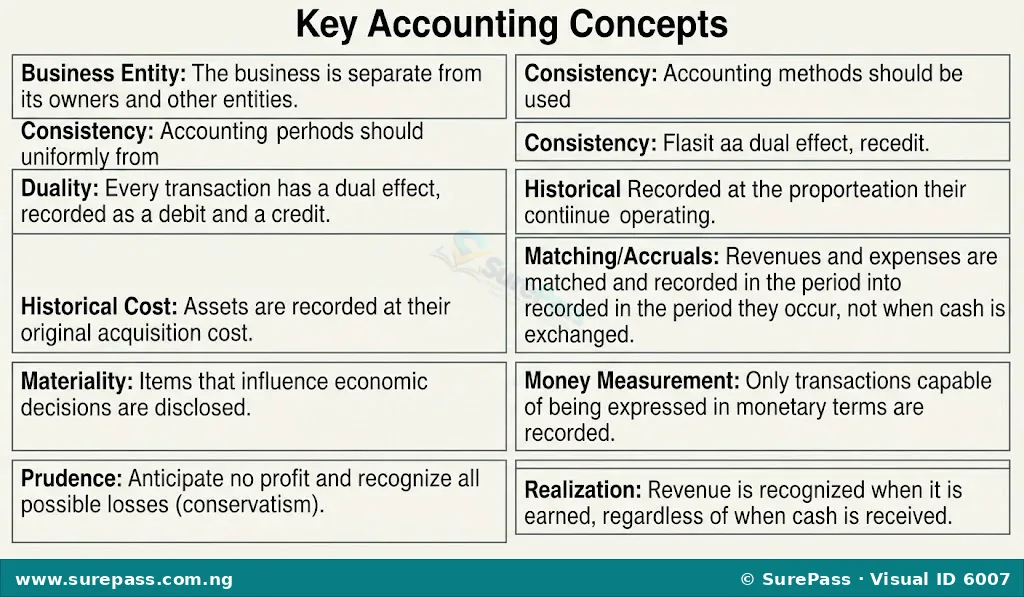
Recording and Interpreting Business Transactions Using Appropriate Accounting Concepts
Applying accounting concepts is not just theoretical; it is fundamental to the practical work of recording and interpreting business transactions. Each concept influences how an accountant makes decisions about journal entries, ledger postings, and the preparation of financial statements.
Here are examples of how these concepts are applied:
- Business Entity: When the owner of a tailoring business takes N10,000 from the business cash register for personal use, the transaction is recorded as “Drawings” (a reduction in owner’s equity) and “Cash” (a reduction in assets). It is not recorded as a business expense, maintaining the separation between the owner and the business.
- Consistency: A manufacturing company uses the straight-line method to calculate depreciation on its machinery. To adhere to the consistency concept, the company continues to use this method year after year, allowing for a clear comparison of asset values and expenses over time. If they decide to change to a reducing balance method, they must disclose this change and its impact in their financial statements.
- Duality: When a business buys office furniture worth N150,000 on credit, the transaction is recorded by debiting “Office Furniture” (an increase in assets) and crediting “Creditors” (an increase in liabilities) by N150,000. This dual entry ensures the accounting equation remains balanced.
- Going Concern: A transport company purchases a new bus for N15,000,000. This bus is recorded at its purchase price and depreciated over its useful life (e.g., 10 years), assuming the company will continue to operate and use the bus for that period. If the company was expected to close down soon, the bus would be valued at its immediate resale value, which would likely be much lower.
- Historical Cost: A business acquires a piece of land for N5,000,000. Even if the market value of the land increases to N7,000,000 a few years later, the land will continue to be shown in the balance sheet at its original cost of N5,000,000 (less any impairment, if applicable). This provides an objective and verifiable record.
- Matching/Accruals: A school pays its teachers’ salaries for March in early April. According to the matching concept, the March salaries are recorded as an expense in the financial statements for March, even though the cash payment occurs in April. This ensures that the expense is matched against the revenue earned in March.
- Materiality: A large supermarket chain purchases a small calculator for N2,500. Instead of recording it as an asset and depreciating it, the company immediately records it as an expense. This is because N2,500 is an immaterial amount compared to the supermarket’s millions of Naira in assets and expenses, and capitalising it would not significantly affect the financial statements.
- Money Measurement: A company has a highly skilled and motivated workforce, which is a significant advantage. However, because employee morale and skill cannot be reliably expressed in monetary terms, they are not directly recorded as assets in the company’s financial statements. Only the monetary transactions related to salaries, training, etc., are recorded.
- Prudence: A business has some old inventory that might be difficult to sell. The original cost of the inventory was N200,000, but its estimated net realisable value (what it can be sold for, less selling costs) is N150,000. Following the prudence concept, the inventory is valued at N150,000 (the lower of cost or net realisable value), anticipating a potential loss and avoiding overstating assets.
- Realization: A construction company receives a N10,000,000 advance payment for building a house. The revenue is not fully recognised when the cash is received. Instead, it is recognised progressively as the construction work is completed and the company earns the right to the payment, for example, based on milestones achieved.
By consistently applying these concepts, accountants ensure that financial statements are not only accurate but also provide a true and fair view of a business’s financial performance and position, enabling informed decision-making.




0 comments
Open the discussion when you need it. Comments stay collapsed until requested so the initial article remains light.