


ARTICLE CONTENTSOn this page 9 sections
Trading Account of a Sole Trader
Performance Objectives
By the end of the lesson, students should be able to:
- explain the meaning of trading account;
- state the importance of trading account;
- identify items included in the trading account;
- discuss the common errors in the trading account;
- prepare a trading account from a given trial balance.
Introduction to Final Accounts
Every business, especially a sole proprietorship, needs to know how well it is performing financially. At the end of an accounting period, usually a year, businesses prepare financial statements known as Final Accounts. These accounts summarise the financial transactions of the business and show its financial performance and position.
Final Accounts typically consist of two main statements: the Trading, Profit and Loss Account (also known as the Income Statement) and the Statement of Financial Position (also known as the Balance Sheet). The Trading Account is the first part of the Income Statement and focuses specifically on the buying and selling activities of a business.
Meaning of Trading Account
A trading account is a financial statement prepared by a business at the end of an accounting period to determine the gross profit or gross loss from its core trading activities.
It shows the direct costs associated with buying and selling goods, comparing the revenue from sales with the cost of goods sold. For a sole trader, it is a crucial step in understanding the profitability of their main business operations before considering other expenses.
Importance of Trading Account
The trading account is important for a sole trader for several reasons:
- Determines Gross Profit or Loss: It clearly shows whether the business has made a gross profit or a gross loss from its primary buying and selling activities. This is the first indicator of the business’s operational efficiency.
- Assesses Trading Performance: By comparing sales revenue with the cost of goods sold, a sole trader can assess how effectively they are managing their purchasing, inventory, and pricing strategies.
- Helps in Decision Making: The gross profit figure helps in making important decisions, such as adjusting selling prices, finding cheaper suppliers, or controlling inventory levels to improve profitability.
- Basis for Further Calculations: The gross profit calculated in the trading account is transferred to the Profit and Loss Account, where other operating expenses are deducted to arrive at the net profit or loss.
- Identifies Trends: Comparing trading accounts over several periods can help a sole trader identify trends in sales, cost of goods sold, and gross profit, allowing them to plan for the future.
Key Items in the Trading Account
The trading account includes specific items that directly relate to the buying and selling of goods. Understanding these items is essential for preparing an accurate trading account.
Opening Inventory
Opening inventory refers to the value of unsold goods that a business has at the beginning of an accounting period.
This inventory was carried over from the previous accounting period and represents goods available for sale at the start of the current period. It is recorded on the debit side of the trading account.
Purchases and Returns
Purchases represent the total value of goods bought by the business for resale during the accounting period.
This includes both cash purchases and credit purchases. Purchases are recorded on the debit side of the trading account.
Purchases returns (also known as returns outwards) occur when a business returns goods to its suppliers due to defects, damage, or incorrect orders. These returns reduce the total purchases and are deducted from purchases in the trading account.
Carriage Inwards
Carriage inwards refers to the cost of transporting goods purchased by the business from the supplier’s location to the business’s premises.
This is considered a direct cost because it is necessary to bring the goods into a condition and location ready for sale. It is added to purchases in the trading account.
Cost of Goods Available for Sale
The cost of goods available for sale is the total cost of all goods that were available for sale during the accounting period.
It is calculated by adding the opening inventory to the net purchases (purchases minus returns outwards, plus carriage inwards). This figure represents the maximum value of goods that could have been sold.
Closing Inventory
Closing inventory refers to the value of unsold goods remaining with the business at the end of an accounting period.
This inventory will be carried forward to the next accounting period as opening inventory. It is recorded on the credit side of the trading account and is usually determined by a physical count of goods at the end of the period.
Sales and Returns
Sales represent the total revenue generated from the goods sold by the business during the accounting period.
This includes both cash sales and credit sales. Sales are recorded on the credit side of the trading account.
Sales returns (also known as returns inwards) occur when customers return goods to the business. These returns reduce the total sales revenue and are deducted from sales in the trading account.
Cost of Goods Sold
The cost of goods sold (COGS) is the direct cost attributable to the production of the goods sold by a company in a reporting period.
It is calculated as: Opening Inventory + Net Purchases (Purchases – Returns Outwards + Carriage Inwards) – Closing Inventory. This figure is crucial for determining the gross profit.
Gross Profit or Gross Loss
Gross profit is the profit a business makes after deducting the cost of goods sold from its net sales revenue.
If the net sales revenue is less than the cost of goods sold, the result is a gross loss. Gross profit is transferred to the Profit and Loss Account.
Format of a Trading Account
The trading account is typically prepared in a ‘T’ format, with debits on the left side and credits on the right side. The debit side lists the direct costs, while the credit side lists the sales revenue and closing inventory.
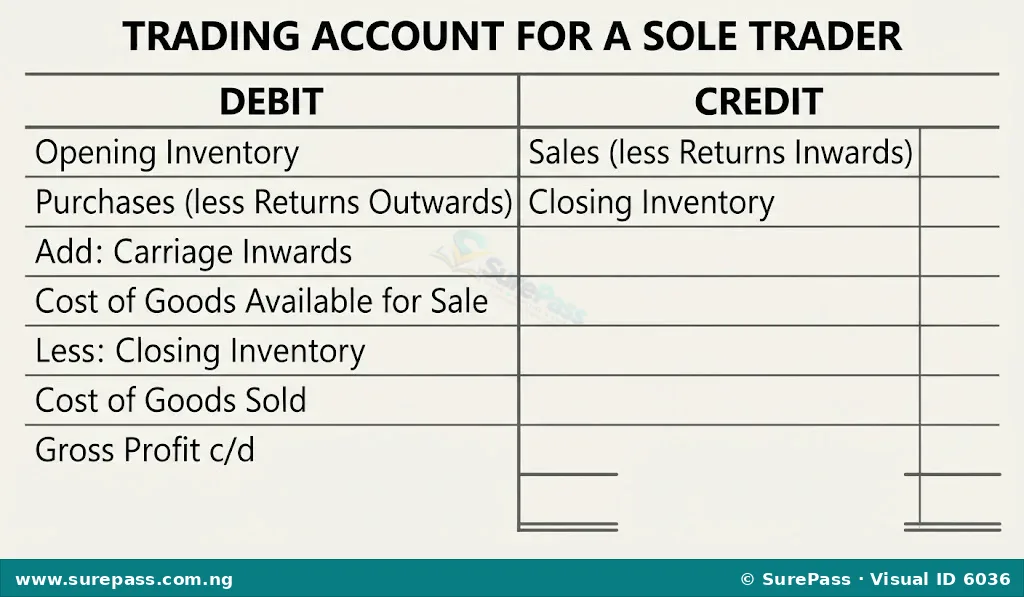
The general format is as follows:
| Debit | Amount (₦) | Credit | Amount (₦) |
|---|---|---|---|
| Opening Inventory | X | Sales | X |
| Purchases | X | Less: Returns Inwards | (X) |
| Less: Returns Outwards | (X) | Net Sales | X |
| Net Purchases | X | Closing Inventory | X |
| Add: Carriage Inwards | X | ||
| Cost of Goods Available for Sale | X | ||
| Less: Closing Inventory | (X) | ||
| Cost of Goods Sold | X | ||
| Gross Profit c/d | X | ||
| Total | X | Total | X |
Common Errors in Preparing a Trading Account
Several common errors can occur when preparing a trading account, leading to an incorrect gross profit or loss figure. Awareness of these errors helps in preparing accurate financial statements.
Misclassification of Direct and Indirect Expenses
A common error is including indirect expenses in the trading account. The trading account should only include direct costs related to purchasing and bringing goods to a saleable condition.
For example, carriage inwards (cost of transporting goods purchased) is a direct expense and belongs in the trading account. However, carriage outwards (cost of transporting goods sold to customers) is a selling expense, an indirect cost, and should be charged to the Profit and Loss Account, not the trading account. Including carriage outwards in the trading account would overstate the cost of goods sold and understate the gross profit.
Omitting Closing Inventory
Closing inventory is a crucial item in the trading account as it reduces the cost of goods sold and is recorded on the credit side. Forgetting to include the closing inventory will result in an overstated cost of goods sold and an understated gross profit (or an overstated gross loss).
Closing inventory is usually determined by a physical count at the end of the accounting period and is not typically found in the trial balance.
Incorrect Calculation of Purchases
The calculation of net purchases must be accurate. Errors can arise from:
- Forgetting Returns Outwards: If purchases returns are not deducted from total purchases, the purchases figure will be overstated, leading to an overstated cost of goods sold and an understated gross profit.
- Forgetting Carriage Inwards: If carriage inwards is not added to purchases, the cost of goods sold will be understated, leading to an overstated gross profit.
Posting Sales Returns on the Wrong Side
Sales returns (returns inwards) reduce the total sales revenue. They should be deducted from sales on the credit side of the trading account. Posting them on the debit side, or failing to deduct them from sales, will lead to an incorrect net sales figure, which in turn affects the gross profit calculation.
Preparing a Trading Account: A Step-by-Step Guide
Preparing a trading account involves systematically arranging the relevant figures from the trial balance and any additional information (like closing inventory). The steps are:
- Identify Opening Inventory: Locate the opening inventory figure from the trial balance. This is the first item on the debit side.
- Calculate Net Purchases:
- Find the Purchases figure from the trial balance.
- Deduct Returns Outwards (Purchases Returns) from Purchases.
- Add Carriage Inwards to the result. This gives the Net Purchases.
- Calculate Cost of Goods Available for Sale: Add Opening Inventory to Net Purchases.
- Calculate Net Sales:
- Find the Sales figure from the trial balance.
- Deduct Returns Inwards (Sales Returns) from Sales. This gives the Net Sales. This is the first item on the credit side.
- Include Closing Inventory: The closing inventory figure is usually provided as additional information, not in the trial balance. It is entered on the credit side of the trading account.
- Calculate Cost of Goods Sold: Deduct Closing Inventory from the Cost of Goods Available for Sale.
- Determine Gross Profit or Gross Loss:
- Sum all items on the credit side (Net Sales + Closing Inventory).
- Sum all items on the debit side (Opening Inventory + Net Purchases + Carriage Inwards – Closing Inventory, which is the Cost of Goods Sold).
- If the credit side total is greater than the debit side total, the difference is Gross Profit. This is entered on the debit side to balance the account.
- If the debit side total is greater than the credit side total, the difference is Gross Loss. This is entered on the credit side to balance the account.
- Balance the Account: Ensure both the debit and credit totals are equal.
Worked Example: Preparing a Trading Account
Below is a trial balance for Bola’s Enterprises as at 31st December 2023:
| Account | Debit (₦) | Credit (₦) |
|---|---|---|
| Opening Inventory | 15,000 | |
| Purchases | 80,000 | |
| Sales | 120,000 | |
| Returns Inwards | 2,000 | |
| Returns Outwards | 3,000 | |
| Carriage Inwards | 1,500 | |
| Carriage Outwards | 1,000 | |
| Other Expenses | 5,000 | |
| Capital | 70,000 | |
| Cash | 48,500 | |
| Total | 158,000 | 193,000 |
Additional Information: Closing Inventory as at 31st December 2023 was ₦20,000.
Required: Prepare the Trading Account for Bola’s Enterprises for the year ended 31st December 2023.
Solution:
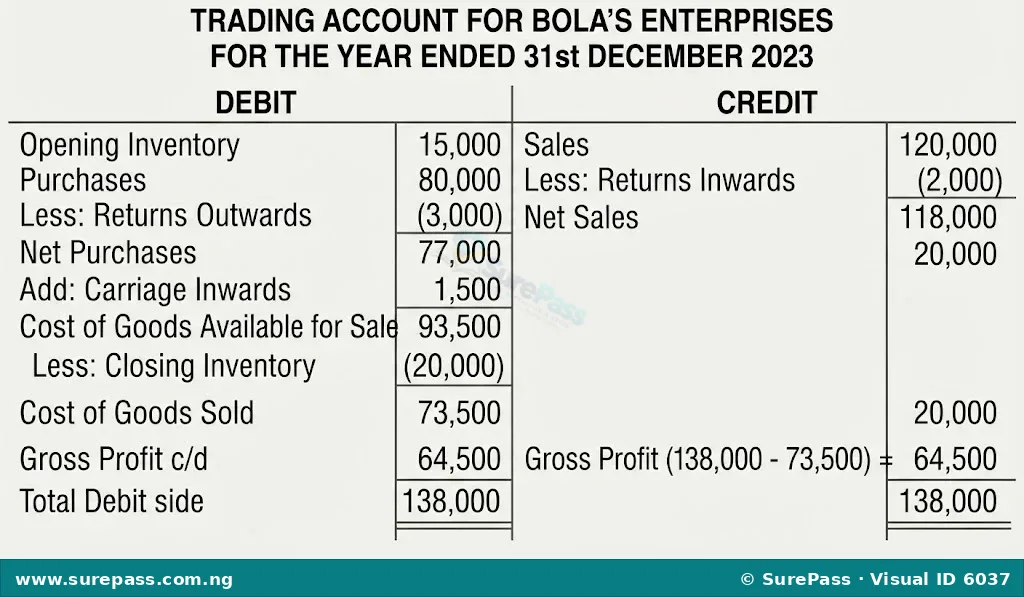
| Bola’s Enterprises | |||
|---|---|---|---|
| Trading Account for the Year Ended 31st December 2023 | |||
| Details | ₦ | Details | ₦ |
| Opening Inventory | 15,000 | Sales | 120,000 |
| Purchases | 80,000 | Less: Returns Inwards | (2,000) |
| Less: Returns Outwards | (3,000) | Net Sales | 118,000 |
| Net Purchases | 77,000 | Closing Inventory | 20,000 |
| Add: Carriage Inwards | 1,500 | ||
| Cost of Goods Available for Sale | 93,500 | ||
| Less: Closing Inventory | (20,000) | ||
| Cost of Goods Sold | 73,500 | ||
| Gross Profit c/d | 64,500 | ||
| Total | 138,000 | Total | 138,000 |


0 comments
Open the discussion when you need it. Comments stay collapsed until requested so the initial article remains light.