


ARTICLE CONTENTSOn this page 8 sections
The Cash Book
Performance Objectives
By the end of the lesson, students should be able to:
- state the meaning and uses of a cash book;
- differentiate between types of cash books;
- prepare different types of cash books;
- record sample transactions into a cash book correctly.
Meaning of Cash Book
A cash book is a special journal used to record all transactions involving cash receipts and cash payments.
It serves as both a journal and a ledger account for cash and bank transactions. Businesses use a cash book to keep a detailed record of money coming in and going out, ensuring that cash balances are always known.
Dual Function of the Cash Book
The cash book performs a dual function in accounting:
-
As a Journal (Book of Original Entry): All cash and bank transactions are first recorded in the cash book in chronological order (date order). This is similar to how transactions are recorded in a journal before being posted to the ledger.
-
As a Ledger Account: The cash book also acts as the Cash Account and Bank Account in the ledger. It has a debit side for receipts and a credit side for payments, just like a T-account in the ledger. Therefore, there is no need to open separate Cash and Bank accounts in the general ledger when a cash book is maintained.
Types of Cash Books
Cash books are categorised based on the number of money columns they have. The common types of cash books are:
- Single Column Cash Book
- Double Column Cash Book
- Three Column Cash Book
Single Column Cash Book
A single column cash book has only one money column on both the debit and credit sides. This column is used to record cash transactions only.
It is suitable for small businesses that deal mainly in cash and do not have many bank transactions or discounts.
Double Column Cash Book
A double column cash book has two money columns on both the debit and credit sides. These columns are typically for Cash and Bank transactions.
This type of cash book is used by businesses that handle both cash and bank transactions frequently. It allows for the recording of cash receipts and payments, as well as bank deposits and withdrawals, in one book.
Three Column Cash Book
A three column cash book has three money columns on both the debit and credit sides. These columns are for Discount, Cash, and Bank.
This is the most comprehensive type of cash book and is used by businesses that frequently offer or receive cash discounts, in addition to handling cash and bank transactions. The discount columns are used to record cash discounts allowed (on the debit side) and cash discounts received (on the credit side).
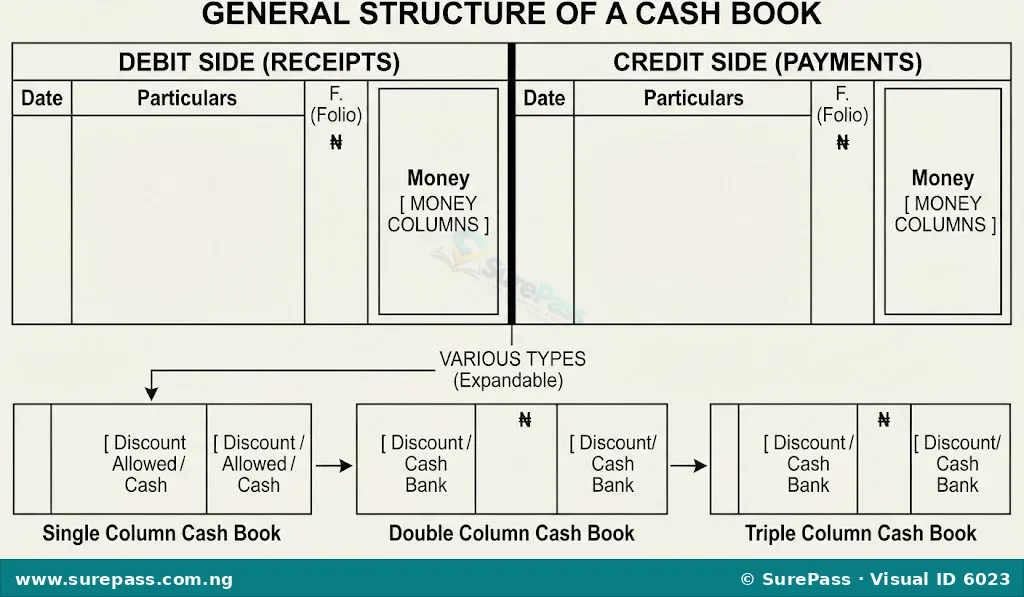
Structure and Format of the Cash Book
All cash books are divided into two main sides: the Debit side (left-hand side) and the Credit side (right-hand side). The Debit side records all cash and bank receipts, while the Credit side records all cash and bank payments.
The common columns found in a cash book are:
-
Date: The date on which the transaction occurred.
-
Particulars: A brief description of the transaction, indicating the source of cash received or the reason for cash paid.
-
Folio (L.F. – Ledger Folio): This column is used to record the page number of the ledger account to which the corresponding entry has been posted. For example, if cash was received from a customer, the customer’s account in the ledger would be credited, and the page number of that account would be written in the folio column of the cash book.
-
Amount Columns: These vary depending on the type of cash book:
-
Cash Column: Records all cash receipts and cash payments.
-
Bank Column: Records all receipts into the bank (deposits) and all payments made from the bank (cheques issued, withdrawals).
-
Discount Column: Records cash discounts allowed (on the debit side) and cash discounts received (on the credit side).
-
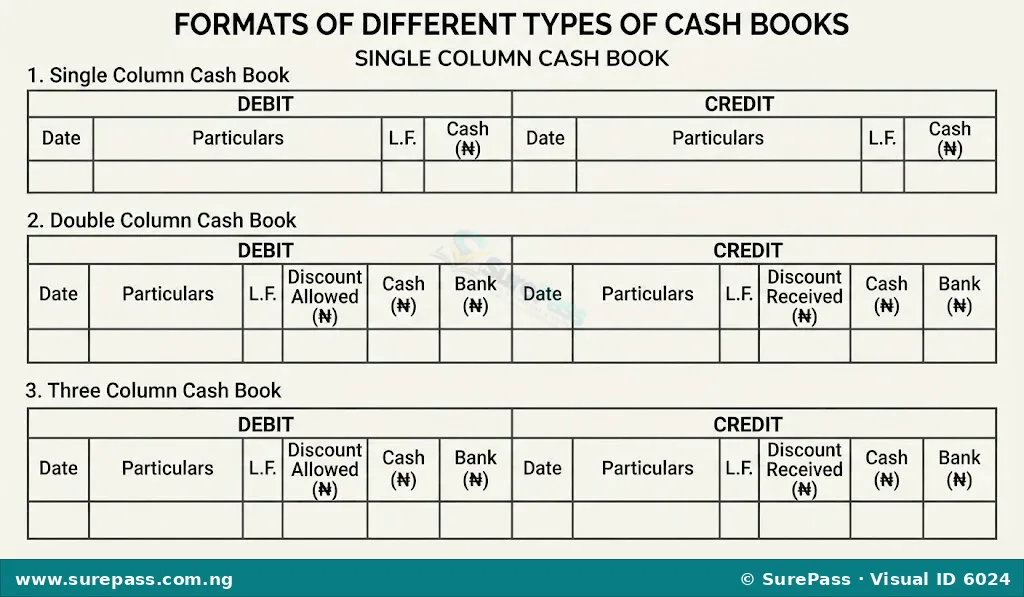
Format of a Single Column Cash Book
The single column cash book has one money column for cash on both sides.
The format is as follows:
| Date | Particulars | L.F. | Cash (₦) | Date | Particulars | L.F. | Cash (₦) |
|---|---|---|---|---|---|---|---|
| (Receipts) | (Payments) |
Format of a Double Column Cash Book
The double column cash book has two money columns for cash and bank on both sides.
The format is as follows:
| Date | Particulars | L.F. | Cash (₦) | Bank (₦) | Date | Particulars | L.F. | Cash (₦) | Bank (₦) |
|---|---|---|---|---|---|---|---|---|---|
| (Receipts) | (Payments) |
Format of a Three Column Cash Book
The three column cash book has three money columns for discount, cash, and bank on both sides.
The format is as follows:
| Date | Particulars | L.F. | Discount Allowed (₦) | Cash (₦) | Bank (₦) | Date | Particulars | L.F. | Discount Received (₦) | Cash (₦) | Bank (₦) |
|---|---|---|---|---|---|---|---|---|---|---|---|
| (Receipts) | (Payments) |
Common Transactions Recorded in the Cash Book
The cash book records all transactions that involve the movement of cash or money through the bank. Common transactions include:
-
Cash Sales: Money received from selling goods for cash.
-
Cash Purchases: Money paid for buying goods for cash.
-
Receipts from Debtors: Money received from customers who previously bought goods on credit. This can be in cash or by cheque.
-
Payments to Creditors: Money paid to suppliers for goods previously bought on credit. This can be in cash or by cheque.
-
Bank Deposits: Cash paid into the bank account.
-
Bank Withdrawals: Cash taken out of the bank account for office use or personal use (drawings).
-
Payments by Cheque: Payments made to suppliers or for expenses using a cheque.
-
Receipts by Cheque: Money received from customers or other sources by cheque, which is then deposited into the bank.
-
Expenses Paid in Cash or by Cheque: Payments for rent, salaries, electricity, etc.
-
Cash Discounts: Discounts allowed to customers for prompt payment (recorded on the debit side) or discounts received from suppliers for prompt payment (recorded on the credit side).
Preparing Different Types of Cash Books
Preparing a cash book involves recording transactions on the appropriate side (debit for receipts, credit for payments) and in the correct column (cash, bank, or discount).
Preparing a Single Column Cash Book
This cash book records only cash transactions. Bank transactions are ignored or recorded in a separate bank account in the ledger.
Example 1: Single Column Cash Book
Record the following transactions in the single column cash book of Mr. Ade for May 2024:
- May 1: Cash in hand ₦5,000
- May 3: Received cash from sales ₦2,500
- May 5: Paid for goods in cash ₦1,000
- May 8: Paid rent in cash ₦500
- May 10: Received cash from a debtor, Bola ₦1,500
- May 12: Paid wages in cash ₦700
The procedure involves the following steps:
-
Draw the format for a single column cash book.
-
Record the opening cash balance on the debit side as “Balance b/d”.
-
Record all cash receipts on the debit side, stating the source in the particulars column.
-
Record all cash payments on the credit side, stating the reason in the particulars column.
-
Balance the cash book at the end of the period by finding the difference between the total debits and total credits. This difference is the closing balance (Balance c/d).
-
Bring down the closing balance to the next period as the opening balance (Balance b/d).
Solution: Single Column Cash Book for Mr. Ade
| Date | Particulars | L.F. | Cash (₦) | Date | Particulars | L.F. | Cash (₦) |
|---|---|---|---|---|---|---|---|
| 2024 May 1 | Balance b/d | 5,000 | 2024 May 5 | Purchases | 1,000 | ||
| May 3 | Sales | 2,500 | May 8 | Rent | 500 | ||
| May 10 | Bola | 1,500 | May 12 | Wages | 700 | ||
| May 31 | Balance c/d | 6,800 | |||||
| Total | 9,000 | Total | 9,000 | ||||
| June 1 | Balance b/d | 6,800 |
Preparing a Double Column Cash Book
This cash book records both cash and bank transactions. It is important to distinguish between cash in hand and cash at bank.
Example 2: Double Column Cash Book
Record the following transactions in the double column cash book of Mrs. Obi for June 2024:
- June 1: Cash in hand ₦10,000; Cash at bank ₦20,000
- June 3: Received cash from sales ₦3,000
- June 5: Paid cash into bank ₦2,000 (Contra entry)
- June 7: Paid for goods by cheque ₦4,000
- June 10: Received cheque from a debtor, Chika ₦5,000, deposited into bank
- June 12: Paid wages in cash ₦1,500
- June 15: Withdrew cash from bank for office use ₦1,000 (Contra entry)
- June 18: Paid rent by cheque ₦2,500
The procedure involves the following steps:
-
Draw the format for a double column cash book.
-
Record the opening cash and bank balances on the debit side as “Balance b/d”.
-
Record all cash receipts in the cash column on the debit side.
-
Record all cheques received and deposited into the bank in the bank column on the debit side.
-
Record all cash payments in the cash column on the credit side.
-
Record all payments by cheque or bank withdrawals in the bank column on the credit side.
-
Contra Entries: These are transactions that affect both the cash and bank columns of the cash book. They are marked with a ‘C’ in the L.F. column. Examples include:
-
Cash deposited into the bank: Debit Bank column, Credit Cash column.
-
Cash withdrawn from the bank for office use: Debit Cash column, Credit Bank column.
-
-
Balance both the cash and bank columns separately at the end of the period to find the closing balances (Balance c/d).
-
Bring down the closing balances to the next period as the opening balances (Balance b/d).
Solution: Double Column Cash Book for Mrs. Obi
| Date | Particulars | L.F. | Cash (₦) | Bank (₦) | Date | Particulars | L.F. | Cash (₦) | Bank (₦) |
|---|---|---|---|---|---|---|---|---|---|
| 2024 Jun 1 | Balance b/d | 10,000 | 20,000 | 2024 Jun 5 | Bank (Contra) | C | 2,000 | ||
| Jun 3 | Sales | 3,000 | Jun 7 | Purchases | 4,000 | ||||
| Jun 5 | Cash (Contra) | C | 2,000 | Jun 12 | Wages | 1,500 | |||
| Jun 10 | Chika | 5,000 | Jun 15 | Cash (Contra) | C | 1,000 | |||
| Jun 15 | Bank (Contra) | C | 1,000 | Jun 18 | Rent | 2,500 | |||
| Jun 30 | Balance c/d | 10,500 | 19,500 | ||||||
| Total | 14,000 | 27,000 | Total | 14,000 | 27,000 | ||||
| Jul 1 | Balance b/d | 10,500 | 19,500 |
Preparing a Three Column Cash Book
This cash book includes columns for Discount, Cash, and Bank. Discounts allowed are recorded on the debit side, and discounts received are recorded on the credit side.
Example 3: Three Column Cash Book
Record the following transactions in the three column cash book of Mr. Emeka for July 2024:
- July 1: Cash in hand ₦8,000; Cash at bank ₦15,000
- July 3: Received cash from sales ₦4,000
- July 5: Paid cash into bank ₦3,000 (Contra)
- July 7: Paid Okoro by cheque ₦2,800, discount received ₦200
- July 10: Received cheque from a debtor, Femi ₦4,900, discount allowed ₦100. Cheque deposited immediately.
- July 12: Paid wages in cash ₦1,200
- July 15: Withdrew cash from bank for office use ₦1,000 (Contra)
- July 18: Paid rent by cheque ₦2,000
- July 20: Received cash from a customer, Grace ₦1,950, discount allowed ₦50
The procedure involves the following steps:
-
Draw the format for a three column cash book.
-
Record the opening cash and bank balances on the debit side as “Balance b/d”.
-
Record all cash receipts in the cash column on the debit side.
-
Record all cheques received and deposited into the bank in the bank column on the debit side.
-
Record cash discounts allowed (when receiving money) in the “Discount Allowed” column on the debit side.
-
Record all cash payments in the cash column on the credit side.
-
Record all payments by cheque or bank withdrawals in the bank column on the credit side.
-
Record cash discounts received (when paying money) in the “Discount Received” column on the credit side.
-
Mark contra entries with a ‘C’ in the L.F. column.
-
Balance the cash and bank columns separately at the end of the period. The discount columns are only totalled, not balanced, as they are later posted to the Discount Allowed and Discount Received accounts in the ledger.
-
Bring down the closing cash and bank balances to the next period as the opening balances.
Solution: Three Column Cash Book for Mr. Emeka
| Date | Particulars | L.F. | Discount Allowed (₦) | Cash (₦) | Bank (₦) | Date | Particulars | L.F. | Discount Received (₦) | Cash (₦) | Bank (₦) |
|---|---|---|---|---|---|---|---|---|---|---|---|
| 2024 Jul 1 | Balance b/d | 8,000 | 15,000 | 2024 Jul 5 | Bank (Contra) | C | 3,000 | ||||
| Jul 3 | Sales | 4,000 | Jul 7 | Okoro | 200 | 2,800 | |||||
| Jul 5 | Cash (Contra) | C | 3,000 | Jul 12 | Wages | 1,200 | |||||
| Jul 10 | Femi | 100 | 4,900 | Jul 15 | Cash (Contra) | C | 1,000 | ||||
| Jul 15 | Bank (Contra) | C | 1,000 | Jul 18 | Rent | 2,000 | |||||
| Jul 20 | Grace | 50 | 1,950 | Jul 31 | Balance c/d | 10,750 | 16,100 | ||||
| Total | 150 | 14,950 | 22,900 | Total | 200 | 14,950 | 22,900 | ||||
| Aug 1 | Balance b/d | 10,750 | 16,100 |



0 comments
Open the discussion when you need it. Comments stay collapsed until requested so the initial article remains light.