



ARTICLE CONTENTSOn this page 6 sections
Income Statement
Performance Objectives
By the end of the lesson, students should be able to:
- explain the meaning of income statement;
- discuss the importance of income statements;
- explain the concepts in income statement;
- prepare an income statement.
Meaning of Income Statement
An income statement is a financial report that shows a business’s financial performance over a specific period, usually a month, a quarter, or a year.
It summarises all the income earned and expenses incurred by a business during that period. The main purpose of an income statement is to determine whether a business has made a profit or a loss.
The income statement is also known as the Profit and Loss Account or Statement of Financial Performance.
Importance of Preparing Income Statements
Preparing an income statement is crucial for any business because it provides valuable information to various stakeholders. Understanding the financial performance helps in making informed decisions.
The importance of income statements includes:
- Assessing Profitability: It clearly shows whether the business has made a net profit or a net loss during the accounting period. This is the primary indicator of a business’s success.
- Evaluating Performance: Business owners and managers use the income statement to evaluate how well the business is performing. They can compare current performance with past periods or with industry benchmarks.
- Decision Making: The information on income and expenses helps management make important decisions, such as whether to increase sales efforts, reduce certain expenses, or adjust pricing strategies.
- Reporting to Stakeholders: Owners, investors, lenders, and other interested parties rely on the income statement to understand the financial health and performance of the business. Lenders, for example, use it to assess a business’s ability to repay loans.
- Tax Calculation: The net profit figure from the income statement is used to calculate the amount of income tax a business needs to pay to the government.
Items in an Income Statement
An income statement is made up of key components that show how a business generates revenue and what costs it incurs. For SS1, the main items to understand are income, expenses, and net income.
Income
Income represents the money a business earns from its primary activities during a specific period.
For most businesses, the main source of income is from selling goods or providing services. This is often referred to as sales revenue.
Examples of income include:
- Sales Revenue: Money received from customers for goods sold or services rendered.
- Rent Received: Income earned from renting out a property owned by the business.
- Commission Received: Money earned for acting as an agent or facilitating a transaction for another party.
Expenses
Expenses are the costs incurred by a business in the process of generating its income.
These are the outflows of money or other economic resources that a business uses up to operate and earn revenue. Expenses reduce the profit of a business.
Examples of common expenses include:
- Purchases: The cost of goods bought by a trading business for resale.
- Salaries and Wages: Payments made to employees for their work.
- Rent Paid: Cost of using property or premises not owned by the business.
- Electricity and Water Bills: Costs for utilities consumed by the business.
- Stationery: Cost of office supplies like paper, pens, and files.
- Advertising: Money spent to promote the business’s products or services.
- Insurance: Payments made to protect the business against risks.
Net Income (Net Profit or Net Loss)
Net income is the final result of the income statement, calculated by subtracting total expenses from total income.
If the total income is greater than the total expenses, the business has made a net profit. This means the business has earned more than it spent. If the total expenses are greater than the total income, the business has incurred a net loss. This means the business has spent more than it earned.
Preparing an Income Statement
Preparing an income statement involves listing all income items and all expense items for a specific period and then calculating the net income or net loss. The statement follows a clear format to ensure clarity and consistency.
Format of an Income Statement
The basic format of an income statement for SS1 is straightforward:
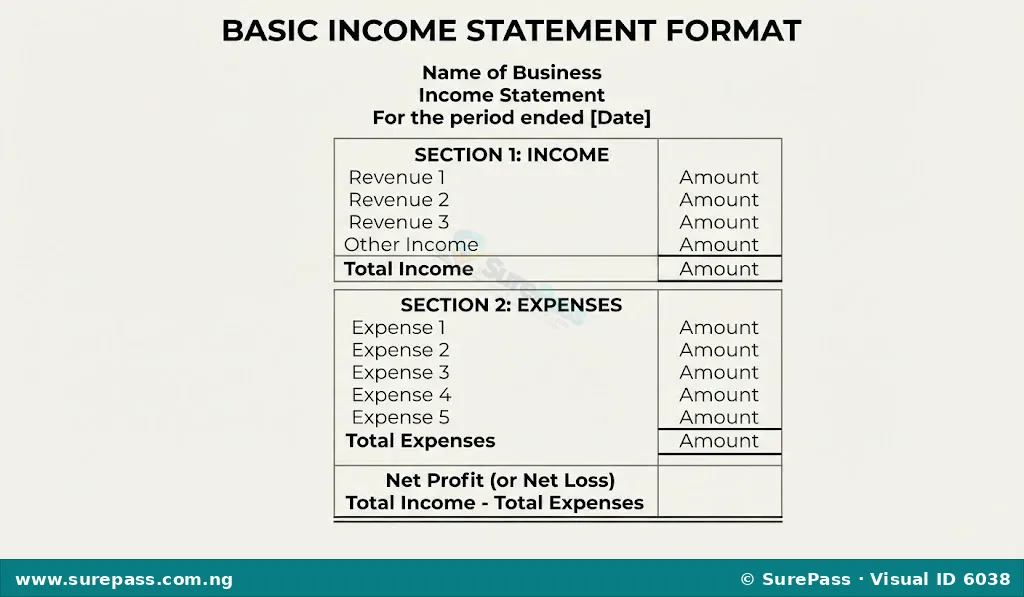
The procedure for preparing an income statement involves the following steps:
- Heading: Start with the name of the business, followed by “Income Statement”, and then “For the period ended [Date]”. The date is important as the income statement covers a specific period.
- List Income: List all sources of income for the period. For SS1, this will typically be Sales Revenue. Write the amount next to each income item.
- Calculate Total Income: Add up all the income amounts to get the “Total Income”.
- List Expenses: List all the expenses incurred during the period. Write the amount next to each expense item.
- Calculate Total Expenses: Add up all the expense amounts to get the “Total Expenses”.
- Calculate Net Income: Subtract the “Total Expenses” from the “Total Income”. The result is the “Net Profit” if positive, or “Net Loss” if negative.
Worked Example: Preparing an Income Statement
Mr. Ade’s Provision Store had the following financial data for the year ended 31st December 2023:
- Sales Revenue: N500,000
- Purchases: N200,000
- Salaries: N80,000
- Rent Paid: N30,000
- Electricity Bill: N10,000
- Stationery: N5,000
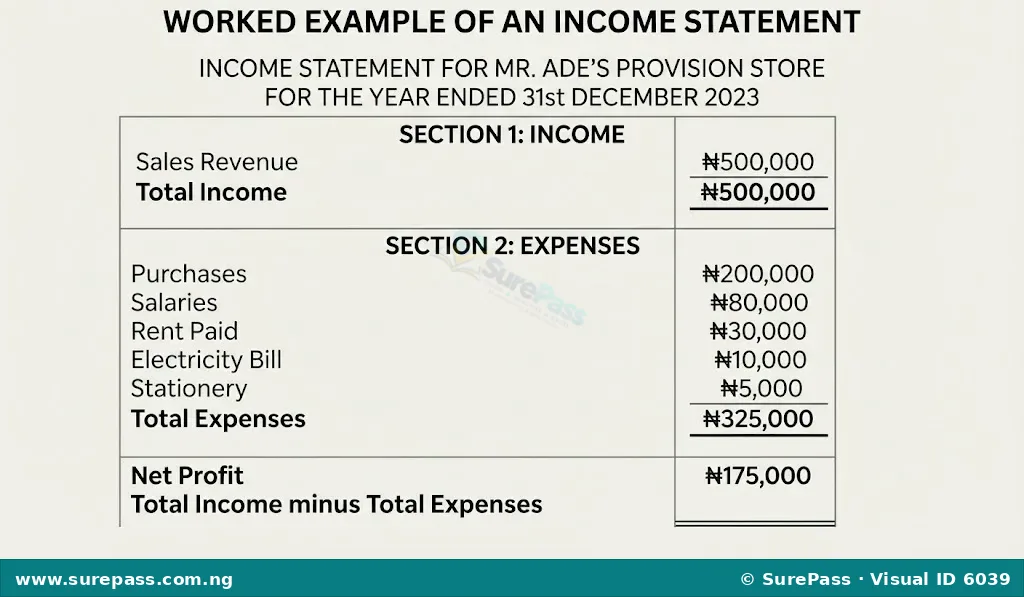
Prepare an Income Statement for Mr. Ade’s Provision Store for the year ended 31st December 2023.
Solution:
Mr. Ade’s Provision Store
Income Statement
For the year ended 31st December 2023
| Details | Amount (N) |
|---|---|
| Income: | |
| Sales Revenue | 500,000 |
| Total Income | 500,000 |
| Expenses: | |
| Purchases | 200,000 |
| Salaries | 80,000 |
| Rent Paid | 30,000 |
| Electricity Bill | 10,000 |
| Stationery | 5,000 |
| Total Expenses | 325,000 |
| Net Profit (Total Income – Total Expenses) | 175,000 |



0 comments
Open the discussion when you need it. Comments stay collapsed until requested so the initial article remains light.