


ARTICLE CONTENTSOn this page 7 sections
The Cash Book (II)
Performance Objectives
By the end of the lesson, students should be able to:
- differentiate between a cash book and a ledger;
- post entries from the cash book into the ledger;
- balance a cash book accurately;
- record contra entries.
Introduction to the Cash Book
In Financial Accounting, businesses record all their financial transactions. The cash book is a special type of ledger that records all cash and bank transactions. It serves as both a journal (for initial recording) and a ledger account (for cash and bank). It is essential for keeping track of money received and paid out by a business.
The cash book can have different formats, such as a single-column cash book (for cash only), a two-column cash book (for cash and bank), or a three-column cash book (for cash, bank, and discount).
Differences Between a Cash Book and a Ledger
While the cash book is a type of ledger, there are key differences in their primary functions and scope within the accounting system.
What is a Cash Book?
A cash book is a book of original entry (journal) and a ledger account for cash and bank transactions. It records all receipts and payments of cash and bank, and sometimes discounts allowed and received.
What is a Ledger?
A ledger is a principal book of accounts where all transactions are summarised and classified into individual accounts. It contains all the accounts of a business, such as sales, purchases, expenses, assets, liabilities, and capital.
The main differences between a cash book and a ledger are:
- Dual Role: A cash book serves as both a journal (book of original entry) and a ledger account for cash and bank. A general ledger, on the other hand, is purely a book of final entry where transactions are posted from journals.
- Scope of Transactions: A cash book only records transactions involving cash and bank. A ledger contains all types of accounts, including those for credit sales, credit purchases, expenses, income, assets, and liabilities.
- Balancing: The cash book is balanced regularly to determine the cash and bank balances. While individual ledger accounts are also balanced, the cash book’s balance is particularly important as it represents the actual cash and bank position.
- Discount Column: A three-column cash book includes discount columns for recording discounts allowed and received. A general ledger does not typically have specific discount columns within individual accounts, as discounts are usually recorded in separate discount accounts.
- Contra Entries: The cash book is unique in recording contra entries, which are transactions affecting both the cash and bank columns simultaneously. Such entries do not occur in other ledger accounts.
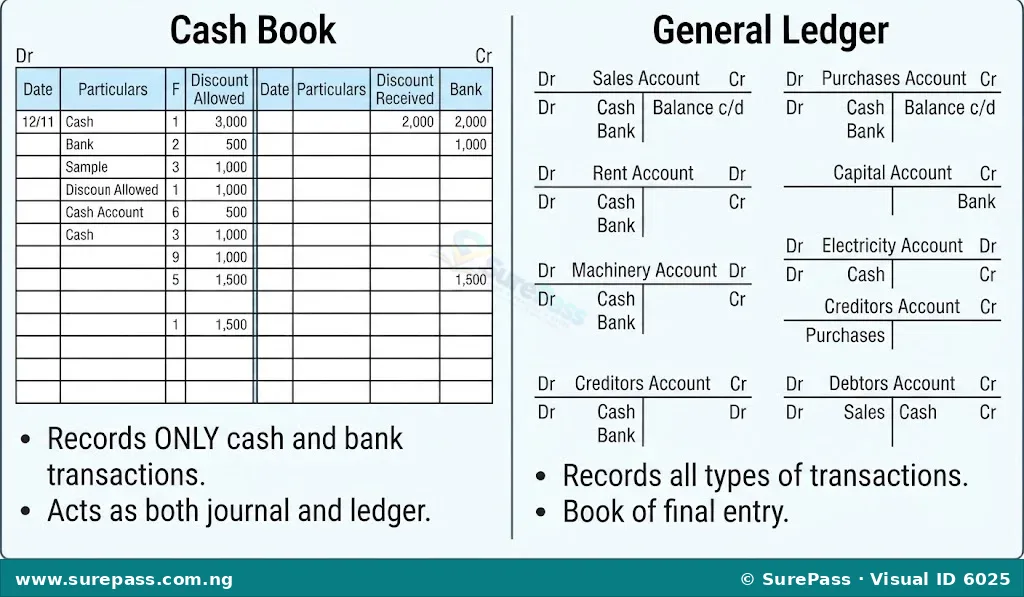
Posting from Cash Book to the Ledger
Posting is the process of transferring entries from the books of original entry (like the cash book) to the respective accounts in the ledger. Since the cash book itself acts as the cash and bank ledger accounts, transactions recorded in the cash book are posted to other relevant ledger accounts.
When posting from the cash book, remember the double-entry principle: for every debit entry in the cash book, there must be a corresponding credit entry in another ledger account, and vice versa.
Steps for Posting from a Three-Column Cash Book to the Ledger
The following steps outline the process of posting from a three-column cash book:
- Identify the other account: For each entry in the cash book, identify the other account affected by the transaction.
- Determine the side: If an amount is on the debit (receipts) side of the cash book, the corresponding entry in the other ledger account will be on the credit side. If an amount is on the credit (payments) side of the cash book, the corresponding entry in the other ledger account will be on the debit side.
- Record the amount: Post the amount from the cash or bank column to the appropriate side of the other ledger account.
- Enter the date: Record the date of the transaction in the ledger account.
- Write the particulars: In the ledger account, write “To Cash” or “To Bank” (if debiting) or “By Cash” or “By Bank” (if crediting) to indicate the source of the entry.
- Enter the folio: In the ledger account, write “CB” (Cash Book) in the Folio column to show that the entry came from the cash book. In the cash book, write the ledger folio number (e.g., L.F. 1, L.F. 2) in the Folio column of the corresponding entry.
- Post Discounts: Discounts allowed (debit side of cash book) are posted to the credit side of the individual customer’s account and the debit side of the Discounts Allowed account in the ledger. Discounts received (credit side of cash book) are posted to the debit side of the individual supplier’s account and the credit side of the Discounts Received account in the ledger.
Worked Example: Posting from Cash Book to Ledger
Consider the following entries from a cash book:
Cash Book (Extract)
| Debit Side (Receipts) | Credit Side (Payments) | ||||||||||
|---|---|---|---|---|---|---|---|---|---|---|---|
| Date | Particulars | L.F. | Discount Allowed (₦) | Cash (₦) | Bank (₦) | Date | Particulars | L.F. | Discount Received (₦) | Cash (₦) | Bank (₦) |
| Jan 1 | Balance b/d | 5,000 | 15,000 | ||||||||
| Jan 5 | Sales | 2,000 | Jan 8 | Purchases | 7,000 | ||||||
| Jan 10 | J. Musa (received cheque) | 100 | 4,900 | Jan 12 | Rent Paid | 1,500 | |||||
| Jan 15 | K. Bello (paid by cheque) | 50 | 2,450 | ||||||||
Posting these entries to the Ledger:
Sales Account
| Debit | Credit | ||||
|---|---|---|---|---|---|
| Date | Particulars | Amount (₦) | Date | Particulars | Amount (₦) |
| Jan 5 | By Cash (CB) | 2,000 | |||
J. Musa Account
| Debit | Credit | ||||
|---|---|---|---|---|---|
| Date | Particulars | Amount (₦) | Date | Particulars | Amount (₦) |
| Jan 10 | By Bank (CB) | 4,900 | |||
| Jan 10 | By Discounts Allowed (CB) | 100 | |||
Discounts Allowed Account
| Debit | Credit | ||||
|---|---|---|---|---|---|
| Date | Particulars | Amount (₦) | Date | Particulars | Amount (₦) |
| Jan 10 | To J. Musa (CB) | 100 | |||
Purchases Account
| Debit | Credit | ||||
|---|---|---|---|---|---|
| Date | Particulars | Amount (₦) | Date | Particulars | Amount (₦) |
| Jan 8 | To Bank (CB) | 7,000 | |||
Rent Account
| Debit | Credit | ||||
|---|---|---|---|---|---|
| Date | Particulars | Amount (₦) | Date | Particulars | Amount (₦) |
| Jan 12 | To Cash (CB) | 1,500 | |||
K. Bello Account
| Debit | Credit | ||||
|---|---|---|---|---|---|
| Date | Particulars | Amount (₦) | Date | Particulars | Amount (₦) |
| Jan 15 | To Bank (CB) | 2,450 | |||
| Jan 15 | To Discounts Received (CB) | 50 | |||
Discounts Received Account
| Debit | Credit | ||||
|---|---|---|---|---|---|
| Date | Particulars | Amount (₦) | Date | Particulars | Amount (₦) |
| Jan 15 | By K. Bello (CB) | 50 | |||
Balancing the Cash Book
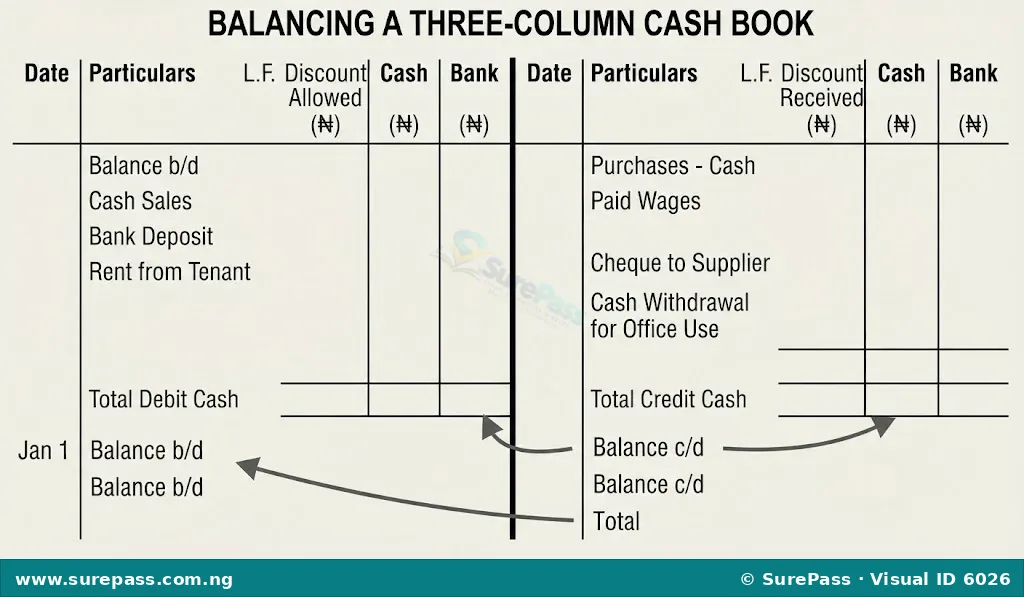
Balancing the cash book means finding the difference between the total debits (receipts) and total credits (payments) for both the cash and bank columns. This difference represents the closing balance of cash in hand and cash at bank at the end of a period.
Steps for Balancing a Three-Column Cash Book
The procedure for balancing a cash book involves the following steps:
- Sum the Discount Columns: Add up the amounts in the “Discount Allowed” column (debit side) and the “Discount Received” column (credit side). These totals are not balanced but are transferred to the Discounts Allowed Account and Discounts Received Account in the ledger respectively.
- Sum the Cash Columns: Add up all the amounts in the “Cash” column on the debit side. Then, add up all the amounts in the “Cash” column on the credit side.
- Find the Cash Balance: Compare the total of the debit cash column with the total of the credit cash column. The cash column usually has a debit balance (receipts are greater than payments). Write the difference on the side with the smaller total, calling it “By Balance c/d” (carried down).
- Sum the Bank Columns: Add up all the amounts in the “Bank” column on the debit side. Then, add up all the amounts in the “Bank” column on the credit side.
- Find the Bank Balance: Compare the total of the debit bank column with the total of the credit bank column. The bank column can have either a debit balance (deposits greater than withdrawals) or a credit balance (overdraft, withdrawals greater than deposits). Write the difference on the side with the smaller total, calling it “By Balance c/d” or “To Balance c/d” as appropriate.
- Total the Columns: Draw a single line above the totals and a double line below the totals for each column (Cash, Bank, Discount) on both sides. The totals on both sides for Cash and Bank columns must now be equal.
- Bring Down the Balance: On the first day of the next accounting period, bring down the closing balance. If it was “By Balance c/d” on the credit side, it becomes “To Balance b/d” (brought down) on the debit side of the next period. If it was “To Balance c/d” on the debit side, it becomes “By Balance b/d” on the credit side (for a bank overdraft).
Worked Example: Balancing a Cash Book
Using the previous cash book entries and adding a closing date:
Cash Book (Extract)
| Debit Side (Receipts) | Credit Side (Payments) | ||||||||||
|---|---|---|---|---|---|---|---|---|---|---|---|
| Date | Particulars | L.F. | Discount Allowed (₦) | Cash (₦) | Bank (₦) | Date | Particulars | L.F. | Discount Received (₦) | Cash (₦) | Bank (₦) |
| Jan 1 | Balance b/d | 5,000 | 15,000 | ||||||||
| Jan 5 | Sales | 2,000 | Jan 8 | Purchases | 7,000 | ||||||
| Jan 10 | J. Musa | 100 | 4,900 | Jan 12 | Rent Paid | 1,500 | |||||
| Jan 15 | K. Bello | 50 | 2,450 | ||||||||
| Jan 31 | Balance c/d | 5,500 | 10,450 | ||||||||
| Total | 100 | 7,000 | 19,900 | Total | 50 | 7,000 | 19,900 | ||||
| Feb 1 | Balance b/d | 5,500 | 10,450 | ||||||||
Calculations:
- Cash Column:
- Debit Total: ₦5,000 + ₦2,000 = ₦7,000
- Credit Total: ₦1,500
- Balance c/d (Cash): ₦7,000 – ₦1,500 = ₦5,500 (placed on credit side)
- Bank Column:
- Debit Total: ₦15,000 + ₦4,900 = ₦19,900
- Credit Total: ₦7,000 + ₦2,450 = ₦9,450
- Balance c/d (Bank): ₦19,900 – ₦9,450 = ₦10,450 (placed on credit side)
Recording Contra Entries
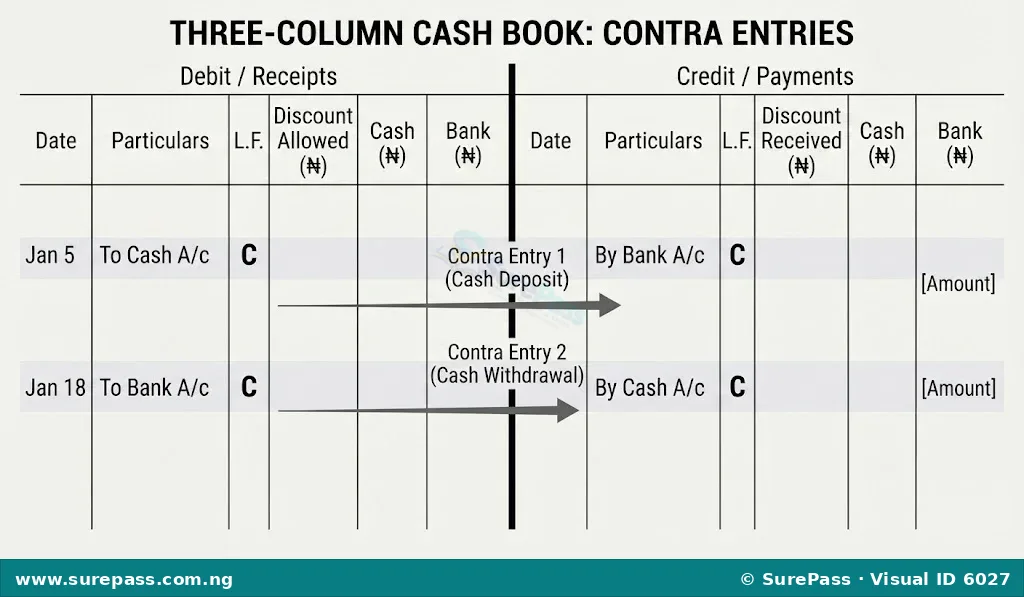
A contra entry is a transaction that affects both the cash and bank columns of the cash book simultaneously. It involves a transfer of funds between the cash box and the bank account of the business. These entries are unique because they have a dual effect within the cash book itself, meaning no posting is required to a separate ledger account for that part of the transaction.
Contra entries are identified by the letter ‘C’ in the Ledger Folio (L.F.) column on both the debit and credit sides of the cash book.
Common Types of Contra Entries
- Cash deposited into the bank: When cash from the business’s cash box is deposited into its bank account.
- Effect: Cash decreases (credit cash column), and Bank increases (debit bank column).
- Entry:
- Debit Bank column, write “To Cash” in particulars, and ‘C’ in L.F.
- Credit Cash column, write “By Bank” in particulars, and ‘C’ in L.F.
- Cash withdrawn from the bank for office use: When cash is taken from the bank account for day-to-day office expenses (not for personal use by the owner, which would be drawings).
- Effect: Bank decreases (credit bank column), and Cash increases (debit cash column).
- Entry:
- Debit Cash column, write “To Bank” in particulars, and ‘C’ in L.F.
- Credit Bank column, write “By Cash” in particulars, and ‘C’ in L.F.
Worked Example: Recording Contra Entries
Assume the following transactions occurred in February:
- Feb 5: Deposited ₦3,000 cash into the bank.
- Feb 10: Withdrew ₦1,000 from the bank for office use.
Cash Book (Extract)
| Debit Side (Receipts) | Credit Side (Payments) | ||||||||||
|---|---|---|---|---|---|---|---|---|---|---|---|
| Date | Particulars | L.F. | Discount Allowed (₦) | Cash (₦) | Bank (₦) | Date | Particulars | L.F. | Discount Received (₦) | Cash (₦) | Bank (₦) |
| Feb 1 | Balance b/d | 5,500 | 10,450 | ||||||||
| Feb 5 | To Cash | C | 3,000 | Feb 5 | By Bank | C | 3,000 | ||||
| Feb 10 | To Bank | C | 1,000 | Feb 10 | By Cash | C | 1,000 | ||||



0 comments
Open the discussion when you need it. Comments stay collapsed until requested so the initial article remains light.