



ARTICLE CONTENTSOn this page 10 sections
Petty Cash Book
Performance Objectives
By the end of the lesson, students should be able to:
- state the meaning and purpose of a petty cash book;
- discuss the different types of petty cash book;
- describe the imprest system;
- identify expenses recorded in the petty cash book;
- prepare and record entries in a petty cash book;
- post totals from the petty cash book to the ledger;
- explain the advantages of the petty cash book.
Meaning of Petty Cash
Petty cash refers to a small amount of cash kept on hand by a business for minor, day-to-day expenses that are too small to be paid by cheque or electronic transfer.
These small expenses are often unpredictable and require immediate payment, such as buying stationery, paying for transport, or making small repairs.
Meaning and Purpose of a Petty Cash Book
A petty cash book is a subsidiary book of account used to record small, frequent cash payments that are not practical to record in the main cash book.
The purpose of a petty cash book is to:
- Provide a systematic record of small cash payments.
- Reduce the number of entries in the main cash book, making it less cluttered.
- Allow for better control over small expenditures.
- Enable the delegation of responsibility for minor payments to a specific individual, usually called the petty cashier.
- Facilitate the analysis of small expenses into different categories.
Types of Petty Cash System
Businesses use different systems to manage their petty cash. The two main types of petty cash systems are:
- Ordinary/Columnar Petty Cash System
- Imprest System
Ordinary/Columnar Petty Cash System
In the ordinary or columnar petty cash system, a fixed amount of money is given to the petty cashier. The petty cashier makes payments from this fund and records them in the petty cash book. When the fund runs low, the petty cashier requests a reimbursement for the exact amount spent. This system does not always ensure that the fund is restored to its original fixed amount, as the reimbursement might only cover the expenses incurred.
Imprest System
The imprest system is a more controlled and widely used method for managing petty cash. Under this system, a fixed amount of money, known as the imprest amount, is given to the petty cashier at the beginning of a period (e.g., a week or a month).
The petty cashier makes payments from this fund and records them. At the end of the period, the petty cashier submits a summary of expenses and is reimbursed for the exact amount spent. This reimbursement restores the petty cash fund to its original imprest amount for the next period.
Features of the Imprest System
The imprest system has several key features that make it effective for managing petty cash:
- Fixed Imprest Amount: A specific, fixed sum of money is initially issued to the petty cashier. This amount remains constant at the start of each period.
- Reimbursement of Actual Expenditure: At the end of a period, the petty cashier is reimbursed only for the exact amount of money spent during that period.
- Restoration of Fund: The reimbursement ensures that the petty cash fund is always restored to its original fixed imprest amount at the beginning of each new period.
- Control and Accountability: The system provides strong control over petty cash as the petty cashier must account for all expenditures before receiving reimbursement. The total of cash remaining and vouchers for expenses should always equal the imprest amount.
- Regular Review: The system encourages regular review of petty cash expenses, usually at the point of reimbursement.
Expenses Recorded in the Petty Cash Book
The petty cash book is used to record small, routine expenses that are typically paid in cash. These expenses are usually minor and do not warrant the use of a cheque or bank transfer. Examples of expenses recorded in the petty cash book include:
- Stationery purchases (e.g., pens, paper, envelopes)
- Postage stamps and courier fees
- Transport fares (e.g., bus fares, taxi fares for staff on official duties)
- Refreshments for staff or visitors
- Cleaning supplies
- Minor repairs (e.g., fixing a light bulb, small plumbing issues)
- Newspaper and magazine subscriptions
- Small donations or contributions
- Sundry expenses (miscellaneous small items)
Advantages of the Petty Cash Book
Using a petty cash book offers several advantages to a business:
- Reduces Entries in Main Cash Book: It prevents the main cash book from becoming cluttered with numerous small entries, making it easier to manage larger transactions.
- Saves Time and Effort: It saves the time and effort that would be spent writing cheques for very small amounts or processing numerous small bank transfers.
- Better Control over Small Expenses: It provides a dedicated record for small payments, allowing for better monitoring and control over these expenditures.
- Delegation of Responsibility: It allows a petty cashier to manage minor payments, freeing up the main cashier or accountant to focus on larger financial matters.
- Analysis of Expenses: The analysis columns in the petty cash book allow for easy classification and summarisation of small expenses, which helps in budgeting and cost control.
- Convenience: It provides ready cash for immediate, minor expenses, ensuring smooth day-to-day operations without delays.
Preparing and Recording Entries in a Petty Cash Book
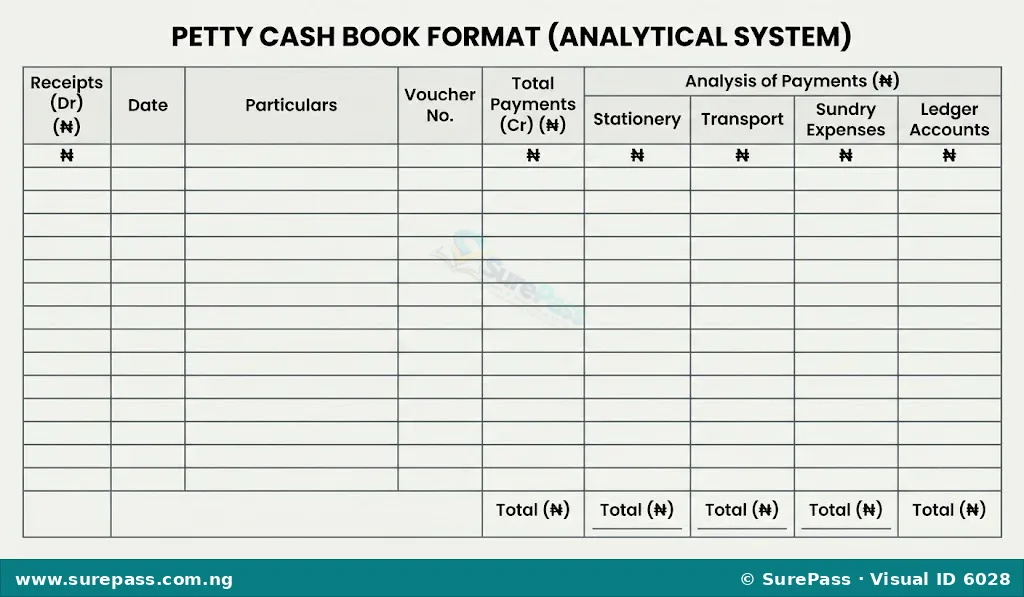
The petty cash book is typically prepared in a columnar format, allowing for the recording of receipts, payments, and the analysis of payments into different expense categories. The format usually includes a ‘Receipts’ column, a ‘Date’ column, a ‘Particulars’ column, a ‘Voucher No.’ column, a ‘Total Payments’ column, and several ‘Analysis of Payments’ columns for specific expense types.
The procedure for preparing and recording entries involves the following steps:
- Receive Imprest Amount: The petty cashier receives the initial imprest amount from the main cashier or bank. This is recorded in the ‘Receipts’ column.
- Make Payments: As small expenses arise, the petty cashier makes payments from the fund.
- Obtain Vouchers: For every payment made, a petty cash voucher or receipt should be obtained and numbered.
- Record Entries: Each payment is recorded in the petty cash book:
- Enter the date of payment.
- Write a brief description of the expense in the ‘Particulars’ column.
- Enter the voucher number in the ‘Voucher No.’ column.
- Record the total amount paid in the ‘Total Payments’ column.
- Allocate the payment to the appropriate ‘Analysis of Payments’ column (e.g., Stationery, Transport, Sundry Expenses).
- Balance the Book: At the end of the period, total all the ‘Analysis of Payments’ columns and the ‘Total Payments’ column. Calculate the cash remaining by subtracting the ‘Total Payments’ from the ‘Receipts’.
- Request Reimbursement: Under the imprest system, the petty cashier requests reimbursement for the total amount spent, restoring the fund to its original imprest amount.
Observe the typical format of a petty cash book below:
Worked Example: Preparing a Petty Cash Book
Mr. Ade, the petty cashier for Excellent Enterprises, operates an imprest system with a float of N5,000.00. The following transactions occurred in the first week of March 2024:
- March 1: Received N5,000.00 imprest from the main cashier.
- March 2: Paid N800.00 for stationery (Voucher No. 001).
- March 3: Paid N500.00 for bus fare for messenger (Voucher No. 002).
- March 4: Paid N300.00 for cleaning supplies (Voucher No. 003).
- March 5: Paid N700.00 for postage stamps (Voucher No. 004).
- March 6: Paid N400.00 for refreshments for visitors (Voucher No. 005).
- March 7: Paid N250.00 for minor repairs to office equipment (Voucher No. 006).
Prepare the petty cash book for the week ended March 7, 2024, and balance it off.
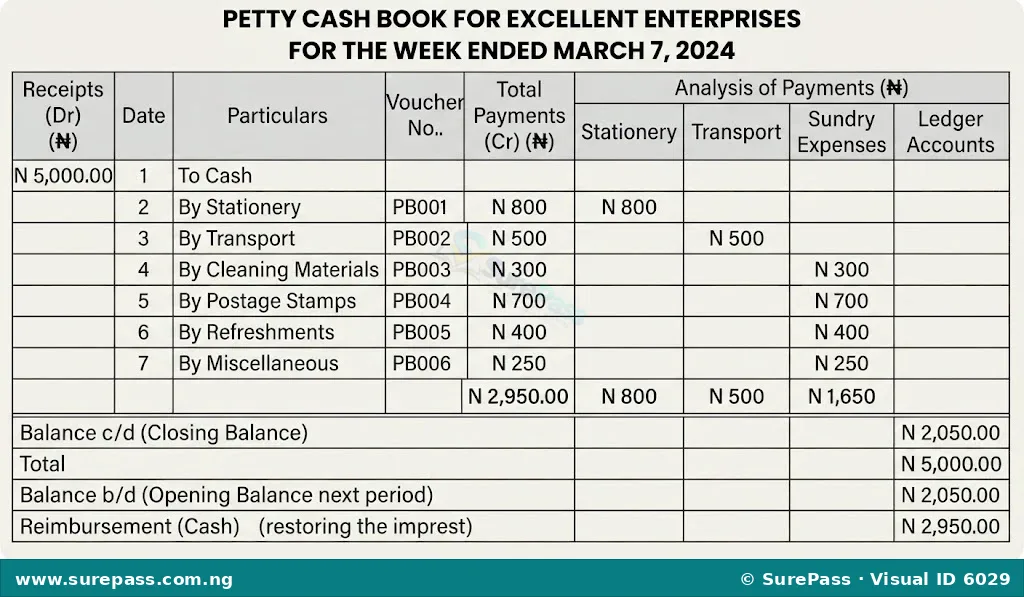
The preparation of the petty cash book is shown below:
Explanation of the Worked Example:
- On March 1, the N5,000.00 received is entered in the ‘Receipts’ column.
- Each payment is recorded in the ‘Total Payments’ column and then allocated to the relevant ‘Analysis of Payments’ column. For example, N800.00 for stationery is entered in ‘Total Payments’ and also in the ‘Stationery’ column.
- Cleaning supplies, postage stamps, refreshments, and minor repairs are grouped under ‘Sundry Expenses’ as they are miscellaneous small items.
- At the end of the week, the ‘Total Payments’ column is summed up (N2,950.00).
- Each ‘Analysis of Payments’ column is also summed up (Stationery N800.00, Transport N500.00, Sundry Expenses N1,650.00).
- The cash balance remaining is calculated: N5,000.00 (Receipts) – N2,950.00 (Total Payments) = N2,050.00. This is the ‘Balance c/d’ (balance carried down).
- The ‘Balance c/d’ is then brought down as ‘Balance b/d’ (balance brought down) for the next period.
- Under the imprest system, the petty cashier is reimbursed for the amount spent (N2,950.00) to restore the fund to N5,000.00 for the next period. This reimbursement is recorded in the ‘Receipts’ column for the new period.
Posting Totals from the Petty Cash Book to the Ledger
After the petty cash book is balanced, the totals from the ‘Analysis of Payments’ columns are posted to the respective expense accounts in the main ledger. The total payments made are also posted to the credit side of the Cash or Bank account in the main ledger, representing the money withdrawn for petty cash.
The procedure for posting totals to the ledger involves the following steps:
- Debit Expense Accounts: For each ‘Analysis of Payments’ column, the total amount is debited to the corresponding expense account in the ledger. For example, the total of the ‘Stationery’ column is debited to the Stationery Account.
- Credit Cash/Bank Account: The total amount of payments made from the petty cash fund (the reimbursement amount) is credited to the Cash Account or Bank Account in the main ledger. This represents the money that was initially issued or reimbursed to the petty cashier.
Worked Example: Posting to the Ledger
Using the data from Excellent Enterprises’ petty cash book for the week ended March 7, 2024:
- Total Stationery: N800.00
- Total Transport: N500.00
- Total Sundry Expenses: N1,650.00
- Total Payments (Reimbursement): N2,950.00
The ledger accounts would be posted as follows:
Stationery Account
| Date | Particulars | Folio | Amount (N) | Date | Particulars | Folio | Amount (N) |
|---|---|---|---|---|---|---|---|
| March 7 | Petty Cash | PCB | 800.00 |
Transport Account
| Date | Particulars | Folio | Amount (N) | Date | Particulars | Folio | Amount (N) |
|---|---|---|---|---|---|---|---|
| March 7 | Petty Cash | PCB | 500.00 |
Sundry Expenses Account
| Date | Particulars | Folio | Amount (N) | Date | Particulars | Folio | Amount (N) |
|---|---|---|---|---|---|---|---|
| March 7 | Petty Cash | PCB | 1,650.00 |
Cash/Bank Account (Extract)
| Date | Particulars | Folio | Amount (N) | Date | Particulars | Folio | Amount (N) |
|---|---|---|---|---|---|---|---|
| … | … | March 7 | Petty Cash (Reimbursement) | PCB | 2,950.00 |
Explanation of Posting:
- The total for each expense category (Stationery, Transport, Sundry Expenses) is debited to its respective ledger account. This increases the expense.
- The total amount reimbursed to the petty cashier (N2,950.00) is credited to the Cash or Bank Account, as this money was paid out from the main cash/bank fund to replenish the petty cash.





0 comments
Open the discussion when you need it. Comments stay collapsed until requested so the initial article remains light.