



ARTICLE CONTENTSOn this page 7 sections
Accounting Standards
Performance Objectives
By the end of the lesson, students should be able to:
- explain the meaning of accounting standards;
- discuss the importance of accounting standards;
- state the objectives of accounting standards;
- differentiate between International Financial Reporting Standards (IFRS) and International Public Sector Accounting Standards (IPSAS);
- prepare a simple financial report using accounting standards.
Meaning of Accounting Standards
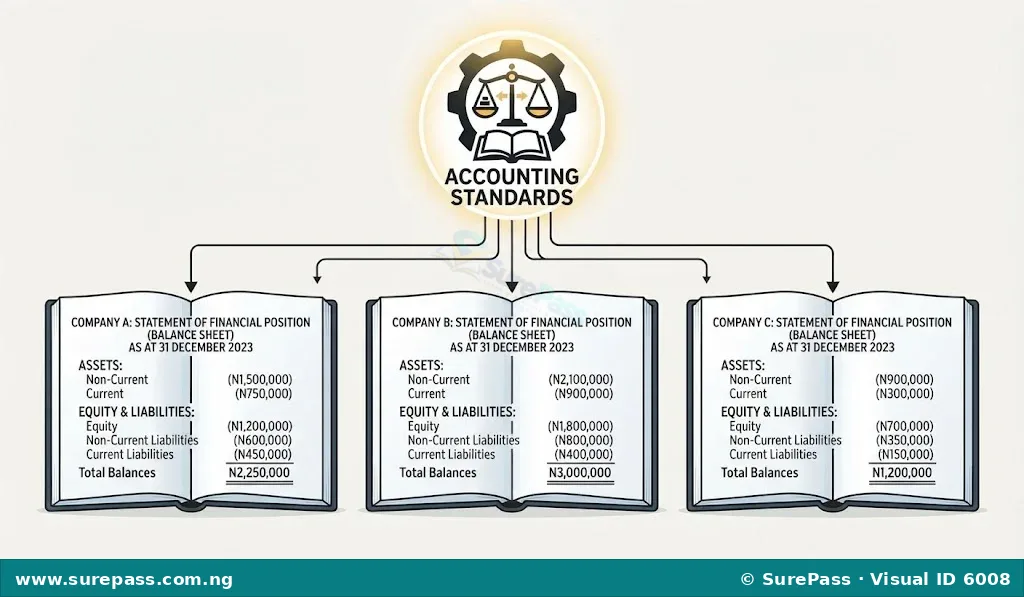
Accounting standards are a set of rules, principles, and guidelines that companies and organisations must follow when preparing and presenting their financial statements.
These standards ensure that financial information is consistent, comparable, reliable, and transparent. They provide a common language for financial reporting, making it easier for users to understand and compare the financial performance and position of different entities.
Importance of Accounting Standards
Accounting standards are crucial for several reasons, benefiting various users of financial information:
- Comparability: Standards allow investors, creditors, and other stakeholders to compare the financial performance and position of different companies. Without standards, each company might use different methods, making comparisons difficult or misleading.
- Transparency: They ensure that financial statements provide a clear and honest view of an organisation’s financial health. This reduces the chances of hidden information or misleading practices.
- Reliability: By following established rules, the financial information becomes more trustworthy and credible. Users can have confidence that the figures presented are based on consistent principles.
- Accountability: Standards hold management accountable for their financial decisions and the reporting of those decisions. They ensure that management presents information fairly and accurately.
- Investor Confidence: When investors know that financial statements are prepared according to recognised standards, they are more confident in making investment decisions. This helps in attracting capital for businesses.
- Reduced Fraud and Errors: The strict guidelines provided by accounting standards help to minimise the possibility of errors and fraudulent activities in financial reporting.
- Regulatory Compliance: Many countries and regulatory bodies require companies to adhere to specific accounting standards, making compliance essential for legal operation.
Objectives of Accounting Standards
The primary objectives of accounting standards are to:
- Provide Useful Information: To ensure that financial statements provide information that is useful to a wide range of users (like investors, creditors, employees, and the public) in making economic decisions.
- Enhance Comparability: To make it easier for users to compare the financial performance and position of different entities over time and across different organisations.
- Ensure Reliability: To ensure that financial information is free from material error and bias, and can be depended upon by users to represent faithfully what it purports to represent.
- Promote Transparency: To ensure that all relevant financial information is disclosed clearly and completely, preventing hidden liabilities or assets.
- Improve Understandability: To make financial statements easy to understand for users who have a reasonable knowledge of business and economic activities.
- Facilitate Decision-Making: To provide a basis for informed economic decisions by various stakeholders, including investment, lending, and management decisions.
Categories of Accounting Standards
Globally, two major categories of accounting standards are widely recognised and applied, depending on the type of entity:
- International Financial Reporting Standards (IFRS)
- International Public Sector Accounting Standards (IPSAS)
International Financial Reporting Standards (IFRS)
International Financial Reporting Standards (IFRS) are a set of accounting standards developed by the International Accounting Standards Board (IASB).
These standards are designed to be a common global language for business affairs so that company accounts are understandable and comparable across international borders. IFRS are primarily used by private sector entities, such as publicly traded companies, private businesses, and other profit-oriented organisations.
The goal of IFRS is to make financial reporting consistent, transparent, and easily comparable around the world, which helps investors and other stakeholders make informed economic decisions.
International Public Sector Accounting Standards (IPSAS)
International Public Sector Accounting Standards (IPSAS) are a set of accounting standards developed by the IPSAS Board (IPSASB) of the International Federation of Accountants (IFAC).
These standards are specifically designed for public sector entities around the world. This includes national governments, state governments, local governments, government agencies, and other public sector organisations. IPSAS aim to improve the quality of financial reporting by public sector entities, leading to better-informed decisions about the allocation of public resources.
IPSAS promote transparency and accountability in the management of public funds, which is vital for good governance.
Differentiating International Financial Reporting Standards (IFRS) and International Public Sector Accounting Standards (IPSAS)
While both IFRS and IPSAS aim to improve financial reporting, they cater to different types of organisations and have distinct focuses. The key differences are:
- Users: IFRS are primarily used by private sector entities (businesses aiming for profit), while IPSAS are used by public sector entities (governments and their agencies).
- Objective: IFRS focus on providing information useful for economic decision-making by investors and creditors, often related to profit generation. IPSAS focus on providing information for accountability and decision-making regarding the use of public resources.
- Nature of Transactions: IFRS deal with commercial transactions and profit-making activities. IPSAS deal with public service delivery, taxation, grants, and other non-commercial transactions typical of government operations.
- Reporting Focus: IFRS emphasise financial performance and position from a profit perspective. IPSAS emphasise accountability for public funds and the efficient use of resources.
The table below summarises the main distinctions:
| Feature | International Financial Reporting Standards (IFRS) | International Public Sector Accounting Standards (IPSAS) |
|---|---|---|
| Primary Users | Private sector entities (e.g., companies, businesses) | Public sector entities (e.g., governments, agencies) |
| Main Objective | To provide information for economic decisions by investors and creditors, focusing on profit. | To provide information for accountability and decision-making regarding public resource allocation. |
| Nature of Operations | Commercial, profit-oriented activities. | Public service delivery, non-commercial activities, taxation, grants. |
| Focus of Reporting | Financial performance, financial position, cash flows from a profit perspective. | Accountability for public funds, efficient use of resources, service delivery. |
Preparing a Simple Financial Report Using Accounting Standards
Preparing a financial report involves presenting an organisation’s financial information in a structured and understandable way, following accounting standards. For SS1, we will focus on a very simple example of an Income Statement (also known as a Statement of Profit or Loss), which shows a business’s revenues and expenses over a period to determine its profit or loss.
Accounting standards guide how these items are recognised, measured, and presented, ensuring consistency and clarity.
Example: Simple Income Statement for a Small Business
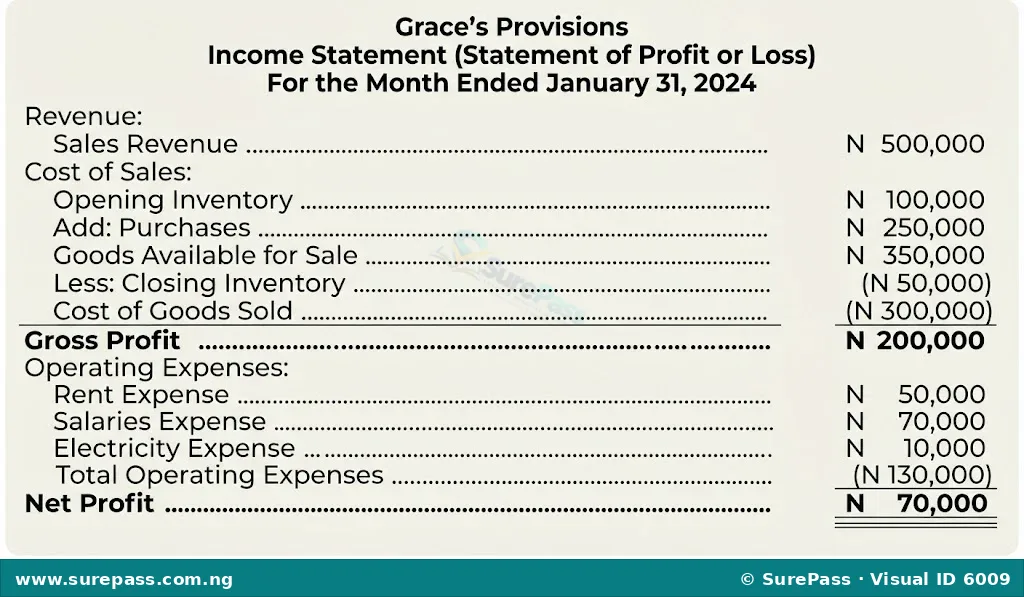
Imagine a small business, “Grace’s Provisions,” that sells goods. At the end of the month, Grace wants to know if her business made a profit or a loss. She collects the following information for the month of January 2024:
- Sales Revenue: N500,000
- Cost of Goods Sold (what she paid for the goods she sold): N300,000
- Rent Expense: N50,000
- Salaries Expense: N70,000
- Electricity Expense: N10,000
Using accounting standards, Grace would prepare her Income Statement as follows:
Grace’s Provisions
Income Statement (Statement of Profit or Loss)
For the Month Ended January 31, 2024
Sales Revenue
Explanation of the Financial Report:
- Sales Revenue: This is the total amount of money Grace received from selling her goods during January. Accounting standards require that revenue is recognised when it is earned, not necessarily when cash is received.
- Cost of Goods Sold: This is the direct cost of the goods that Grace sold. Standards dictate how inventory costs are matched with sales revenue.
- Gross Profit: This is calculated by subtracting the Cost of Goods Sold from Sales Revenue. It shows the profit made from the core selling activity before other expenses are considered.
- Operating Expenses: These are the costs incurred in running the business, not directly related to the goods sold. Standards require that expenses are recognised when they are incurred, regardless of when cash is paid.
- Rent Expense: The cost of using the shop space for the month.
- Salaries Expense: The cost of paying employees for their work during the month.
- Electricity Expense: The cost of electricity consumed by the business during the month.
- Net Profit: This is the final profit remaining after all expenses have been deducted from the revenue. A positive net profit means the business made money, while a negative figure (Net Loss) means it lost money.
By following accounting standards, Grace ensures that her Income Statement is clear, accurate, and can be understood by anyone familiar with basic financial reporting. This helps her make informed decisions about her business, such as whether she needs to increase sales or reduce expenses.




0 comments
Open the discussion when you need it. Comments stay collapsed until requested so the initial article remains light.