


ARTICLE CONTENTSOn this page 7 sections
Cosmetology Business Start-up
Performance Objectives
By the end of the lesson, students should be able to:
- state the meaning of cosmetology business start-up;
- discuss various industry entry requirements for cosmetology start-up;
- explain the benefits of starting an enterprise;
- identify cosmetology goods and services;
- identify resources / tools for cosmetology start-up.
Meaning of Cosmetology Business Start-up
A business start-up is a newly established enterprise in its early stages of development, created by one or more entrepreneurs to solve a problem, meet a market demand or offer unique products and services.
A cosmetology business start-up is a newly established beauty enterprise that offers professional hair, skin, nail or makeup products and services to clients.
Starting a cosmetology business involves transforming beauty skills into a commercial venture. This process requires careful planning, market research, securing capital, choosing a suitable location, acquiring necessary tools, and registering the business under appropriate regulatory bodies. The business can take various forms, such as a home-based salon, a mobile beauty service, a retail beauty store or a full-service commercial salon.
Industry Entry Requirements for Cosmetology Enterprise
Industry entry requirements are the legal, professional, and operational standards that an entrepreneur must meet before establishing and running a business. In the cosmetology industry, these requirements are essential to protect public health, ensure safety, maintain professional standards, and build trust with clients.
The primary industry entry requirements for starting a cosmetology enterprise in Nigeria include:
- Business Registration: The enterprise must be registered with the Corporate Affairs Commission (CAC). This legal process establishes the business as a recognized entity, which can operate as a sole proprietorship, a partnership or a private limited company.
- Professional Training and Certification: The entrepreneur or the employed staff must possess formal training and recognized certificates or diplomas from accredited beauty academies. This proves technical competence and ensures that services are rendered safely and professionally.
- Regulatory Approvals and Licensing: If the business manufactures, imports or sells beauty products, it must obtain approval from the National Agency for Food and Drug Administration and Control (NAFDAC). Additionally, local government permits and environmental health certificates are required to operate a physical salon.
- Health and Safety Compliance: The business premises must meet strict sanitation standards. This includes having proper waste disposal systems, adequate ventilation, clean running water, and sterilisation equipment for tools to prevent the spread of infections.
- Tax Registration: The business must register with the Federal Inland Revenue Service (FIRS) and the relevant State Internal Revenue Service for tax identification and compliance.
- Premises Inspection: Health and safety officers from the local government authority must inspect the salon or production facility to ensure it is safe for public use before operations begin.
Benefits of Starting an Enterprise in Cosmetology
The beauty and cosmetology industry is one of the fastest-growing sectors in the economy. Establishing an enterprise in this field offers numerous advantages to the entrepreneur, the community, and the nation.
The benefits of starting an enterprise in cosmetology include:
- Financial Independence and Wealth Creation: A successful cosmetology business provides a steady source of income and profit for the owner, leading to financial self-reliance and long-term wealth.
- Job Creation: The enterprise employs other skilled professionals, such as hairstylists, makeup artists, nail technicians, receptionists, and managers, thereby reducing unemployment in the community.
- Skill Utilization and Personal Satisfaction: It allows beauty professionals to express their creativity, utilize their technical skills, and experience the satisfaction of making clients look and feel good.
- Economic Growth: Cosmetology businesses contribute to the local and national economy through tax payments, purchasing raw materials from local suppliers, and increasing economic activity.
- Business Flexibility: Owners have the freedom to set their working hours, choose their target market, and introduce innovative beauty trends.
Goods and Services in Cosmetology
A cosmetology business generates revenue by offering tangible products, intangible services or a combination of both. Understanding the distinction between goods and services helps the entrepreneur manage inventory and deliver quality customer care.
Cosmetology goods are tangible physical products manufactured, distributed or sold by a beauty enterprise for personal grooming, hair care, skincare or makeup application.
Cosmetology services are intangible, professional beauty treatments and grooming procedures performed by trained specialists on a client’s hair, skin, nails or face.
Common examples of cosmetology goods include:
- Hair Care Products: Shampoos, conditioners, hair creams, styling gels, hair oils, relaxers, and hair extensions.
- Skincare Products: Body lotions, moisturizers, facial cleansers, sunscreens, exfoliating scrubs, and body washes.
- Nail Care Products: Nail polishes, acrylic powders, nail hardeners, cuticle oils, and nail polish removers.
- Makeup Cosmetics: Foundations, powders, lipsticks, eyeliners, eyeshadows, and setting sprays.
Common examples of cosmetology services include:
- Hair Styling and Treatment: Hair washing, cutting, coloring, relaxing, braiding, weaving, and dreadlock styling.
- Nail Care Services: Manicures, pedicures, nail extensions, nail art, and cuticle treatments.
- Skincare and Facial Treatments: Facial cleansing, steaming, exfoliating, acne treatments, and body massages.
- Makeup Artistry: Bridal makeup, casual makeup, photographic makeup, and eyebrow shaping or threading.
Observe the diagram below to understand how cosmetology offerings are classified into goods and services.
Resources and Tools for Cosmetology Start-up
To set up a cosmetology business, various resources and tools must be gathered. These resources are categorized into financial, human, physical, and technical assets, which work together to ensure smooth business operations.
The essential resources required for a cosmetology start-up include:
- Financial Resources: Capital is needed to rent a shop, purchase equipment, buy initial stock, pay salaries, and cover utility bills. Sources of capital include personal savings, family loans, partnership contributions or bank credits.
- Human Resources: This refers to the skilled personnel needed to run the business, including qualified cosmetologists, stylists, nail technicians, receptionists, and managers.
- Physical Resources (Infrastructure): This includes a well-located shop or salon space, reliable electricity supply (often supported by a generator), clean running water, and proper ventilation.
- Technical Tools and Equipment: These are the specific instruments used to perform beauty treatments and services.
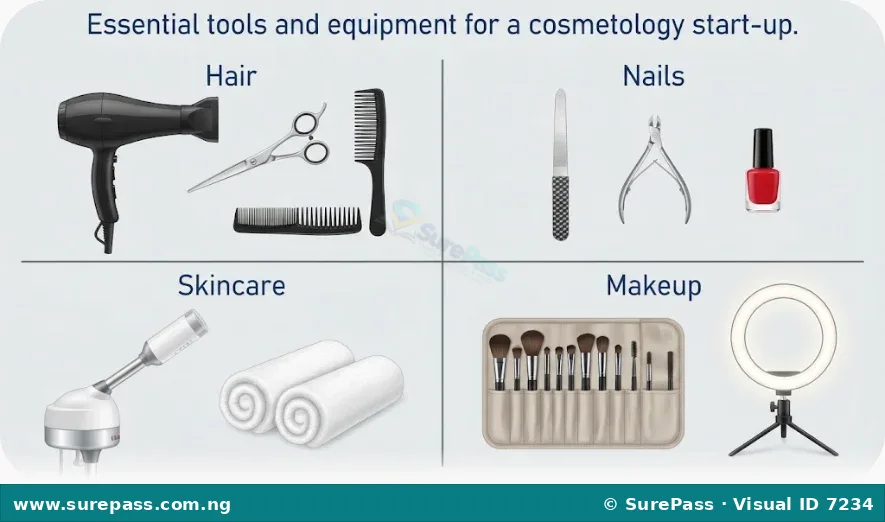
The technical tools and equipment required for a cosmetology salon include:
- Hair Styling Tools: Handheld hair dryers, standing hood dryers, hair straighteners, curling irons, hair clippers, scissors, combs, brushes, and rollers.
- Nail Care Tools: Manicure bowls, nail files, buffers, cuticle nippers, UV/LED nail lamps, and sterilising units.
- Skincare and Facial Tools: Facial steamers, extraction tools, facial beds, magnifying lamps, and clean towels.
- Makeup Artistry Tools: Makeup brush sets, beauty blenders, makeup chairs, ring lights, and cosmetic organizers.
- Salon Furniture: Styling chairs, washing basins (shampoo bowls), reception desks, waiting chairs, and display shelves for products.
- Sanitation and Safety Tools: Autoclaves or UV sterilizers, disinfectant jars, first aid kits, fire extinguishers, and personal protective equipment (aprons, gloves, face masks).
Look at the illustration below to identify the essential tools and equipment used in a professional cosmetology setup.




0 comments
Open the discussion when you need it. Comments stay collapsed until requested so the initial article remains light.