



ARTICLE CONTENTSOn this page 7 sections
Desirable ethics in life and Business
Performance Objectives
By the end of the lesson, students should be able to:
- explain the meaning of ethics in life and business;
- identify the desirable ethics in life and business;
- explain the benefits of practicing ethics in life and business.
Meaning of Ethics in Life and Business
Ethics is a system of moral principles that guide the behavior, decisions and actions of an individual or a group.
It helps people distinguish between what is right and what is wrong, ensuring that actions do not harm others but rather contribute positively to society.
Personal ethics refers to the moral principles and values that guide an individual’s private life, conduct and daily interactions with others.
These principles are often learned from family, religious teachings, culture and society. They influence how a person treats friends, family members and strangers in everyday situations.
Business ethics refers to the professional rules, standards and moral principles that guide behavior and decision-making in the workplace or commercial environment.
In the beauty and cosmetology industry, business ethics ensure that clients are treated fairly, products are safe, services are delivered professionally and the business operates within the law.
Understanding Ethics Through Personal Examples
To understand how ethics operate in daily life and business, consider the following personal scenarios:
In daily life, a student finds a high-value smartphone on a desk in the school laboratory. A personal ethical framework of honesty prompts the student to hand the phone over to the school authority so the rightful owner can recover it, rather than keeping or selling it.
In the cosmetology business, a hairstylist notices that a client has a highly contagious scalp infection, such as ringworm, during a consultation. An ethical cosmetologist will politely and privately explain the situation to the client, refuse to perform the service to prevent spreading the infection to other clients or stylists, and recommend a dermatologist. This decision prioritizes public health and safety over immediate financial gain.
Examples of Desirable Ethics in Life and Business
Desirable ethics are positive moral values that individuals and business owners should possess and practice consistently. In the beauty and cosmetology industry, these practices build a strong foundation for professional success.
Common examples of desirable ethics in life and business include:
- Honesty: This involves being truthful in all dealings. For a cosmetologist, honesty means using genuine, unadulterated beauty products, charging the agreed price without hidden fees, and giving realistic advice about what a treatment can achieve.
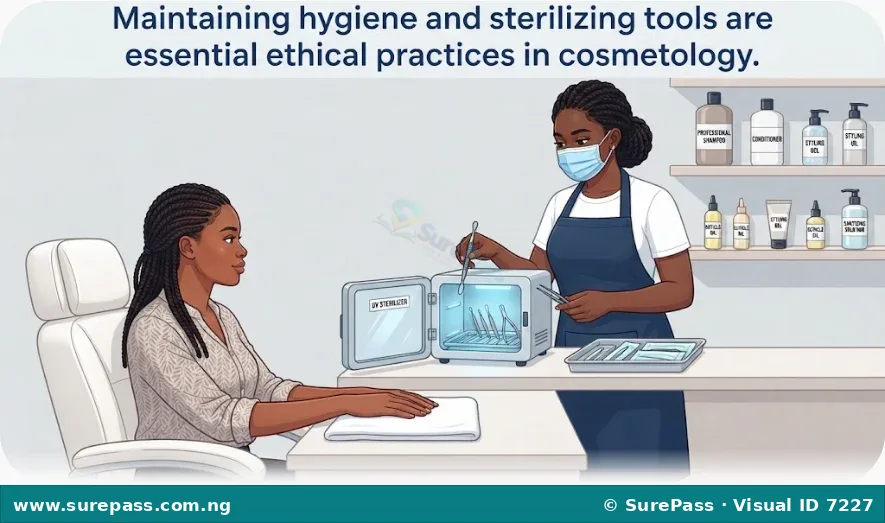
- Integrity: This is the consistency of actions, values and principles. It means doing the right thing even when no one is watching, such as properly sterilizing manicure tools between clients or disposing of expired cosmetics.
- Reliability and Punctuality: This refers to being dependable and keeping promises. Arriving on time for client appointments and delivering quality services within the promised timeframe demonstrates respect for the client’s time.
- Respect: This involves treating clients, colleagues, employees and competitors with dignity. It includes listening to client preferences, respecting their physical boundaries and avoiding derogatory remarks about competing salons.
- Confidentiality: This is the practice of keeping personal information private. Clients often share personal stories or health details during beauty treatments. An ethical cosmetologist keeps such information strictly confidential and does not gossip.
- Fairness: This means treating everyone equally without bias or discrimination. It involves charging uniform prices for the same services and attending to clients based on their booking order rather than personal favoritism.
- Accountability: This is the willingness to accept responsibility for one’s actions. If a beauty treatment causes an adverse reaction or does not meet the agreed standard, an ethical business owner admits the mistake, apologizes and offers a safe solution or refund.
- Hygiene and Safety: This involves maintaining a clean, safe and hazard-free environment. It includes sweeping hair off the floor immediately, washing hands before touching a client’s face and ensuring proper ventilation when using chemical products like hair relaxers or acrylic nail monomers.
Observe the image below to see how professional ethics are applied in a salon setting.
Benefits of Practicing Desirable Ethics in Life and Business
Practicing good ethics brings positive outcomes to individuals, businesses and the community as a whole. In the competitive beauty industry, ethical behavior is a key driver of long-term survival and growth.
The benefits of practicing desirable ethics in life and business include:
- Building Trust and Credibility: When clients know that a cosmetologist is honest and uses safe products, they develop trust in the business. Trust is the foundation of any successful professional relationship.
- Customer Retention and Loyalty: Clients are highly likely to return to a salon where they are treated with respect, fairness and professionalism. This reduces the cost of constantly looking for new customers.
- Positive Reputation: Word-of-mouth recommendations are powerful in the beauty industry. Satisfied, well-treated clients will speak positively about the business to friends, family and on social media, which attracts new clients naturally.
- Conflict Reduction: Clear, honest communication and fair pricing prevent misunderstandings between the cosmetologist and the client, leading to a peaceful working environment.
- Business Growth and Profitability: A business built on ethical practices attracts loyal clients, skilled employees and potential business partners, leading to steady financial growth.
- Peace of Mind: Operating with integrity allows individuals and business owners to live and work without the fear of being exposed for dishonesty, fraud or poor practices.
- Avoidance of Legal Issues: Complying with safety regulations, using approved cosmetics and practicing honest advertising protects the business from lawsuits, fines and closure by regulatory agencies.
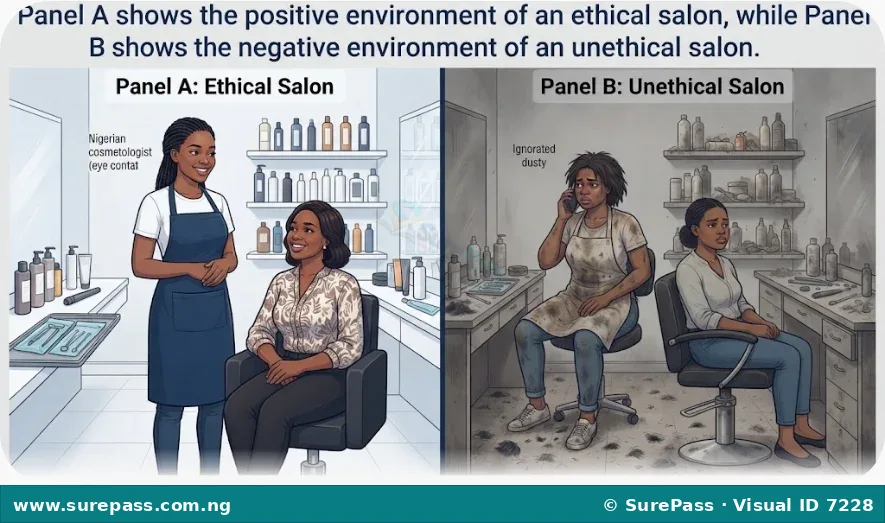
The diagram below illustrates the contrast between ethical and unethical business environments.
Practical Application: Identifying Desirable and Undesirable Ethics
To develop the skill of recognizing ethical and unethical behaviors in real-life cosmetology business scenarios, students can participate in role-playing activities.
The role-play activity involves the following steps:
- Divide into small groups of three or four students.
- Assign roles within each group, such as the Cosmetologist, the Client and the Observer.
- Select one of the scenarios provided below to act out.
- Perform the scenario twice: first demonstrating undesirable (bad) ethics, and then demonstrating desirable (good) ethics.
- Have the Observers note down the specific ethical behaviors shown in both performances and discuss the consequences of each.
Role-Play Scenario 1: The Diluted Product
In this scenario, a client visits a salon for a premium hair conditioning treatment that costs a high fee.
During the bad ethics performance, the cosmetologist secretly dilutes the expensive conditioner with water and cheap lotion to make it last longer, while charging the client the full price. The client notices the poor quality and complains, but the cosmetologist rudely denies any wrongdoing.
During the good ethics performance, the cosmetologist opens a fresh, high-quality product bottle in front of the client, explains its benefits, applies it professionally and charges the standard, transparent price. The client leaves satisfied and books another appointment.
Role-Play Scenario 2: Client Confidentiality
In this scenario, a client shares a personal concern about severe hair loss due to stress during a scalp treatment.
During the bad ethics performance, as soon as the client leaves, the cosmetologist loudly gossips about the client’s hair loss and personal life with another stylist and other clients in the waiting area.
During the good ethics performance, the cosmetologist listens empathetically, offers professional advice on scalp care, reassures the client privately and does not discuss the matter with anyone else after the client departs.
Summary of Desirable and Undesirable Ethics
The table below summarizes the key differences between desirable and undesirable ethics in the cosmetology business:
| Ethical Area | Desirable (Good) Ethics | Undesirable (Bad) Ethics | |
|---|---|---|---|
| Product Use | Using genuine, safe and unexpired products. | Diluting products or using cheap, expired substitutes. | |
| Hygiene | Sterilizing tools and keeping the salon clean. | Reusing dirty tools on multiple clients. | |
| Client Relations | Respecting client privacy and keeping secrets. | Gossiping about clients’ personal lives or conditions. | |
| Pricing | Charging fair, transparent and agreed prices. | Adding hidden charges or cheating clients. | |
| Punctuality | Keeping appointments and respecting clients’ time. | Keeping clients waiting without apology or reason. |





0 comments
Open the discussion when you need it. Comments stay collapsed until requested so the initial article remains light.