



ARTICLE CONTENTSOn this page 9 sections
Concept of Money
Performance Objectives
By the end of the lesson, students should be able to:
- explain the meaning and origin of money;
- discuss the uses of money;
- state the importance and methods of saving money;
- describe the sources of funding for cosmetology start-up;
- create a savings card;
- show how to carefully record savings.
Meaning and Evolution of Money
Money is anything that is generally accepted as a medium of exchange for goods and services and in the settlement of debts.
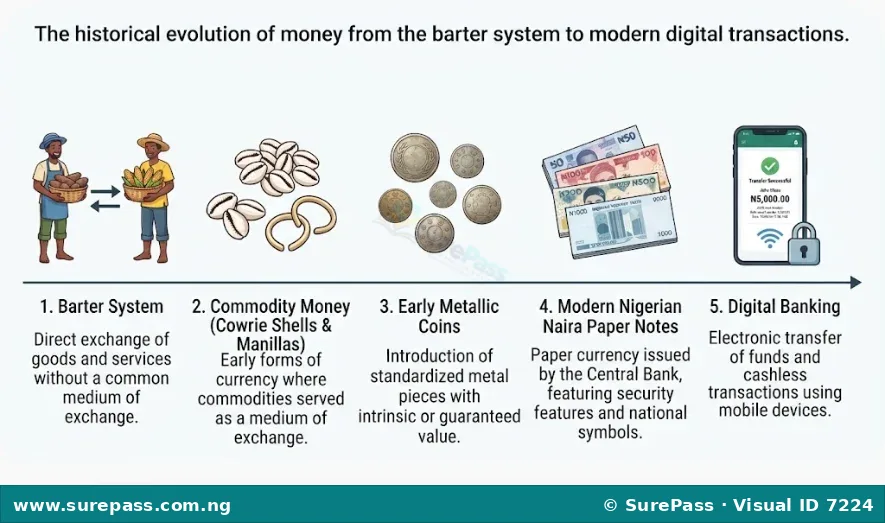
Before the invention of money, trade was conducted through a system known as barter. The barter system involved the direct exchange of goods for other goods. For example, a hair weaver might exchange a hairstyling service directly for a basket of tomatoes. However, the barter system had several major limitations, including the difficulty of finding someone who wanted what was being offered and who also possessed what was needed. This difficulty is known as the double coincidence of wants. Other problems included the difficulty of dividing large goods into smaller units and the challenge of transporting heavy items over long distances.
To overcome these challenges, societies began to use specific valuable items as commodity money. In Nigeria and other parts of West Africa, early forms of commodity money included:
- Cowrie shells
- Manillas (decorative metal rings)
- Salt blocks
- Beads
- Brass rods
As trade expanded, commodity money was replaced by metallic money, which consisted of coins made from precious metals like gold, silver, and copper. Coins were durable, easy to carry, and could be divided into smaller values. Over time, governments and banks began issuing paper money to represent the gold or silver held in their reserves. This transition made transactions much lighter and more convenient.
In the modern economy, money has evolved beyond physical coins and paper notes to include digital or electronic money. Transactions in cosmetology businesses today are frequently completed using electronic bank transfers, point-of-sale (POS) machines, and mobile banking applications.
Uses of Money
Money plays a vital role in daily life and in the operation of a cosmetology business. The primary uses of money are categorized into four main functions:
- Medium of Exchange: Money facilitates the buying and selling of goods and services. A cosmetologist uses money to purchase hair products, makeup kits, and salon equipment, while clients pay money to receive beauty treatments.
- Measure of Value: Money provides a standard unit to express the price of goods and services. Instead of guessing the worth of a haircut compared to a manicure, a salon owner can set a clear price in Naira, such as three thousand Naira for a haircut and two thousand Naira for a manicure.
- Store of Value: Money allows individuals to preserve purchasing power for the future. A cosmetologist can save money earned today to buy a heavy-duty hair dryer or rent a shop space next year, confident that the money will retain its usefulness.
- Standard of Deferred Payment: Money enables the purchase of goods and services on credit. If a supplier delivers beauty products to a salon with an agreement for payment in thirty days, the future debt is recorded and settled using money.
Saving Money
Saving is the act of keeping aside a portion of current income for future use instead of spending it immediately.
For an aspiring cosmetologist, saving is a foundational financial habit that bridges the gap between planning a business and actually launching it.
Importance of Saving Money
The practice of saving is essential for several reasons:
- Capital Accumulation: Saving helps gather the necessary funds to buy basic cosmetology tools, such as clippers, rollers, makeup brushes, and hand towels, to start a small-scale business.
- Emergency Preparedness: Unforeseen events, such as the breakdown of a hair steamer or a sudden increase in shop rent, can be managed smoothly when there are savings to fall back on.
- Financial Independence: Relying on personal savings reduces the need to borrow money with high interest rates, allowing the business owner to retain full control of their earnings.
- Business Expansion: Saved funds can be reinvested into the business to introduce new services, hire assistants, or purchase advanced beauty technology.
Methods of Saving Money
There are different methods available for saving money, ranging from traditional systems to modern banking options:
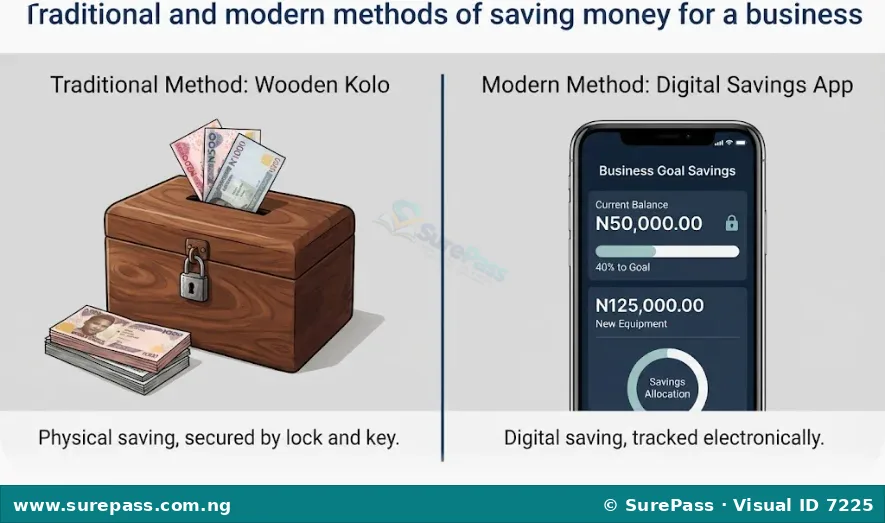
- Traditional Piggy Bank (Kolo): This is a simple wooden, plastic, or clay box with a small slot for inserting coins or paper notes. It is kept in a secure place at home and broken open only when the savings target is reached.
- Traditional Thrift Savings (Ajo or Esusu): This is a rotating savings system common in Nigerian communities. A group of people contributes a fixed amount of money daily or weekly, and the total sum collected is given to one member at the end of each cycle until every member has received their share.
- Bank Savings Accounts: This involves keeping money in a formal financial institution. It is a secure method that protects money from theft or physical damage, and it can earn interest over time.
- Digital Savings Platforms: These are mobile phone applications that allow users to automate their savings daily, weekly, or monthly, often offering higher interest rates than traditional bank accounts.
Sources of Funding for a Cosmetology Start-up
Starting a cosmetology business requires capital to purchase initial stock, secure a workspace, and pay for utilities. For a senior secondary school graduate or a young entrepreneur, the most accessible sources of funding are personal and family sources.
Personal Sources
Personal funding comes directly from the entrepreneur’s own efforts and assets. The main personal sources include:
- Personal Savings: Money accumulated over time from pocket money, gifts, or previous employment. This is the safest form of capital because it does not require repayment or interest.
- Sale of Personal Assets: An entrepreneur can sell personal belongings that are no longer needed, such as an old mobile phone, a bicycle, or jewelry, to raise quick cash for the business.
- Part-time Work or Mobile Services: Providing basic beauty services directly to clients at their homes (home services) before owning a salon can generate immediate income that can be saved to fund a permanent shop.
Family Sources
Family members are often willing to support a new business venture. The main family sources include:
- Soft Loans: These are loans given by parents, siblings, or relatives with highly flexible repayment terms and usually zero interest. This reduces the financial pressure on the start-up.
- Cash Gifts: Non-refundable financial contributions given by family members to support the entrepreneur’s ambition. These gifts do not have to be repaid.
- Family Partnerships: A relative may agree to provide the starting capital in exchange for a small share of the business profits over time.
How to Design and Make a Savings Card
A savings card is a simple, physical tool used to track personal savings manually. It helps an entrepreneur stay disciplined by showing exactly how much money has been saved over a period.
The required materials are:
- A sheet of stiff cardboard paper (any colour)
- A long ruler
- A pencil and a black or blue pen
- A pair of scissors
The procedure involves the following steps:
- Measure and Cut: Use the ruler and pencil to measure a rectangle of 15 centimetres by 21 centimetres (A5 size) on the cardboard paper. Carefully cut out the rectangle using the scissors.
- Create the Header: At the top of the card, write the title: “COSMETOLOGY START-UP SAVINGS CARD” in bold capital letters. Below the title, write spaces for “Name of Saver”, “Target Amount”, and “Start Date”.
- Draw the Ledger Table: Use the ruler and pen to draw a table with six columns. Label the columns from left to right as follows: Date, Description, Amount Deposited (₦), Amount Withdrawn (₦), Balance (₦), and Signature.
- Rule the Rows: Draw at least ten horizontal rows below the column headers to allow space for recording multiple transactions.
- Store Safely: Place the completed savings card in a clean envelope or a plastic folder to protect it from moisture and dirt.
How to Carefully Record Savings
Accurate record-keeping ensures that the entrepreneur knows the exact amount of money available at any given time. It prevents errors, tracks progress, and builds financial discipline.
The guidelines for careful recording are:
- Record Immediately: Write down every deposit or withdrawal on the savings card immediately after the transaction occurs. Do not rely on memory.
- Keep Chronological Order: Always write transactions in the order they happen, starting from the top row and moving downwards.
- Calculate the Running Balance: Add any new deposit to the previous balance to get the new balance. Subtract any withdrawal from the previous balance to get the new balance.
- Use Ink: Always write with a pen rather than a pencil to prevent accidental erasure or unauthorized alterations of the records.
An example of a correctly recorded savings card is shown below:
| Date | Description | Amount Deposited (₦) | Amount Withdrawn (₦) | Balance (₦) | Signature |
|---|---|---|---|---|---|
| 05/10/2023 | Pocket money savings | 2,000 | 0 | 2,000 | A.B. |
| 12/10/2023 | Gift from Uncle | 5,000 | 0 | 7,000 | A.B. |
| 18/10/2023 | Bought makeup brushes | 0 | 3,000 | 4,000 | A.B. |
| 25/10/2023 | Weekend hair braiding job | 4,500 | 0 | 8,500 | A.B. |
Evaluation Guide
To assess understanding, students should answer the following questions:
- Describe the meaning of money and explain how it evolved from the barter system to modern digital currency.
- Discuss four major uses of money in a cosmetology business.
- Explain why it is important for an aspiring cosmetologist to save money, and list three methods of saving.
- Enumerate the personal and family sources of funding available for starting a cosmetology business.
- Create a physical savings card using cardboard paper and rule it with the correct column headers.
- Using the created savings card, record three hypothetical transactions: a deposit of ₦5,000, a withdrawal of ₦1,500, and a deposit of ₦3,000, showing the correct running balance for each step.





0 comments
Open the discussion when you need it. Comments stay collapsed until requested so the initial article remains light.