



ARTICLE CONTENTSOn this page 11 sections
Population and Settlement of Nigeria
Performance Objectives
By the end of the lesson, students should be able to:
- explain the meaning of population and settlement;
- identify types of settlement;
- discuss population distribution and patterns in Nigeria;
- describe the settlement patterns and urbanization in Nigeria;
- identify challenges of population growth in Nigeria;
- discuss the implication of settlement expansion in Nigeria.
Understanding Population
Population refers to the total number of people living in a specific geographical area at a particular time. This area could be a village, town, state, country, or even the entire world.
Studying population helps in understanding how many people live in an area, how they are distributed, and how their numbers change over time. This information is crucial for planning and development.
Population Concepts
Several key concepts help in understanding population dynamics:
- Population Size: This is the total number of individuals in a given area. For example, the population size of Nigeria is the total number of people living within its borders.
- Population Density: This measures how crowded an area is. It is calculated by dividing the total population of an area by its land area (usually in square kilometres). A high population density means many people live in a small area, while a low density means fewer people are spread over a larger area.
- Population Distribution: This describes how people are spread out across a geographical area. It shows where people live in large numbers and where they live in small numbers.
- Population Growth: This refers to the increase in the number of people in a population over a period. It is influenced by birth rates, death rates, and migration.
Factors Influencing Population Distribution
The way people are spread across Nigeria is not uniform; some areas are densely populated, while others are sparsely populated. This uneven distribution is influenced by various factors:
- Physical Factors:
- Climate: Areas with favourable climate, such as moderate rainfall and temperature, tend to attract more people. Regions with extreme heat or very low rainfall may be sparsely populated.
- Relief and Topography: Flat or gently undulating plains are generally more attractive for settlement and agriculture than mountainous or rugged terrains.
- Soil Fertility: Fertile soils support agriculture, which can sustain larger populations. Areas with poor soils tend to have fewer people.
- Water Availability: Access to fresh water for drinking, agriculture, and industrial use is a major determinant. River basins and areas with reliable water sources often have higher population densities.
- Natural Resources: Areas rich in mineral resources (like oil, solid minerals) or forests can attract people seeking employment or livelihoods.
- Economic Factors:
- Employment Opportunities: Areas with industries, commercial activities, or fertile agricultural land offer more job opportunities, attracting migrants.
- Infrastructure: Regions with good roads, electricity, communication networks, and other amenities tend to be more populated as they support economic activities and improve living standards.
- Trade and Commerce: Areas that serve as major trade routes or commercial centres often become densely populated.
- Social and Historical Factors:
- Historical Settlements: Some areas have been continuously settled for centuries due to historical reasons, such as being ancient kingdoms or trade hubs.
- Cultural and Religious Factors: Certain cultural or religious practices may lead to concentration of people in specific areas.
- Security: Areas that are perceived as safe and secure tend to attract and retain more people compared to conflict-prone regions.
Population Distribution and Patterns in Nigeria
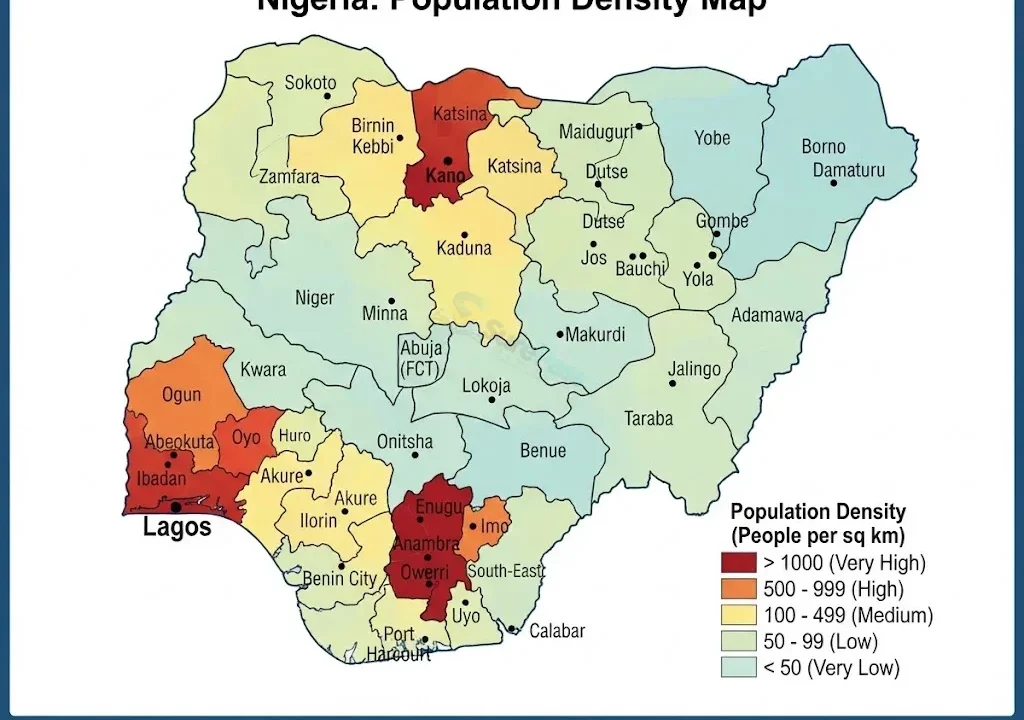
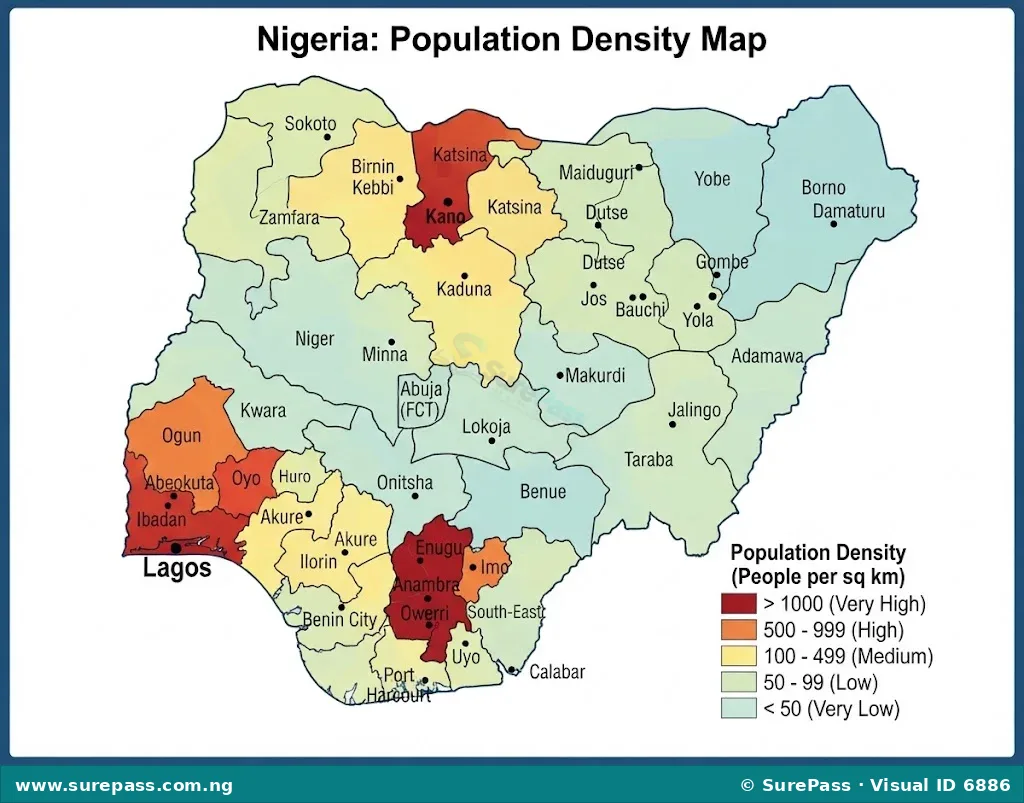
Nigeria is the most populous country in Africa, but its population is not evenly distributed. There are distinct patterns of population concentration and sparsity across the country.
Densely Populated Areas
These are regions where a large number of people live in a relatively small area, resulting in high population density. Examples in Nigeria include:
- South-Western Nigeria: This region, particularly Lagos State and parts of Ogun and Oyo States (e.g., Ibadan), is highly urbanised and industrialised, offering numerous economic opportunities.
- South-Eastern Nigeria: States like Anambra, Imo, and Abia have high population densities due to historical settlement, intensive agriculture, and commercial activities.
- Kano and Kaduna States (Northern Nigeria): These states are major commercial and agricultural centres in the North, attracting large populations.
- Parts of the Niger Delta: Areas with oil exploration and related activities, despite environmental challenges, can attract populations seeking employment.
Sparsely Populated Areas
These are regions where fewer people live, leading to low population density. Examples in Nigeria include:
- Parts of the Middle Belt: States like Taraba, Benue, and Plateau, while agriculturally rich in some areas, generally have lower population densities compared to the South.
- North-Eastern Nigeria: States such as Borno, Yobe, and Adamawa, particularly the arid and semi-arid zones, tend to be sparsely populated due to harsh environmental conditions and, in recent times, insecurity.
- Forest Reserves and Game Parks: These protected areas naturally have very low or no permanent human population.
Understanding Settlement
A settlement is a place where people live and interact, forming a community. It can range from a small isolated dwelling to a large city.
Settlements are dynamic and change over time in size, function, and structure. They are fundamental units of human organisation on the Earth’s surface.
Types of Settlement
Settlements are broadly classified into two main types based on their size, functions, and characteristics:
- Rural Settlements:
Rural settlements are typically small in size, with a low population density. The primary economic activities in rural areas are usually agriculture, fishing, forestry, and other primary occupations. Life in rural settlements is often characterised by close-knit communities, traditional lifestyles, and a slower pace of life.
Examples of rural settlements in Nigeria include villages, hamlets, and small farming communities.
- Urban Settlements:
Urban settlements are larger in size and have a high population density. Their primary economic activities are usually secondary (manufacturing) and tertiary (services, commerce) industries. Urban areas offer a wider range of services, infrastructure, and employment opportunities.
Examples of urban settlements in Nigeria include towns, cities, and metropolitan areas like Lagos, Abuja, and Port Harcourt.
Classification of Settlement
Settlements can also be classified based on their size and function, forming a hierarchy:
- Hamlet: A very small group of houses, often without services like shops or schools.
- Village: A larger collection of houses than a hamlet, usually with some basic services like a primary school or a small market.
- Town: Larger than a village, with more services, shops, and some industries. It serves as a local administrative and commercial centre for surrounding villages.
- City: A large and important urban area with a wide range of services, industries, and administrative functions. Cities often have universities, major hospitals, and diverse economic activities.
- Conurbation/Metropolis: A very large urban area formed when several cities and towns grow and merge together. Lagos is an example of a metropolis in Nigeria.
Settlement Patterns
Settlement patterns describe the spatial arrangement of buildings and houses within a settlement, and how settlements are distributed across the landscape. These patterns are influenced by physical features, economic activities, and historical factors.
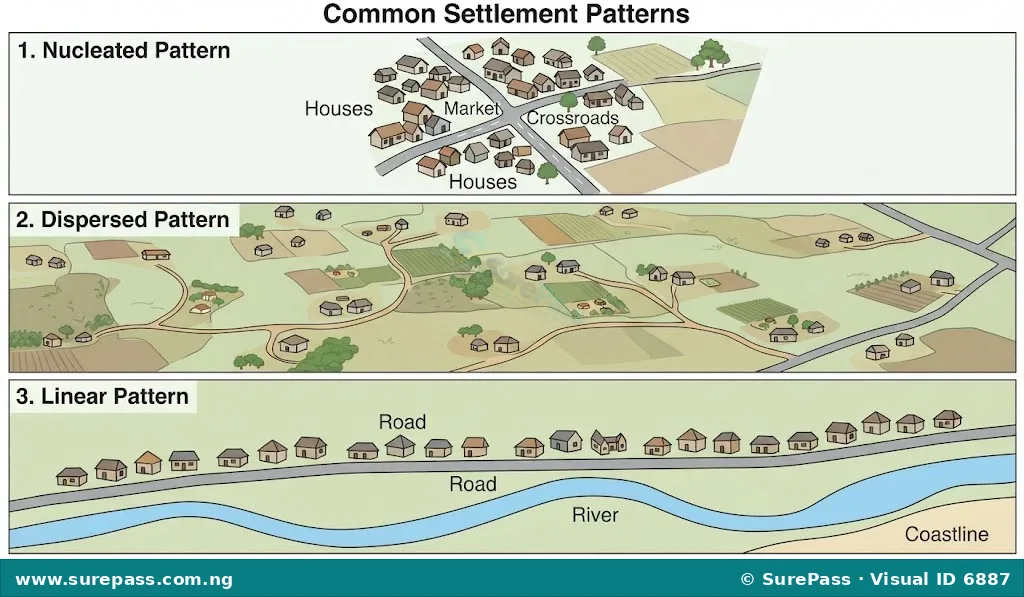
The main types of settlement patterns are:
- Nucleated (Clustered) Settlement Pattern:
In a nucleated pattern, houses and buildings are closely grouped together around a central point, such as a market, a crossroads, a water source, or a religious centre. This pattern is common in areas where security was historically important, or where land is communally owned and farming plots are located outside the main cluster.
Many traditional villages and towns in Nigeria, especially in the northern and parts of the western regions, exhibit nucleated patterns.
- Dispersed (Scattered) Settlement Pattern:
A dispersed pattern is characterised by individual houses or small groups of houses scattered far apart from each other, often separated by farmland or open spaces. This pattern is common in areas where agriculture is the primary activity and farmers prefer to live on their land for easier access.
Dispersed settlements are often found in parts of the Middle Belt and some rural areas of Southern Nigeria.
- Linear (Ribbon) Settlement Pattern:
In a linear pattern, houses and buildings are arranged in a long, narrow strip, typically along a major transportation route like a road, railway line, or a river. This pattern often develops where access to transport or a resource (like water) is crucial.
Many settlements along major highways or river banks in Nigeria show a linear pattern.
Concept of Urbanization and Urban Growth in Nigeria
Urbanization is the process by which an increasing proportion of a country’s population comes to live in urban areas. It involves the growth of cities and towns, both in terms of population size and physical expansion.
Urban growth refers specifically to the increase in the population of urban areas. In Nigeria, urbanization has been rapid, driven by various factors.
Factors Driving Urban Growth in Nigeria
Urban growth in Nigeria is primarily driven by:
- Rural-Urban Migration: Many people move from rural areas to cities in search of better employment opportunities, education, healthcare, and improved living standards.
- Natural Increase: The birth rate in urban areas often exceeds the death rate, contributing to population growth.
- Reclassification of Settlements: Some large rural settlements may grow sufficiently to be reclassified as urban centres.
- Industrialisation and Commercial Activities: Cities are centres of manufacturing, trade, and services, which attract people and businesses.
- Government Policies: Establishment of administrative headquarters, universities, and other institutions in urban areas can stimulate growth.
Settlement Patterns and Urbanization in Nigeria
Urbanization has significantly altered settlement patterns in Nigeria. As cities grow, they often absorb surrounding rural settlements, leading to the expansion of urban areas and changes in the traditional patterns.
In many Nigerian cities, a mix of settlement patterns can be observed. The older, core areas might show nucleated patterns, while newer developments on the outskirts often exhibit more planned, grid-like patterns or linear developments along new roads.
The rapid pace of urbanization has led to the emergence of large metropolitan areas, where several towns and cities have merged to form continuous urban landscapes, such as the Lagos metropolitan area.
Major Urban Centres of Nigeria
Nigeria has numerous urban centres that serve as economic, administrative, and cultural hubs. Some of the major urban centres include:
- Lagos: The largest city in Nigeria and one of the largest in Africa, a major port city, commercial, and industrial hub.
- Abuja: The Federal Capital Territory, a planned city and the administrative centre of Nigeria.
- Ibadan: A historical city in the South-West, known for its large market and educational institutions.
- Kano: A major commercial and industrial city in Northern Nigeria, with a rich historical heritage.
- Port Harcourt: A major oil city and port in the Niger Delta region.
- Kaduna: An important industrial and administrative centre in Northern Nigeria.
- Benin City: A historical city in the South-South, known for its cultural heritage.
- Enugu: A major city in the South-East, historically known for coal mining.
- Onitsha: A prominent commercial city and river port in the South-East.
- Maiduguri: A major city in the North-East, serving as a regional centre.
Challenges of Population Growth and Settlement Expansion
Rapid population growth and uncontrolled settlement expansion in Nigeria pose significant challenges across various sectors:
Social Challenges
- Overcrowding: High population density in urban areas leads to overcrowding in housing, public transport, and social amenities.
- Increased Crime Rates: Overcrowding, unemployment, and poverty can contribute to an increase in crime and social unrest.
- Inadequate Social Services: Existing schools, hospitals, and recreational facilities become overstretched and insufficient to cater to the growing population.
- Slum Development: Rapid influx of people into cities often leads to the development of informal settlements or slums, characterised by poor housing, lack of basic amenities, and unsanitary conditions.
- Ethnic and Religious Tensions: Competition for resources and opportunities in densely populated areas can sometimes exacerbate ethnic or religious tensions.
Economic Challenges
- Unemployment and Underemployment: The job market in urban areas often cannot absorb the large number of job seekers, leading to high rates of unemployment and underemployment.
- Poverty: High unemployment and low wages contribute to widespread poverty, especially in urban slums.
- Increased Cost of Living: Demand for housing, food, and services in urban areas drives up prices, making life expensive for many residents.
- Strain on Resources: Growing populations place immense pressure on natural resources such as water, land, and energy.
- Reduced Agricultural Land: As settlements expand, valuable agricultural land on the urban fringes is converted for housing and infrastructure, affecting food production.
Infrastructural Challenges
- Housing Shortage: There is a severe shortage of affordable housing, forcing many to live in substandard conditions or informal settlements.
- Traffic Congestion: The increase in population and vehicles leads to severe traffic congestion, especially in major cities, impacting productivity and quality of life.
- Inadequate Water Supply: Existing water supply systems struggle to meet the demands of a rapidly growing urban population, leading to water scarcity.
- Poor Sanitation and Waste Management: The volume of waste generated increases significantly, overwhelming existing waste management systems and leading to environmental pollution and health hazards.
- Insufficient Electricity Supply: The demand for electricity often outstrips supply, resulting in frequent power outages.
- Inadequate Transportation Networks: Roads and public transport systems are often insufficient and poorly maintained, making movement difficult.
Implication of Settlement Expansion in Nigeria
The continuous expansion of settlements, particularly urban areas, has several significant implications for Nigeria:
- Loss of Agricultural Land: As cities grow outwards, they convert fertile agricultural land into residential, commercial, and industrial areas. This reduces the land available for food production, potentially leading to food insecurity.
- Environmental Degradation: Settlement expansion often leads to deforestation, soil erosion, and loss of biodiversity as natural habitats are destroyed. Increased waste generation and pollution of air and water bodies are also common.
- Increased Pressure on Infrastructure: Existing infrastructure (roads, water, electricity, sewage systems) becomes overstretched, leading to breakdowns and reduced quality of services. New infrastructure development often struggles to keep pace with the rate of expansion.
- Development of Slums and Informal Settlements: Rapid and unplanned expansion often results in the proliferation of slums, which lack basic amenities and pose health and social risks.
- Changes in Land Use Patterns: Traditional land use patterns are disrupted, leading to conflicts over land ownership and usage.
- Increased Commuting Distances and Costs: As people move to the outskirts due to high costs in city centres, commuting distances increase, leading to higher transportation costs and longer travel times.
- Social Disintegration: Rapid expansion can sometimes lead to the breakdown of traditional community structures and social ties, especially in newly developed areas with diverse populations.
- Economic Disparities: While urban centres offer opportunities, the benefits of expansion are often unevenly distributed, leading to increased disparities between the rich and the poor within and around urban areas.





0 comments
Open the discussion when you need it. Comments stay collapsed until requested so the initial article remains light.