


ARTICLE CONTENTSOn this page 9 sections
Natural Resources of Nigeria
Performance Objectives
By the end of the lesson, students should be able to:
- identify types of mineral resources found in Nigeria;
- identify the types of energy resources found in Nigeria;
- identify major water resources in Nigeria;
- describe the land and soil resources of Nigeria;
- indicate the location of different natural resources on a map of Nigeria.
What Are Natural Resources?
Natural resources are materials or substances that occur naturally in the environment and are useful to humans. These resources are found in nature and are not created by people.
Nigeria is rich in various natural resources, which play a vital role in the country’s economy and the daily lives of its citizens. These resources can be broadly categorised into mineral, energy, water, and land and soil resources.
Mineral Resources in Nigeria
Mineral resources are naturally occurring solid substances found beneath the Earth’s surface. They are extracted through mining and are valuable for various industrial and economic purposes.
Nigeria possesses a variety of mineral resources. These include:
- Gold: A precious metal known for its value and resistance to corrosion. Gold is used in jewellery, coinage, and electronics. Significant deposits are found in states like Osun, Kebbi, and Zamfara.
- Lithium: A light metal increasingly important in modern technology. Lithium is primarily used in rechargeable batteries for electric vehicles, mobile phones, and other electronic devices. Deposits have been identified in states such as Nasarawa, Kaduna, and Oyo.
- Tin: A silvery-white metal that is soft and malleable. Tin is often used as a coating for other metals to prevent corrosion, in solders, and in various alloys. Major tin deposits are found on the Jos Plateau in Plateau State.
- Columbite: A black mineral that is a primary source of niobium, a metal used in high-strength steel alloys, jet engines, and superconductors. Columbite is often found alongside tin in Nigeria, particularly in Plateau, Kano, and Kaduna states.
- Iron Ore: A rock from which metallic iron can be extracted. Iron ore is a fundamental raw material for the production of steel, which is essential for construction, manufacturing, and infrastructure development. Large deposits are found in Kogi, Enugu, and Kaduna states.
- Limestone: A sedimentary rock composed mainly of calcium carbonate. Limestone is a crucial raw material for the production of cement, which is vital for construction. It is also used in agriculture and as a building material. Extensive deposits are found in states like Ogun, Benue, Cross River, and Edo.
Energy Resources in Nigeria
Energy resources are natural materials that can be converted into energy to power homes, industries, and transportation. Nigeria is well-endowed with both fossil fuels and renewable energy sources.
The main energy resources in Nigeria are:
- Petroleum (Crude Oil): A fossil fuel formed from ancient organic matter. Petroleum is Nigeria’s most significant export and a major source of government revenue. It is refined into products like petrol, diesel, kerosene, and aviation fuel. The Niger Delta region is the primary area for petroleum extraction.
- Natural Gas: A fossil fuel consisting mainly of methane. Natural gas is used for electricity generation, industrial fuel, and as a raw material in the petrochemical industry. It is often found alongside petroleum deposits in the Niger Delta.
- Coal: A combustible black or brownish-black sedimentary rock. Coal is primarily used as a fuel for electricity generation and in some industrial processes. Significant coal deposits are found in Enugu, Kogi, Benue, and Gombe states.
- Hydro-electric Power: Electricity generated from the force of moving water. Nigeria has several rivers with potential for hydro-electric power generation. Major hydro-electric power stations include Kainji Dam, Shiroro Dam, and Jebba Dam, which utilise the flow of the River Niger.
Water Resources in Nigeria
Water resources are natural bodies of water that are useful to humans for various purposes, including drinking, agriculture, transportation, and recreation. Nigeria has abundant surface and underground water sources.
Major water resources in Nigeria include:
- Lakes: Large natural bodies of water surrounded by land. Lake Chad, located in the northeastern part of Nigeria, is a significant freshwater lake shared with neighbouring countries. Other smaller lakes and reservoirs are found across the country. Lakes provide water for irrigation, fishing, and support biodiversity.
- Rivers: Natural flowing watercourses, usually freshwater, flowing towards an ocean, sea, lake, or another river. The River Niger and River Benue are the two largest rivers in Nigeria, forming a major inland waterway system. Other important rivers include the Cross River, Ogun River, and Kaduna River. Rivers are crucial for transportation, irrigation, fishing, and hydro-electric power generation.
- Sea: The vast body of saline water that covers most of the Earth’s surface. Nigeria has a coastline along the Atlantic Ocean in the south. The sea provides opportunities for fishing, maritime trade, and oil exploration.
- Groundwater: Water located beneath the Earth’s surface in soil pore spaces and in the fractures of rock formations. Groundwater is accessed through wells and boreholes and is a vital source of drinking water for many communities, especially in areas where surface water is scarce.
- Wetlands: Areas where water covers the soil or is present either at or near the surface of the soil all year or for varying periods of time during the year. These include swamps, marshes, and floodplains, particularly common in the Niger Delta and along river basins. Wetlands are important for biodiversity, water purification, and flood control.
Land and Soil Resources of Nigeria
Land and soil resources refer to the Earth’s surface and the fertile layer of soil that supports plant life. These resources are fundamental for agriculture, forestry, and human settlement.
Nigeria’s diverse climate and geography result in different types of land and soil resources:
- Forest: Areas dominated by dense growth of trees and other woody vegetation. Nigeria has tropical rainforests, particularly in the southern parts of the country, including states like Cross River, Edo, and Ondo. These forests provide timber, non-timber forest products (like fruits, nuts, and medicinal plants), and serve as habitats for wildlife. They also play a crucial role in regulating climate and preventing soil erosion.
- Savannah: Grassland ecosystems characterised by scattered trees and shrubs, found in the central and northern parts of Nigeria. The savannah region includes Guinea Savannah, Sudan Savannah, and Sahel Savannah, moving from south to north. The soils in these areas are generally suitable for growing crops like maize, millet, sorghum, and groundnuts, and for livestock grazing. The savannah also supports various wildlife species.
Importance of Natural Resources
Natural resources are essential for the economic development and well-being of Nigeria. Their importance can be seen in several ways:
- Economic Growth: Resources like petroleum, natural gas, and various minerals are major sources of revenue for the government through exports and taxes. This revenue funds infrastructure projects, education, and healthcare.
- Employment Generation: The extraction, processing, and distribution of natural resources create numerous jobs for people in mining, oil and gas, agriculture, and related industries.
- Industrial Development: Raw materials from natural resources, such as iron ore for steel, limestone for cement, and timber for construction, are crucial for the growth of manufacturing and construction industries.
- Food Security: Land and soil resources, along with water resources, are fundamental for agriculture, which provides food for the population and raw materials for agro-allied industries.
- Energy Supply: Energy resources like petroleum, gas, coal, and hydro-electric power are vital for generating electricity, powering transportation, and fueling industries, which are essential for daily life and economic activities.
- Water Supply: Water resources provide drinking water for communities, support irrigation for agriculture, and facilitate inland navigation and fishing.
Interpreting Natural Resource Distribution Maps
A natural resource distribution map shows where different natural resources are located across a geographical area, such as Nigeria. Interpreting these maps is a key skill in geography as it helps to understand the spatial arrangement and availability of resources.
How to Interpret a Resource Distribution Map
To effectively interpret a natural resource distribution map, follow these steps:
- Read the Title: The title tells you what the map is about (e.g., “Mineral Resources of Nigeria”).
- Examine the Legend (Key): The legend is a box that explains the symbols, colours, or patterns used on the map to represent different resources. Each symbol corresponds to a specific resource.
- Identify the Resources: Locate the symbols on the map and match them to the resources listed in the legend. This helps you identify which resources are present.
- Locate the Resources: Observe where each resource’s symbol is placed on the map. This indicates the geographical areas or states where that resource is found.
- Understand the Scale and Orientation: Note the map scale to understand distances and the compass rose (or north arrow) to determine directions.
- Analyse Distribution Patterns: Look for patterns in the distribution. Are resources concentrated in certain regions? Are some resources found together? For example, tin and columbite are often found in the same areas.
- Relate to Physical Features: Consider how the distribution of resources relates to Nigeria’s physical geography, such as major rivers, mountain ranges, or vegetation zones. For instance, hydro-electric power is found along major rivers.
Observe the map below, which illustrates the distribution of various natural resources in Nigeria.
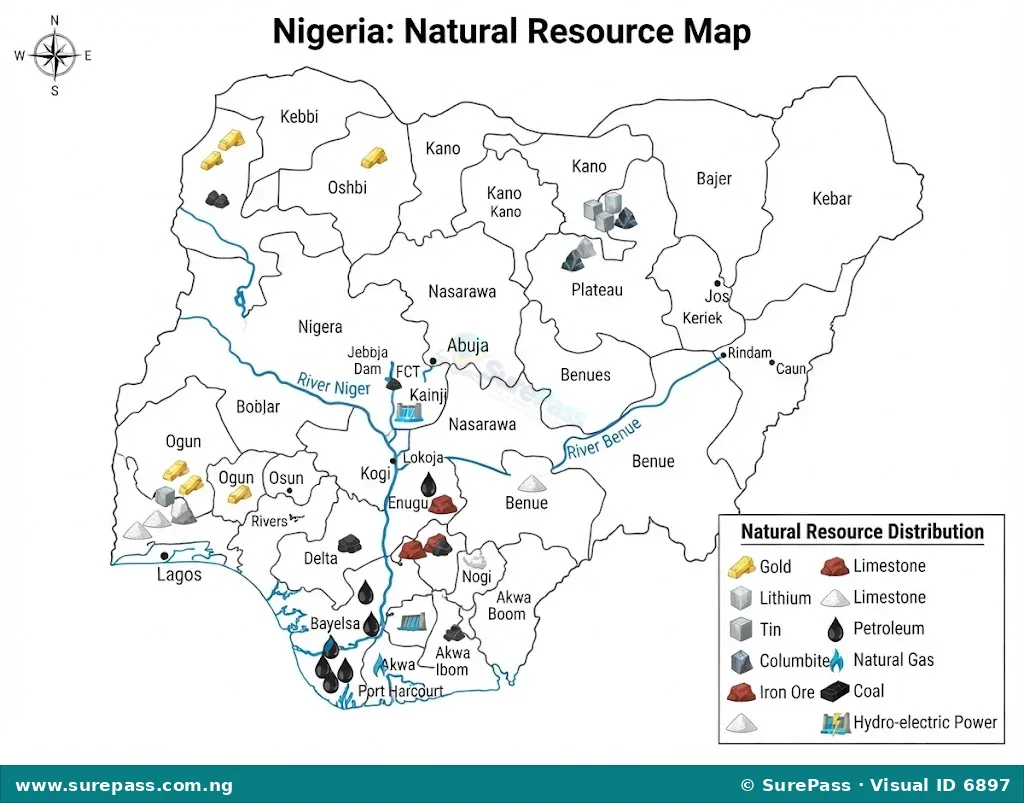
By studying this map, you can identify the types of resources present and their specific locations within Nigeria. For example, you can see that petroleum and natural gas are concentrated in the southern parts of the country, particularly in the Niger Delta region, while coal deposits are prominent in the Middle Belt and eastern regions.




0 comments
Open the discussion when you need it. Comments stay collapsed until requested so the initial article remains light.