



ARTICLE CONTENTSOn this page 12 sections
Family Resources
Performance Objectives
By the end of the lesson, students should be able to:
- identify and list types of family resources;
- state the differences between the various types of resources and explain their importance to family well-being and the achievement of goals;
- present a short report or a visual aid (e.g., a poster, a presentation) explaining the importance of one type of family resource for the quality of family life;
- classify resources into categories such as monetary and non-monetary;
- develop a simple family budget to demonstrate how to manage financial resources effectively.
Meaning of Family Resources
Family resources are the human and non-human assets, capabilities, possessions, and opportunities available to a family that can be used to satisfy needs, solve problems, and achieve goals.
Every family has various resources at its disposal, though the quantity and quality of these resources differ from one household to another. Effective management of these resources determines the standard of living and the overall well-being of the family members.
Types of Family Resources
Family resources are broadly grouped into distinct categories based on their nature and origin. These categories include human resources, material resources, financial resources, and community resources.
1. Human Resources
Human resources are the personal qualities, abilities, energies, and attributes that exist within individual family members. These resources cannot be seen or touched physically, but they are expressed through action and work. Examples of human resources include:
- Time: This is a universal resource shared equally by everyone, consisting of twenty-four hours a day. It is used to perform household chores, study, work, and rest.
- Energy: This is the physical and mental capacity to perform tasks. It is required for cooking, cleaning, farming, and other physical activities.
- Skills and Talents: These are specialized abilities such as sewing, cooking, carpentry, teaching, or mechanical repairs that family members possess.
- Knowledge: This refers to the cognitive understanding, academic qualifications, and practical information that family members use to make decisions and solve daily problems.
- Attitude: This is the mental outlook, interest, and willingness of family members to cooperate, work hard, and adapt to changes.
2. Material Resources
Material resources, also known as non-human resources, are physical objects and tangible possessions owned or controlled by the family. These resources can be seen, touched, and measured. Examples of material resources include:
- Food: The raw and processed agricultural products used to prepare meals for family nutrition and health.
- Housing: The physical shelter or building where the family lives, which provides protection, security, and comfort.
- Appliances and Equipment: Tools and machines such as gas cookers, refrigerators, sewing machines, washing machines, and grinding mills that make household work easier.
- Clothing: The garments and footwear worn by family members for protection, modesty, and identification.
- Land: The physical space owned by the family, which can be used for building, farming, or commercial purposes.
3. Financial Resources
Financial resources refer to the purchasing power of the family in the form of money and monetary instruments. These resources are used to acquire material goods and services. Examples of financial resources include:
- Wages and Salaries: The regular payments received by employed family members for work done.
- Business Profits: The financial gains made from trading, farming, or running private enterprises.
- Savings: Money set aside in banks or traditional cooperative societies (such as esusu or ajo) for future use.
- Investments: Assets purchased with the expectation of generating income, such as shares, bonds, or rental properties.
4. Community Resources
Community resources are public facilities, services, and programmes provided by the government or non-governmental organizations that are available to families within a locality. These resources help families meet needs that they cannot easily satisfy individually. Examples of community resources include:
- Educational Facilities: Public primary and secondary schools, vocational centres, and libraries.
- Health Facilities: General hospitals, primary health care centres, and maternity clinics.
- Infrastructure: Public roads, electricity grids, clean water supply systems, and waste disposal services.
- Recreational Facilities: Public parks, playgrounds, and community halls.
- Security Services: Police stations, local vigilante groups, and fire stations.
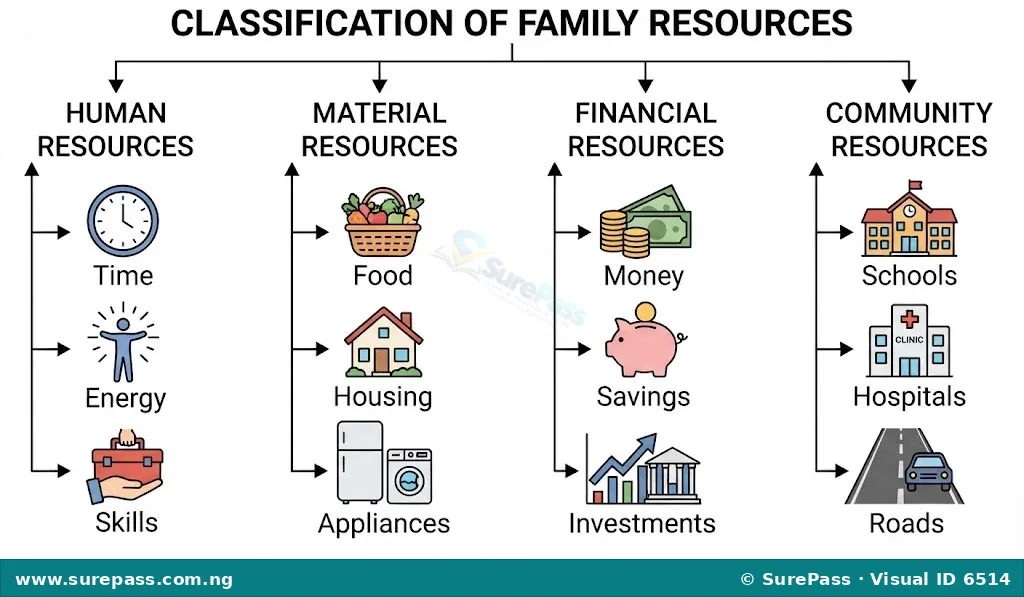
Classification of Family Resources
To manage resources effectively, home managers classify them into distinct groups. The two primary classification systems are human versus non-human resources, and monetary versus non-monetary resources.
Human versus Non-Human Resources
This classification separates resources based on whether they originate from within human beings or from external physical objects.
- Human Resources: These are internal to individuals (e.g., skills, energy, time, knowledge). They cannot be transferred directly to another person, though they can be used to benefit others.
- Non-Human Resources: These are external physical assets, money, and community facilities (e.g., houses, cars, cash, public parks). They can be transferred, bought, sold, or shared.
Monetary versus Non-Monetary Resources
This classification is based on whether the resource involves cash transactions or has a direct monetary value.
- Monetary Resources: These include all forms of money, such as cash, bank deposits, salaries, and business profits. They are easily measured and used directly to purchase goods and services.
- Non-Monetary Resources: These are resources that do not involve direct cash but contribute significantly to family well-being. Examples include time, energy, household skills, family-owned housing, and public community services.
Differences Between Types of Family Resources
Understanding the differences between the various types of resources helps families allocate them properly to achieve their goals.
The key differences among human, material, and financial resources are outlined in the table below:
| Feature | Human Resources | Material Resources | Financial Resources |
|---|---|---|---|
| Nature | Intangible (cannot be physically touched or seen). | Tangible (can be seen, touched, and measured). | Tangible or digital (represented by currency, bank balances, or assets). |
| Source | Originates from within individual family members. | Originates from the physical environment or manufacturing. | Earned through labour, business, or investments. |
| Transferability | Cannot be transferred directly to another person. | Can be easily transferred, sold, or inherited. | Highly transferable and exchangeable for goods and services. |
| Limitation | Limited by physical strength, health, and the 24-hour day. | Limited by wear and tear, physical space, and cost. | Limited by earning capacity and economic conditions. |
| Examples | Time, energy, cooking skills, intelligence. | House, refrigerator, food items, clothing. | Naira notes, bank savings, business profits. |
Characteristics of Family Resources
All family resources share specific characteristics that influence how they are managed. These characteristics include:
- Utility: Resources must have value and be useful in satisfying family needs. For example, a sewing machine is useful only if a family member has the skill to operate it.
- Limitation or Scarcity: Resources are not available in unlimited quantities. Time is limited to 24 hours a day, energy decreases with age or illness, and money is limited by income.
- Interchangeability: Resources can be substituted for one another to achieve the same goal. For example, a family can use financial resources to buy bread, or use human resources (time, energy, and baking skills) to bake bread at home.
- Manageability: Resources can be planned, organized, directed, and controlled. A family can decide how to spend money, allocate chores, or schedule study time.
- Interdependence: The use of one resource often depends on the availability of another. For instance, using a computer (material resource) to type a document requires typing skills (human resource) and electricity (community or material resource).
Importance of Family Resources
Family resources are essential for maintaining stability, comfort, and progress within the household. The importance of these resources includes:
- Meeting Basic Needs: Material and financial resources are used to provide food, clothing, and shelter, which are essential for survival.
- Achievement of Family Goals: Resources enable families to reach short-term and long-term goals, such as paying school fees, buying a car, or building a house.
- Enhancing Family Well-being: Human resources like love, care, and household skills create a peaceful, healthy, and supportive home environment.
- Handling Emergencies: Financial savings and community health facilities help families cope with unexpected events such as sudden illness, accidents, or job loss.
- Improving Quality of Life: Access to community resources like good roads, electricity, and schools elevates the standard of living for the family.
Factors Affecting the Use of Family Resources
The way a family utilizes its resources is influenced by several internal and external factors. These factors include:
- Family Size and Composition: Large families require more material and financial resources (such as food and money for school fees) than smaller families. The age of family members also affects resource use; families with infants require different resources compared to families with teenagers.
- Family Income: The amount of money available determines what goods and services a family can purchase. High-income families have more choices, while low-income families must prioritize basic survival needs.
- Location of the Family: Families living in urban areas have easier access to community resources like electricity, treated water, and specialized hospitals, whereas rural families may rely more on natural resources like farmland and streams.
- Stage of the Family Life Cycle: The resource needs of a family change over time. A newly married couple (beginning stage) has different resource demands compared to a family with school-aged children (expanding stage) or an elderly couple whose children have left home (contracting stage).
- Family Values and Goals: What a family considers important guides how they spend their resources. A family that values education will allocate more financial resources to school fees and books, while a family that values agriculture will invest more in land and farming tools.
- Socio-economic Status: The social standing and educational level of the parents influence how they manage time, energy, and money to improve their household.
Practical Guide: Creating a Resource Classification Chart
Creating a classification chart helps family members identify and organize the resources available to them. This visual tool makes it easier to plan how to use resources efficiently.
The procedure for creating a resource classification chart involves the following steps:
- Gather Materials: Obtain a cardboard sheet, a ruler, pencils, coloured markers, and an eraser.
- Draw the Main Title: Write “CLASSIFICATION OF FAMILY RESOURCES” in bold capital letters at the top of the cardboard.
- Create the Main Branches: Draw four main columns or boxes branching from the title, labelled: Human Resources, Material Resources, Financial Resources, and Community Resources.
- List Specific Examples: Under each column, write down concrete examples relevant to a typical Nigerian family. For instance, under Human, list “Time, Cooking Skills, Energy”; under Material, list “Yam, House, Gas Cooker”; under Financial, list “Salary, Savings”; under Community, list “Public School, Health Centre”.
- Use Colour Coding: Use different coloured markers for each category to make the chart visually distinct and easy to read.
- Review and Display: Check the chart for spelling and correct classification, then display it on a wall or bulletin board.
Practical Guide: Developing a Simple Family Budget
A family budget is a written financial plan that estimates a family’s income and plans how it will be spent over a specific period, usually a month.
Budgeting is a crucial skill for managing financial resources effectively, preventing debt, and ensuring that essential needs are met first. The procedure for developing a simple monthly family budget involves the following steps:
- Identify Total Monthly Income: List all sources of money coming into the family during the month (e.g., father’s salary, mother’s business profit) and add them together to get the total income.
- List Fixed Expenses: Identify expenses that do not change from month to month and must be paid (e.g., house rent, school fees, savings).
- List Variable Expenses: Identify expenses that change depending on consumption or can be adjusted (e.g., food, electricity bills, transportation, fuel, clothing).
- Calculate Total Expenses: Add the fixed expenses and variable expenses together.
- Balance the Budget: Subtract the total expenses from the total income. If the expenses exceed the income, adjust the variable expenses (such as reducing spending on entertainment or luxury clothing) until the budget balances.
An example of a balanced monthly family budget for a household with a monthly income of ₦150,000 is shown below:
| Category | Item Description | Estimated Cost (₦) |
|---|---|---|
| Expected Income | Monthly Salary and Business Profits | 150,000 |
| Fixed Expenses | Rent Contribution (saved monthly) | 20,000 |
| Fixed Expenses | School Fees Savings | 25,000 |
| Fixed Expenses | Emergency Savings | 10,000 |
| Variable Expenses | Foodstuff (Rice, Beans, Yam, Oil, etc.) | 45,000 |
| Variable Expenses | Transportation to Work and School | 20,000 |
| Variable Expenses | Utility Bills (Electricity, Water) | 10,000 |
| Variable Expenses | Medical Care and Toiletries | 12,000 |
| Variable Expenses | Miscellaneous / Entertainment | 8,000 |
| Total Expenses | Sum of all Fixed and Variable Expenses | 150,000 |
| Net Balance | Income minus Expenses (₦150,000 – ₦150,000) | 0 (Balanced) |
Practical Guide: Preparing a Report on the Importance of a Resource
To demonstrate an understanding of how resources affect family life, students can write a short report focusing on one specific resource, such as “Time” or “Financial Resources”.
The procedure for writing a structured academic report on a family resource involves the following steps:
- Choose a Specific Resource: Select one resource (e.g., Time Management).
- Write an Introduction: Define the chosen resource and state why it is classified as a human, material, or financial resource.
- Explain its Importance: Describe at least three ways this resource contributes to the quality of family life. For example, proper time management reduces stress, allows parents to spend quality time with children, and ensures household chores are completed promptly.
- Discuss the Consequences of Poor Management: Explain what happens when the resource is wasted. For example, poor time management leads to late preparation of meals, poor academic performance of children, and constant household friction.
- Provide Recommendations: Suggest practical ways the family can improve the use of this resource (e.g., creating a daily family timetable).
- Format the Report: Write the report neatly on an A4 sheet of paper, using clear headings for each section. Keep the length between one and two pages.




0 comments
Open the discussion when you need it. Comments stay collapsed until requested so the initial article remains light.