



ARTICLE CONTENTSOn this page 10 sections
Family Values
Performance Objectives
By the end of the lesson, students should be able to:
- state the meaning, importance and types of family values;
- describe factors that can influence a family’s value system;
- analyze how negative values affect individual and family behaviour;
- propose ways to foster and maintain values within a family setting.
Meaning of Family Values
Family values are the core beliefs, principles, and standards of behaviour that guide the actions, decisions, and interactions of members within a family unit.
These values act as an internal compass for the family, helping members distinguish between right and wrong. They are passed down from one generation to another, forming the foundation of character development and social responsibility. Through family values, individuals learn how to relate to one another within the home and how to behave as productive citizens in the wider society.
Importance of Family Values
A strong system of family values is essential for the stability of both the home and the nation. The main reasons why family values are important include:
- Character Formation: Family values shape the personality, attitude, and moral character of children from an early age, helping them grow into responsible adults.
- Guidance in Decision-Making: When faced with difficult choices or peer pressure, family values provide individuals with a clear standard to make safe and ethical decisions.
- Family Unity and Bonding: Shared values create a sense of identity, belonging, and mutual respect among family members, which strengthens family relationships.
- Conflict Resolution: Values such as love, patience, and forgiveness provide a peaceful framework for resolving misunderstandings and disputes within the home.
- Social Order and Stability: Since the family is the basic unit of society, families that uphold positive values contribute to a peaceful, law-abiding, and progressive nation.
- Protection Against Social Vices: Strong family values shield young people from negative societal influences such as drug abuse, cultism, examination malpractice, and juvenile delinquency.
Types of Family Values
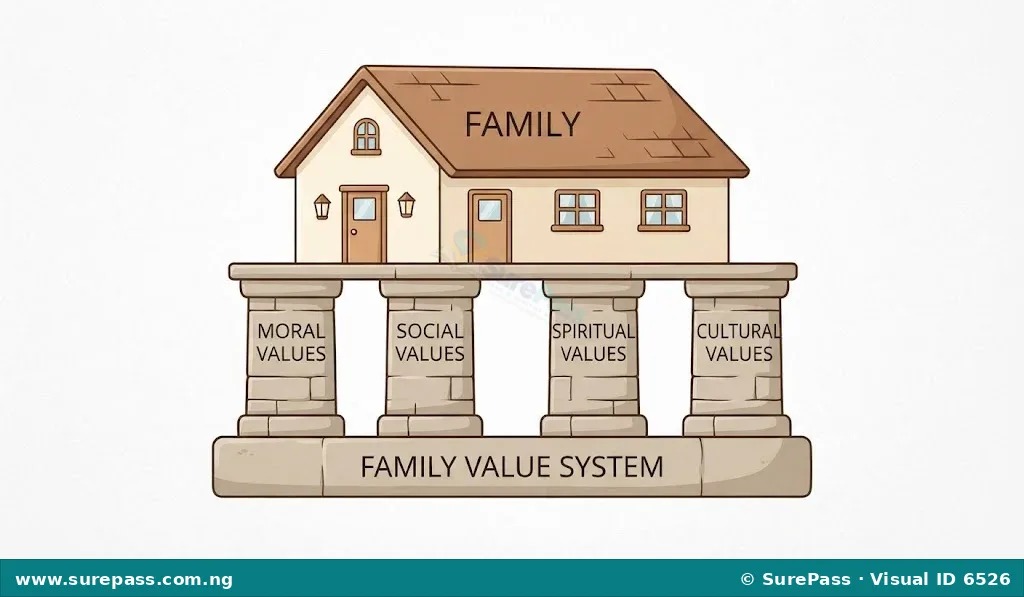
Family values can be grouped into different categories based on the area of life they influence. The major types of family values are:
- Moral Values: These are principles that define right and wrong conduct. Examples include honesty, integrity, truthfulness, fairness, and justice.
- Social Values: These values govern how family members interact with one another and with people in the community. Examples include respect for elders, politeness, cooperation, empathy, tolerance, and hospitality.
- Spiritual or Religious Values: These are beliefs centered on faith, reverence for a higher power, and adherence to religious teachings. Examples include love, charity, faith, prayerfulness, and fear of God.
- Cultural Values: These are traditions, customs, and beliefs inherited from ancestors that define a family’s heritage. Examples include respect for traditional authority, preservation of indigenous languages, and participation in community festivals.
- Economic or Work Values: These values relate to money, labour, and resource management. Examples include hard work, financial discipline, thriftiness, accountability, and resourcefulness.
Factors That Influence Family Value Systems
No two families have the exact same set of values. A family’s value system is shaped by several external and internal factors, which include:
- Culture: Cultural heritage plays a major role in shaping family values. In many Nigerian cultures, values such as respect for elders, communal living, and family honor are highly emphasized. Cultural expectations dictate gender roles, marriage customs, and child-rearing practices, which directly influence what a family considers important.
- Religion: Religious beliefs are a primary source of moral and spiritual values. Families often adopt the ethical codes, doctrines, and practices of their faith, such as Christianity or Islam. These religious teachings guide daily conduct, charity, forgiveness, and the definition of moral uprightness within the home.
- Socioeconomic Status: The educational background, income level, and occupational status of parents influence family values. For instance, highly educated parents may place a premium on academic excellence, critical thinking, and professional achievement. Similarly, economic challenges or wealth can shape a family’s attitude toward money, hard work, savings, and material possessions.
Effects of Negative Values on Individual and Family Behaviour
When positive values are absent or replaced by negative values, both individuals and the family unit suffer severe consequences. Negative values include dishonesty, greed, selfishness, laziness, disrespect, and violence.
The effects of negative values on individual and family behaviour include:
- Breakdown of Trust: Dishonesty and deceit within the family destroy trust between spouses, and between parents and children, leading to suspicion and emotional distance.
- Frequent Conflicts: Selfishness, intolerance, and a lack of respect lead to constant arguments, domestic violence, and the eventual breakdown of marriage or family unity.
- Anti-Social Behaviour: Individuals raised in homes lacking positive values are more likely to engage in social vices such as theft, fraud, cultism, drug abuse, and vandalism.
- Loss of Family Reputation: The criminal or immoral actions of one family member can bring shame, embarrassment, and social isolation to the entire family.
- Poor Academic and Career Performance: A lack of values like hard work, discipline, and perseverance often results in academic failure and poor career progression for family members.

Ways of Teaching and Maintaining Values in the Family
Fostering and maintaining positive values requires deliberate effort from parents and guardians. The most effective methods include:
- Role Modelling: Parents must practice the values they preach. Children learn more by observing the actions, honesty, and kindness of their parents than by merely listening to instructions.
- Direct Instruction and Communication: Parents should hold regular family discussions to teach moral lessons, explain the reasons behind family rules, and discuss the consequences of good and bad behaviour.
- Reward and Discipline: Positive reinforcement, such as praise and rewards, should be used to encourage good behaviour. Conversely, fair and consistent discipline should be applied to correct negative behaviour and teach accountability.
- Family Rituals and Traditions: Engaging in shared activities, such as eating meals together, family prayers, storytelling, and celebrating milestones, reinforces a sense of unity and shared identity.
- Monitoring External Influences: Parents should guide and monitor the media, internet content, and peer groups that children interact with, ensuring that external influences do not contradict family values.
Demonstrating Understanding of Values through Scenario Analysis
To understand how family values are applied in real-life situations, analyze the following hypothetical scenarios and the proposed value-based solutions.
Scenario 1: The Temptation of Academic Dishonesty
Tunde is an SS1 student whose family highly values honesty and hard work. During a terminal examination, Tunde realizes he forgot to study for a difficult Chemistry paper. A classmate offers to show him the answers from a smuggled textbook. Tunde is tempted because he does not want to fail and disappoint his parents.
Analysis and Solution:
If Tunde upholds his family values of honesty and hard work, he will reject the classmate’s offer to cheat. He understands that academic integrity is more important than a high grade obtained through deceit. Tunde will write the exam honestly, accept his actual performance, and use the experience as a lesson to prepare better for future examinations. His parents, guided by the same values, will appreciate his honesty while helping him create a better study plan.
Scenario 2: Financial Hardship and Integrity
The Adebayo family is experiencing severe financial difficulties due to sudden job loss. Mr. Adebayo is offered a business deal that involves falsifying financial records to gain a large sum of money. This money would easily solve the family’s immediate financial problems, including paying school fees.
Analysis and Solution:
If the Adebayo family values integrity and fear of God over material wealth, Mr. Adebayo will decline the dishonest deal. The family will choose to face their financial challenges through legitimate means, such as seeking support from relatives, cutting down expenses, or finding alternative legal sources of income. By choosing integrity, the parents teach their children that moral uprightness must never be sacrificed for financial gain.
Summary
Family values are the foundational principles that guide behaviour and decision-making within the home. They are essential for character development, family unity, and societal peace. Influenced by culture, religion, and socioeconomic status, these values must be actively taught and maintained through role modelling, communication, and discipline to prevent the destructive effects of negative values on individuals and society.





0 comments
Open the discussion when you need it. Comments stay collapsed until requested so the initial article remains light.