


ARTICLE CONTENTSOn this page 10 sections
Problem-Solving, Resilience and Adaptability Skills in Home Management
Performance Objectives
By the end of the lesson, students should be able to:
- explain meaning, importance of problem solving, and resilience skills in Home Management;
- describe the importance of adaptability skills in Home Management;
- identify ways of developing problem- solving, resilience and adaptability skills.
Home management involves the effective organisation and running of a household. It includes various tasks such as meal preparation, cleaning, budgeting, and caring for family members. Daily life in a home often presents unexpected challenges, changes, and difficulties. To manage these situations successfully, individuals and families need specific skills, including problem-solving, resilience, and adaptability.
Meaning of Problem-Solving Skills in Home Management
Problem-solving skills refer to the ability to identify problems, analyse their causes, develop possible solutions, choose the best solution, and implement it effectively.
In home management, problems can range from simple daily issues to more complex challenges. For example, a problem could be a sudden power outage, a broken appliance, or a disagreement among family members about household chores. Effective problem-solving helps to maintain order and harmony in the home.
Importance of Problem-Solving Skills in Home Management
Problem-solving skills are crucial for several reasons in home management:
- Efficient Household Operations: Problems can disrupt daily routines. Good problem-solving helps to quickly resolve issues, ensuring that household tasks continue smoothly. For instance, if a cooking gas cylinder runs out unexpectedly, problem-solving skills help in finding an alternative cooking method or quickly refilling the cylinder.
- Resource Management: Many household problems involve resources like money, time, or food. Problem-solving helps in making the best use of available resources to overcome challenges, preventing waste and ensuring needs are met.
- Stress Reduction: Unresolved problems can lead to stress and tension within the home. By addressing issues systematically, individuals can reduce anxiety and create a more peaceful living environment.
- Improved Decision-Making: Practising problem-solving strengthens the ability to make sound decisions, not just during crises but also in everyday choices related to home management.
- Family Harmony: When problems involving family members arise, such as conflicts over shared spaces or responsibilities, problem-solving skills help in finding fair and acceptable solutions, fostering better relationships.
Meaning of Resilience Skills in Home Management
Resilience skills refer to the ability to recover quickly from difficulties, setbacks, or stressful situations and continue functioning effectively.
In home management, resilience means being able to bounce back when things do not go as planned. This could involve coping with financial difficulties, dealing with illness in the family, or recovering from a natural disaster like a flood or fire that affects the home.
Importance of Resilience Skills in Home Management
Resilience is vital for maintaining stability and well-being in the home:
- Coping with Setbacks: Life presents unexpected challenges such as job loss, illness, or property damage. Resilience enables individuals and families to face these setbacks without being overwhelmed, allowing them to find ways to move forward.
- Emotional Stability: Resilient individuals can manage their emotions during difficult times, preventing stress and frustration from negatively impacting the entire household. They can maintain a positive outlook even when circumstances are tough.
- Adaptation to Change: Resilience often works hand-in-hand with adaptability. It helps family members adjust to new circumstances after a crisis, such as relocating or adjusting to a new budget.
- Strength in Adversity: A resilient family unit can draw strength from each other during challenging periods, supporting one another and working together to overcome obstacles.
- Long-Term Well-being: Developing resilience contributes to the long-term mental and emotional health of all family members, equipping them to handle future difficulties more effectively.
Meaning of Adaptability Skills in Home Management
Adaptability skills refer to the ability to adjust to new conditions, situations, or environments quickly and effectively.
In home management, adaptability means being flexible and open to change. This could involve adjusting meal plans due to unavailable ingredients, changing daily routines because of a new school schedule, or reorganising the home layout to accommodate a new family member or a different living arrangement.
Importance of Adaptability Skills in Home Management
Adaptability is essential for a smoothly running home in a constantly changing world:
- Handling Unexpected Changes: Life is full of surprises, from sudden visitors to changes in work schedules or school activities. Adaptability allows individuals to adjust plans and routines without significant disruption or stress.
- Resourcefulness: When faced with limited resources or unexpected shortages, adaptable individuals can find alternative solutions. For example, if a specific ingredient for a meal is unavailable, an adaptable person can substitute it with another or prepare a different dish.
- Stress Reduction: Resistance to change can cause stress. Being adaptable helps to reduce stress by allowing individuals to flow with changes rather than fighting against them, leading to a calmer household environment.
- Learning and Growth: Adaptability encourages learning new skills and approaches. For instance, adapting to new technology in the home, like a smart appliance, requires learning how to use it.
- Maintaining Harmony: In a family, different members may have different needs or preferences. Adaptability helps in compromising and adjusting to ensure everyone’s needs are considered, promoting peace and cooperation.
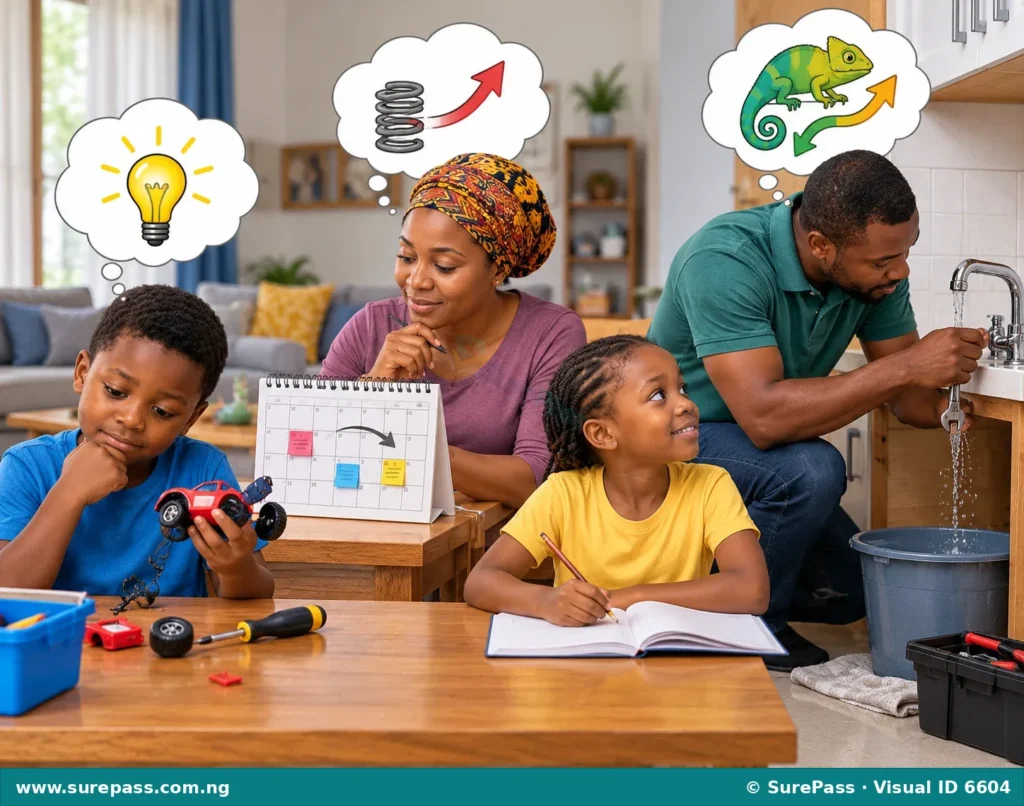
Developing Problem-Solving, Resilience and Adaptability Skills
These essential skills can be developed and strengthened through conscious effort and practice. Here are ways to cultivate them:
- Practise Critical Thinking:
When a problem arises, instead of reacting immediately, take time to think. Ask questions like: What is the real problem? What caused it? What are the possible solutions? What are the pros and cons of each solution? This helps in making informed decisions.
- Break Down Problems:
Large problems can seem overwhelming. Break them into smaller, manageable steps. For example, if the house needs a thorough cleaning, break it down into cleaning one room at a time, or one task at a time (e.g., sweeping all rooms, then mopping all rooms).
- Seek Information and Learn:
When faced with an unfamiliar problem or change, research or ask for advice. Learning new ways of doing things or understanding different perspectives can provide solutions and build confidence. This could involve reading a manual, watching a tutorial, or asking an experienced family member or friend.
- Embrace a Positive Mindset:
Approach challenges with the belief that they can be overcome. A positive attitude helps in seeing difficulties as opportunities for growth rather than insurmountable obstacles. This is crucial for building resilience.
- Develop Flexibility:
Be open to changing plans or trying new approaches when initial methods do not work. Understand that not everything will go according to plan, and being able to adjust is a strength, not a weakness. This is key for adaptability.
- Manage Emotions:
Learn to recognise and manage feelings like frustration, anger, or disappointment when facing difficulties. Taking a deep breath, stepping away for a moment, or talking about feelings can help in responding calmly and constructively. This supports resilience.
- Build a Support System:
Have people in your life—family, friends, or mentors—whom you can turn to for advice, emotional support, or practical help. Knowing you are not alone in facing challenges strengthens resilience.
- Practise Self-Care:
Ensure adequate rest, healthy eating, and regular physical activity. A healthy body and mind are better equipped to handle stress and adapt to changes, boosting both resilience and adaptability.
- Review and Reflect:
After solving a problem or adapting to a change, take time to reflect on what worked, what did not, and what could be done better next time. This continuous learning process strengthens all three skills.
- Set Realistic Expectations:
Understand that perfection is not always achievable. Sometimes, the goal is simply to manage a situation effectively rather than to achieve an ideal outcome. This helps in accepting outcomes and moving forward, which is a sign of resilience.
Applying Problem-Solving, Resilience and Adaptability Skills in Daily Life
These skills are not just theoretical concepts; they are practical tools used every day to navigate the complexities of home and daily life. Here is how they can be applied to solve emerging issues:
Scenario 1: Unexpected Power Outage
Imagine a sudden power outage occurs in the evening, just as dinner is being prepared and children need to study.
- Problem-Solving:
Identify the immediate problem (no light, no electricity for cooking/charging). Brainstorm solutions: use a rechargeable lamp, candles, or phone torch for light; use a gas cooker or charcoal stove for cooking; charge devices with a power bank or at a neighbour’s house if available. Choose the best solution based on available resources and safety.
- Resilience:
Instead of panicking or getting frustrated, accept the situation calmly. Focus on what can be done rather than what cannot. Maintain a positive attitude, perhaps by turning it into a family bonding time with stories by candlelight.
- Adaptability:
Adjust the dinner menu to something that can be cooked easily without electricity or that requires less time. Change the children’s study plan to reading by torchlight or doing homework that does not require electricity. Adapt the evening routine to the new conditions.
Scenario 2: Unforeseen Financial Challenge
A family member loses their job, leading to a sudden reduction in household income.
- Problem-Solving:
Identify the financial gap. Analyse current expenses to find areas where costs can be cut. Brainstorm ways to generate alternative income, even temporarily. Develop a new budget that reflects the reduced income and prioritise essential spending.
- Resilience:
Acknowledge the difficulty but avoid despair. Support each other as a family. Focus on the steps being taken to address the situation rather than dwelling on the loss. Maintain hope and determination.
- Adaptability:
Adjust lifestyle and spending habits to fit the new budget. This might mean cooking more meals at home, reducing entertainment expenses, or finding cheaper alternatives for goods and services. Adapt to a simpler way of living temporarily.
Scenario 3: Change in School Schedule
A child’s school introduces a new, earlier closing time, affecting the family’s afternoon routine and pickup arrangements.
- Problem-Solving:
Identify the conflict with existing schedules. Brainstorm solutions for pickup: who can pick up the child? Can a neighbour help? Is there a school bus option? How will this affect other family members’ schedules? Create a new afternoon schedule.
- Resilience:
Accept that routines sometimes change. Do not get upset about the inconvenience. Focus on finding a workable solution that benefits the child and the family.
- Adaptability:
Adjust work schedules if possible, or coordinate with other parents for carpooling. Modify meal times or homework routines to fit the new pickup time. Be flexible with how household chores are distributed to accommodate the change.





0 comments
Open the discussion when you need it. Comments stay collapsed until requested so the initial article remains light.