


ARTICLE CONTENTSOn this page 8 sections
Concept of Money
Performance Objectives
By the end of the lesson, students should be able to:
- explain the meaning and origin of money;
- discuss the uses of money;
- state the importance and methods of saving money.
- describe the sources of funding for textiles production start- up;
- create a savings card;
- show how to carefully record savings.
Meaning and Evolution of Money
Money is anything generally accepted as a medium of exchange for goods and services, and for the repayment of debts. It is a tool that makes trade and economic activities much easier than they used to be.
Before money as we know it existed, people used a system called barter trade. In a barter system, people exchanged goods and services directly for other goods and services without using any form of money. For example, a farmer might exchange a bag of yams for a tailor’s service in making clothes. This system had many problems, such as finding someone who wanted what you had and also had what you wanted (a “double coincidence of wants”). It was also difficult to determine the exact value of different goods.
Over time, societies developed various forms of money to overcome the challenges of barter. This evolution can be seen in different stages:
-
Commodity Money: Early forms of money were valuable goods themselves. Examples include cowries, salt, livestock (like cows or goats), beads, and even tools. These items were chosen because they were generally desired, durable, and could be divided into smaller units.
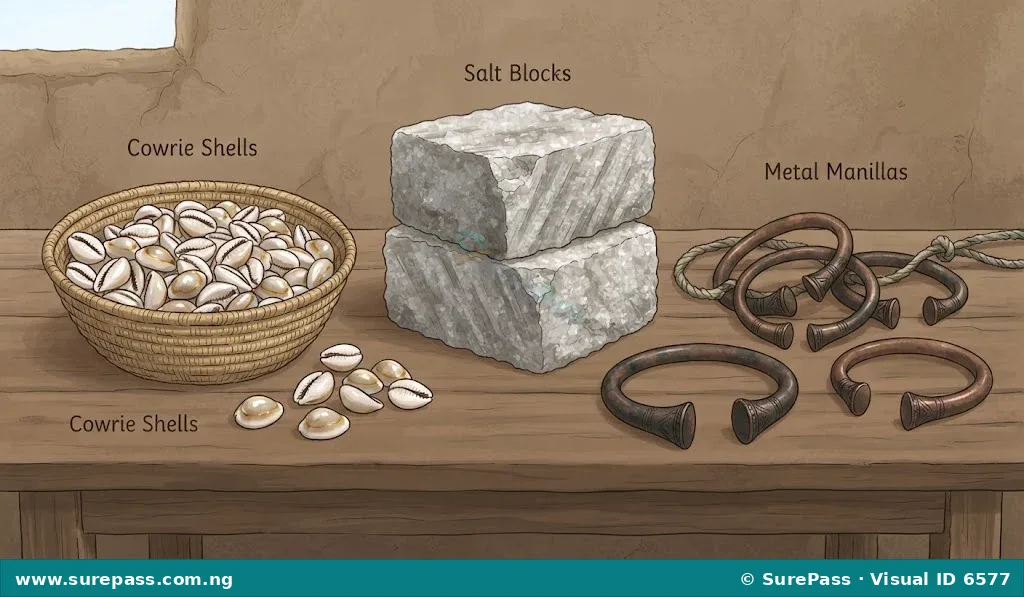
Cowrie shells and other items were once used as money. -
Metallic Money: As societies advanced, precious metals like gold, silver, and copper became popular forms of money. These metals were durable, portable, easily divisible, and had intrinsic value. They were often weighed or shaped into coins to ensure standard value.
-
Paper Money: The use of paper money, or banknotes, emerged as a more convenient and secure way to carry large sums of money. Initially, paper money represented a promise to pay a certain amount of gold or silver held in a bank. Today, most paper money is “fiat money,” meaning its value comes from government decree and public trust, rather than being backed by a physical commodity.
-
Modern Money: In addition to paper money and coins, modern money includes digital forms such as funds held in bank accounts, debit cards, credit cards, and mobile money. These forms allow for quick and secure transactions without the need for physical cash.
Uses of Money
Money serves several important functions in an economy. These functions make it an essential tool for daily life and business transactions:
-
Medium of Exchange: This is the primary use of money. It means money is accepted by everyone in exchange for goods and services. Instead of trading yams for clothes, a farmer sells yams for money and then uses that money to buy clothes. This eliminates the need for a double coincidence of wants found in barter.
-
Measure of Value (Unit of Account): Money provides a common way to measure the value of different goods and services. For example, a bag of rice might cost N20,000, and a pair of shoes might cost N10,000. This allows people to compare the value of different items easily and make informed decisions about buying and selling.
-
Store of Value: Money allows people to save their wealth for future use. If you earn money today, you can keep it and use it to buy goods or services tomorrow, next week, or even next year. It holds its value over time, though its purchasing power can be affected by inflation.
-
Standard of Deferred Payment: Money can be used to settle future debts or payments. This means that if you borrow money today, you can pay it back with money in the future. This function is crucial for loans, credit, and long-term contracts, as it provides a stable unit for future financial obligations.
Saving Money
Meaning of Saving Money
Saving money means setting aside a portion of your income or earnings instead of spending it immediately. It involves putting money away for future use, whether for planned expenses, emergencies, or long-term goals.
Importance of Saving Money
Saving money is a crucial habit for individuals and families. It provides financial security and helps achieve various goals. The importance of saving money includes:
-
For Emergencies: Unexpected events like illness, job loss, or urgent repairs can arise. Savings provide a safety net to cover these costs without going into debt.
-
To Achieve Future Goals: Saving helps in achieving specific goals such as paying for education, buying a house, starting a business, or purchasing expensive items like a car or land.
-
For Investment: Saved money can be invested to earn more money. Investments can include starting a small business, buying shares, or putting money into fixed deposits that yield interest.
-
Financial Security and Independence: Having savings reduces financial stress and provides a sense of security. It allows individuals to make choices without being entirely dependent on immediate income.
-
Retirement Planning: For adults, saving throughout their working lives ensures they have enough money to live comfortably after they stop working.
Methods of Saving Money
There are various ways to save money, ranging from simple home methods to more formal financial institutions. Common methods of saving money include:
-
Piggy Banks (Kolo): This is a traditional and simple method, especially for children and small amounts. Money is kept in a container at home. While convenient, it offers no interest and can be easily accessed.
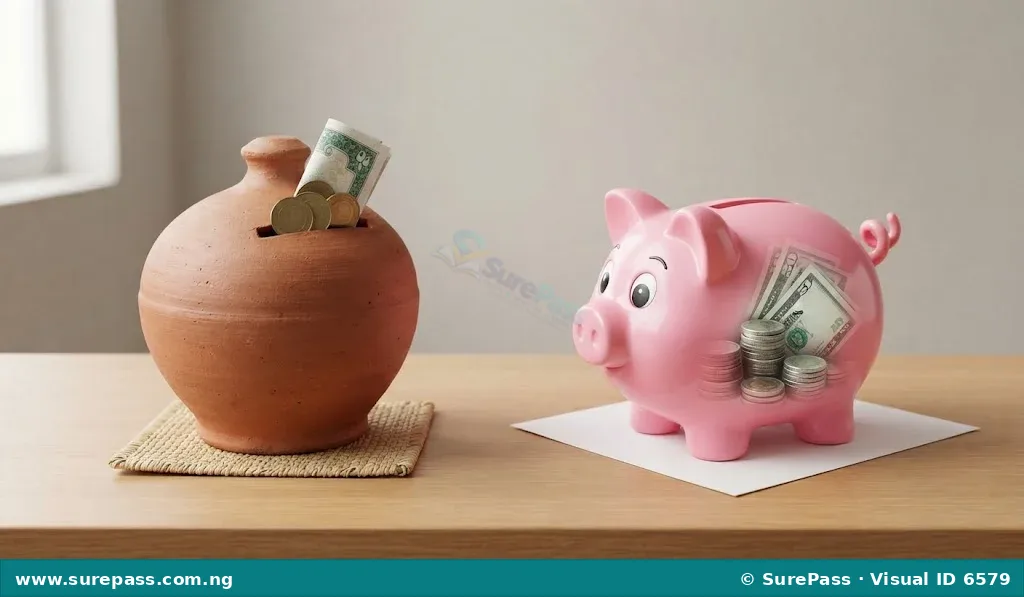
Piggy banks are common tools for saving money at home. -
Bank Accounts: Opening a savings account at a commercial bank is a secure and formal way to save. Banks offer interest on savings, and the money is protected. It also allows for easy deposits and withdrawals.
-
Cooperative Societies (Thrift/Ajo/Esusu): These are informal or semi-formal groups where members regularly contribute a fixed amount of money. The collected sum is then given to each member in rotation, or saved collectively for a common purpose. This method encourages discipline in saving.
-
Fixed Deposits: This involves depositing a lump sum of money in a bank for a fixed period (e.g., 6 months, 1 year) at a higher interest rate. The money cannot be withdrawn before the period ends without penalty.
-
Investment Schemes: For larger savings, people can invest in government bonds, mutual funds, or other financial instruments that offer potentially higher returns, though they may also carry more risk.
Sources of Funding for Textiles Production Start-up
A “start-up” refers to a newly established business, often small, that is in its initial stages of operation. For a textiles production start-up, funding is needed to buy materials, equipment, pay for labour, and cover other initial expenses. The initial capital for such a venture often comes from sources close to the entrepreneur.
The primary sources of funding for a textiles production start-up at this level typically include:
-
Personal Sources: These are funds that the entrepreneur themselves provides. This shows commitment and reduces reliance on external parties. Examples of personal sources include:
-
Personal Savings: Money the entrepreneur has saved over time from their income or allowances.
-
Sale of Personal Assets: Selling personal belongings that are no longer needed, such as old electronics, jewellery, or other valuable items, to raise capital.
-
Inheritance: Money or assets received from a deceased relative.
-
-
Family Sources: Family members are often the first point of contact for financial support for a new business. They are usually more willing to help and may offer more flexible terms than formal lenders. Examples of family sources include:
-
Loans from Family Members: Borrowing money from parents, siblings, or other relatives, often with little or no interest and flexible repayment schedules.
-
Gifts from Family Members: Money given by family members without the expectation of repayment, often as a show of support for the business idea.
-
Creating a Savings Card
A savings card is a simple tool used to track and record money saved. It helps to visualise progress towards a savings goal and encourages consistency. Creating a savings card involves the following steps:
-
Gather Materials: Collect a piece of cardboard paper (or thick paper), a ruler, a pencil, an eraser, and coloured pens or markers.
-
Design the Card Layout:
-
Decide on the size of your card. A standard A5 size (half of an A4 sheet) is usually convenient.
-
At the top, write “My Savings Card” or “Savings Tracker”.
-
Below the title, create a space to write your “Savings Goal” (e.g., N5,000 for a new textbook, N10,000 for a sewing machine).
-
Draw a table with columns for “Date”, “Amount Saved”, and “New Total”. You can also add a column for “Remarks” or “Source of Money”.
-
Ensure there are enough rows for multiple savings entries.
-
-
Decorate the Card: Use coloured pens, markers, or stickers to make your savings card attractive and motivating. You can draw pictures related to your savings goal.
-
Review and Prepare: Check that all headings are clear and the table is neatly drawn. Your savings card is now ready for use.
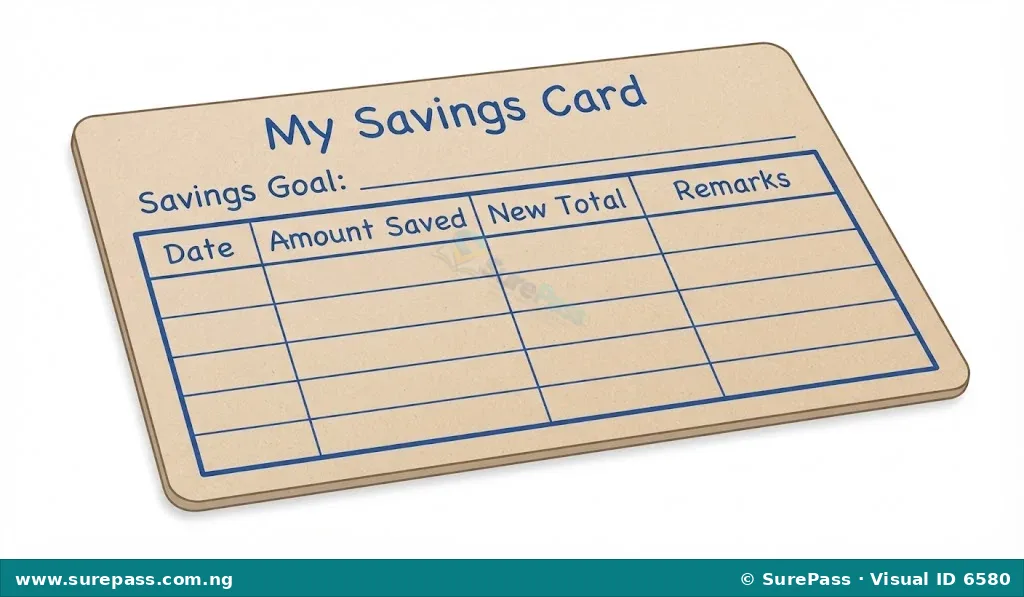
Demonstrating How to Carefully Record Savings
Recording savings accurately is essential for tracking progress and managing money effectively. The procedure involves the following steps:
-
Identify the Savings: Each time you save money, note the exact amount. This could be from your allowance, money earned from chores, or a gift.
-
Note the Date: Look at the current date. This helps you track when you made each saving.
-
Locate Your Savings Card: Keep your savings card in a safe and easily accessible place.
-
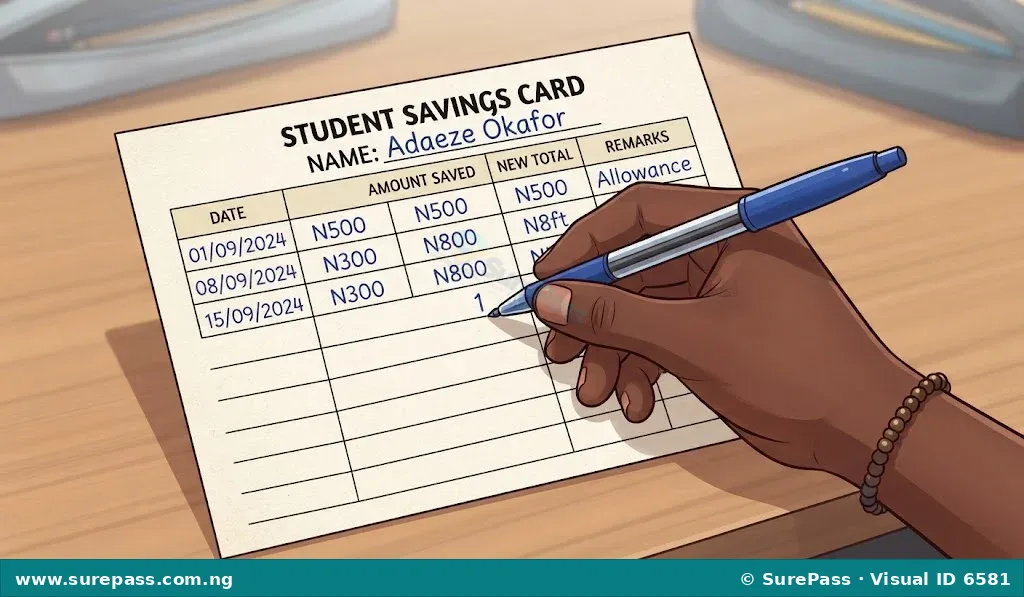
Fill in the “Date” Column: Write the current date in the first empty row of the “Date” column.
-
Fill in the “Amount Saved” Column: Write the exact amount of money you are saving in the “Amount Saved” column for that date.
-
Calculate the “New Total”: Add the “Amount Saved” to your previous total savings. If this is your first saving, the “New Total” will be the “Amount Saved”. Write this new total in the “New Total” column.
-
Add “Remarks” (Optional): In the “Remarks” column, you can briefly note where the money came from (e.g., “Allowance,” “Gift from Aunty,” “From selling crafts”).
-
Store the Card Safely: After recording, return your savings card to its safe place. Regularly review your card to see your progress.




0 comments
Open the discussion when you need it. Comments stay collapsed until requested so the initial article remains light.