



ARTICLE CONTENTSOn this page 7 sections
Record Keeping in the Home-based Business
Performance Objectives
By the end of the lesson, students should be able to:
- describe the meaning and importance of record keeping;
- state and discuss different types of record keeping in home;
- describe ways of keeping record and how to prepare a record book for home- based business.
Meaning of Record Keeping
Record keeping is the process of systematically documenting and storing information about the activities and transactions of a business or household.
For a home-based business, record keeping involves writing down or digitally storing details of sales, purchases, expenses, and other financial activities. This practice helps the business owner to track how money is being earned and spent.
Importance of Record Keeping for Home-Based Businesses
Keeping accurate records is crucial for the success and smooth operation of any home-based business. It provides clear insights into the business’s financial health and helps in making informed decisions.
The importance of record keeping includes:
- Tracking Income and Expenses: Records show how much money the business is making (income) and how much it is spending (expenses). This helps in understanding profitability.
- Monitoring Business Performance: By regularly checking records, a business owner can see if sales are increasing or decreasing, and identify areas where costs can be reduced.
- Making Informed Decisions: Accurate records provide data that helps in planning for the future, such as deciding whether to expand, introduce new products, or adjust prices.
- Meeting Tax Obligations: In some cases, even small home-based businesses may need to report their income and expenses for tax purposes. Good records simplify this process.
- Applying for Loans or Grants: If a business needs financial assistance, lenders or grant providers often require detailed financial records to assess the business’s viability.
- Resolving Disputes: Clear records can serve as evidence in case of disagreements with customers, suppliers, or partners.
- Budgeting and Financial Planning: Records help in creating a realistic budget and planning for future financial needs and goals of the business.
Types of Record Keeping in the Home-Based Business
Different types of records are kept to capture various aspects of a home-based business’s operations. These records help to provide a complete financial picture.
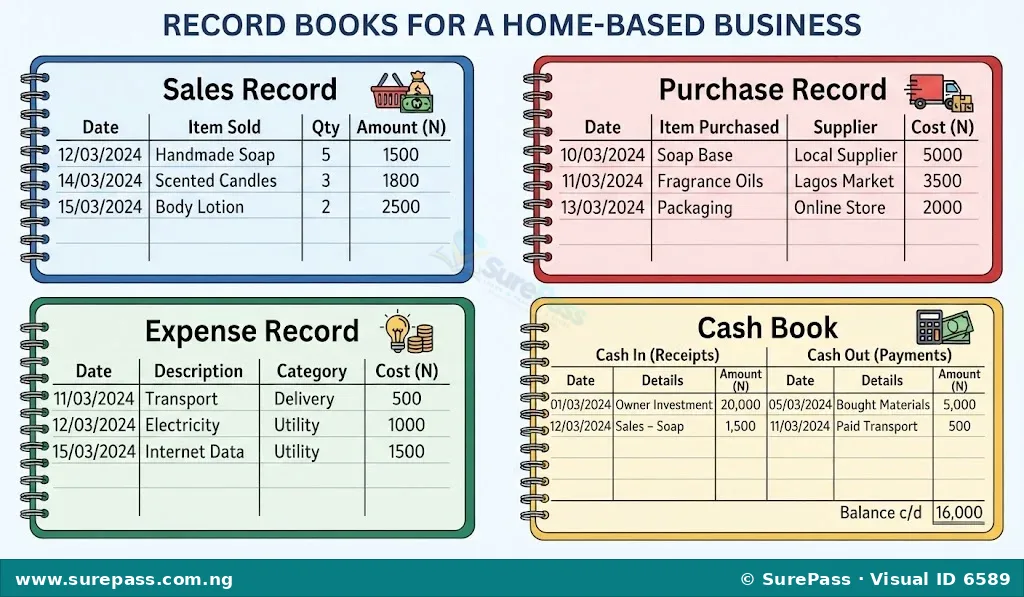
Common types of record keeping for home-based businesses include:
- Sales Record: This record tracks all the money received from selling goods or services. It includes details such as the date of sale, item sold, quantity, price, and customer information.
- Purchase Record: This record documents all items bought for the business, such as raw materials, supplies, or goods for resale. It includes the date of purchase, item bought, quantity, cost, and supplier details.
- Expense Record: This record lists all the money spent on operating the business, apart from purchases for resale. Examples include transport costs, utility bills (if a portion is for business), advertising costs, and packaging materials.
- Cash Book: A cash book records all cash inflows (money coming in) and cash outflows (money going out) of the business. It helps to keep track of the cash balance at any given time.
- Inventory Record: For businesses that sell physical products, an inventory record tracks the quantity of goods available for sale. It helps to know what products are in stock, what needs to be reordered, and to prevent loss.
- Asset Register: This record lists all valuable items owned by the business that are used for a long time, such as equipment, furniture, or tools. It includes details like purchase date, cost, and estimated lifespan.
Ways of Keeping Records
Records can be kept using various methods, depending on the size and complexity of the home-based business, as well as the owner’s preference and available resources.
The common ways of keeping records include:
- Manual Record Keeping: This involves using physical notebooks, ledgers, or specially designed record books. Entries are written by hand. This method is simple and suitable for very small businesses with few transactions.
- Digital Record Keeping: This involves using electronic tools such as computer spreadsheets (e.g., Microsoft Excel, Google Sheets), accounting software, or mobile applications. Digital records offer advantages like easy calculation, data backup, and quick retrieval of information.
- Filing System: For physical documents like receipts, invoices, and bank statements, a systematic filing system (e.g., folders, binders) is essential. These physical documents support the entries made in manual or digital records.
How to Prepare a Record Book for a Home-Based Business
Preparing a record book involves setting up a structured way to capture all necessary business transactions. This section focuses on preparing a simple manual record book, which is a foundational skill.
Preparing a Sales Record Book
A sales record book helps to track all income generated from sales. It can be a simple exercise book or a specially ruled ledger.
The procedure involves the following steps:
- Choose a Notebook: Select a sturdy notebook or exercise book that will be dedicated solely to sales records.
- Label the Book: Write “SALES RECORD BOOK” clearly on the cover and the first page. Include the name of your business and the period it covers (e.g., “January – December 2024”).
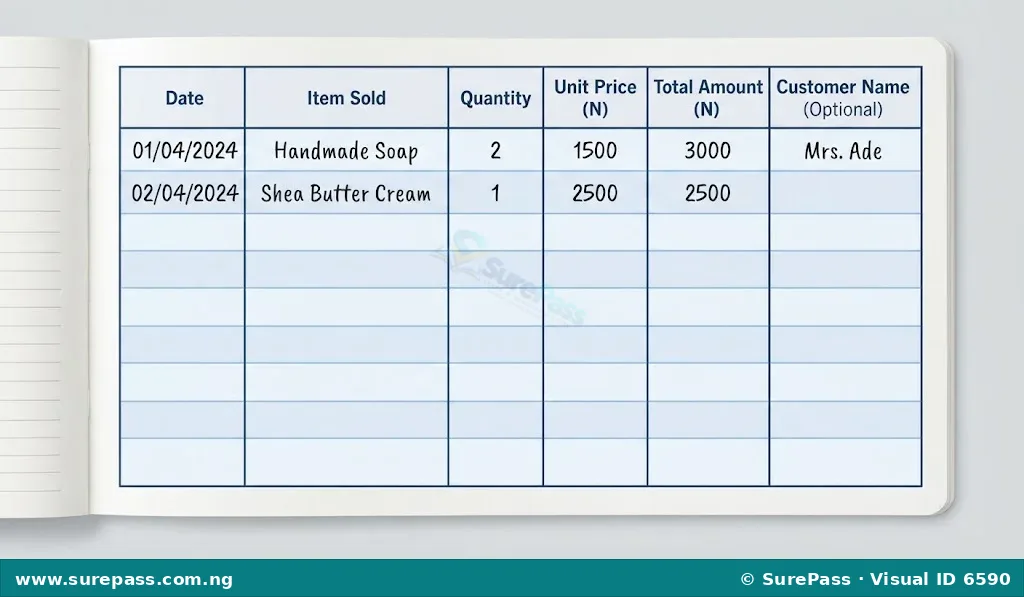
- Create Columns: On each page, draw clear columns with the following headings:
- Date: For the date of the sale.
- Item Sold: For a description of the product or service sold.
- Quantity: For the number of items sold.
- Unit Price (N): For the price of one item.
- Total Amount (N): For the total money received for that sale (Quantity x Unit Price).
- Customer Name (Optional): For the name of the customer, if desired.
- Make Entries: Each time a sale is made, record the details accurately in the appropriate columns.
- Calculate Totals: At the end of each day, week, or month, sum up the “Total Amount (N)” column to find the total sales for that period.
Preparing a Purchase Record Book
A purchase record book helps to track all expenses related to buying goods or materials for the business.
The procedure involves the following steps:
- Choose a Notebook: Use another dedicated notebook for purchase records.
- Label the Book: Write “PURCHASE RECORD BOOK” clearly on the cover and the first page, along with the business name and period.
- Create Columns: Draw columns with the following headings:
- Date: For the date of the purchase.
- Item Purchased: For a description of the item or material bought.
- Quantity: For the number of items purchased.
- Unit Cost (N): For the cost of one item.
- Total Cost (N): For the total money spent on that purchase (Quantity x Unit Cost).
- Supplier Name (Optional): For the name of the supplier.
- Make Entries: Record details of every purchase accurately.
- Calculate Totals: Sum up the “Total Cost (N)” column periodically to know the total purchases for a specific period.
Preparing an Expense Record Book
An expense record book tracks all other operational costs of the business that are not direct purchases for resale.
The procedure involves the following steps:
- Choose a Notebook: Dedicate a separate notebook for expense records.
- Label the Book: Clearly label it “EXPENSE RECORD BOOK” with business name and period.
- Create Columns: Draw columns with the following headings:
- Date: For the date the expense was incurred.
- Description of Expense: For a clear explanation of what the money was spent on (e.g., “Transport fare to market,” “Electricity bill,” “Packaging materials”).
- Amount (N): For the total money spent on that expense.
- Make Entries: Record every business expense as it occurs.
- Calculate Totals: Sum up the “Amount (N)” column regularly to track total expenses.




0 comments
Open the discussion when you need it. Comments stay collapsed until requested so the initial article remains light.