


ARTICLE CONTENTSOn this page 9 sections
Family life Cycle
Performance Objectives
By the end of the lesson, students should be able to:
- explain the meaning and types of family life cycle;
- identify different stages of the family life cycle;
- create a visual representation of the family life cycle, clearly showing the stages and key transitions;
- outline ways of managing family problems;
- create a family tree for their own families to see how different generations have gone through different stages of the family life cycle.
Meaning of the Family Life Cycle
The family life cycle is the series of developmental stages that a family passes through from its establishment by marriage to its eventual dissolution.
Just as an individual grows from infancy to old age, a family also experiences a predictable sequence of growth, change, and contraction over time. Understanding this cycle helps families plan for future needs, manage resources effectively, and prepare for the challenges associated with each stage.
Types of Family Life Cycle
The pattern of family development can vary based on structure, cultural practices, and life choices. The two main types of family life cycles are:
- The Traditional Family Life Cycle: This is the standard sequence that begins with marriage, progresses through childbearing and child-rearing, and ends with the departure of children and the eventual death of the spouses.
- The Alternative Family Life Cycle: This refers to variations that do not follow the traditional sequence. Examples include single-parent family cycles, childless family cycles, and blended family cycles resulting from remarriage.
Stages of the Family Life Cycle
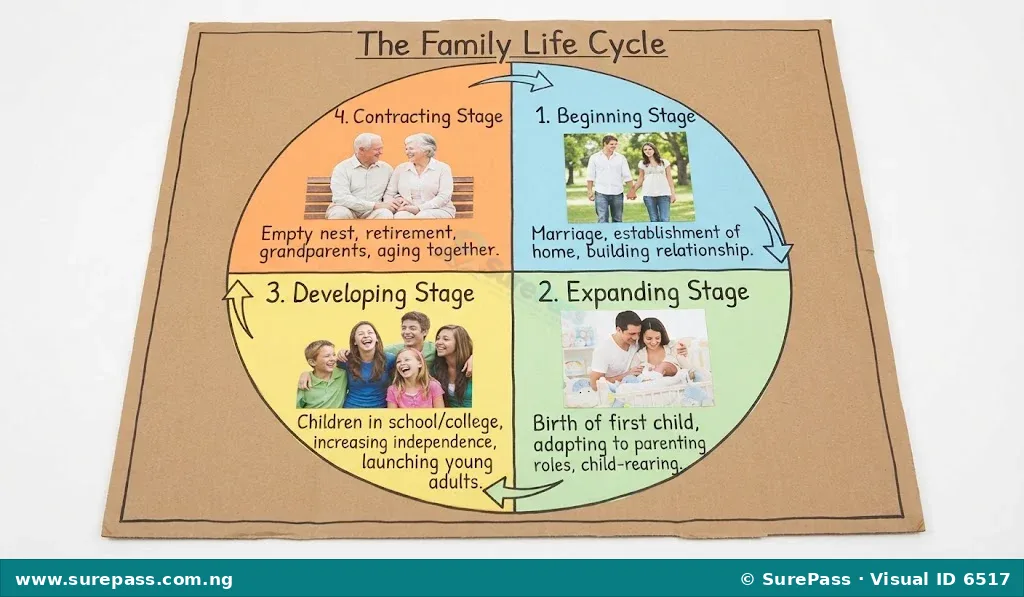
The family life cycle is divided into four distinct stages. Each stage is characterized by changes in family size, roles, and responsibilities.
The four stages of the family life cycle are:
- The Beginning Stage (Establishment Phase): This stage starts with the marriage of two individuals. The primary focus is on mutual adjustment, establishing a home, and planning for the future. Family size is small, consisting of only the husband and wife.
- The Expanding Stage (Childbearing Phase): This stage begins with the birth of the first child and continues until the last child is born. Family size increases, and roles shift from being just spouses to becoming parents. Responsibilities focus heavily on physical care, feeding, and health of young children.
- The Developing Stage (School-Age and Adolescent Phase): This stage spans the period when children are in primary, secondary, and tertiary institutions. Family size remains stable, but the responsibilities shift from basic physical care to socialization, education, and moral guidance. Parents must support children as they seek independence.
- The Contracting Stage (Launching and Retirement Phase): This stage begins when the first child leaves home for independent living, marriage, or employment, and ends with the death of both spouses. Family size decreases. The parents experience the “empty nest” phase and eventually adjust to retirement and aging.
Characteristics and Problems of Each Stage
Each stage of the family life cycle presents unique characteristics and specific challenges that require careful management.
1. The Beginning Stage
The main characteristics of the beginning stage include:
- The family consists of only two members (husband and wife).
- Both partners are usually at the early stages of their careers.
- There is a high level of flexibility in time and financial resources.
Common problems in the beginning stage include:
- Adjustment Challenges: Difficulties in adapting to each other’s habits, values, and temperaments.
- Financial Strain: High initial expenses for renting or buying a house, purchasing furniture, and setting up the home.
- Extended Family Interference: Pressure or interference from in-laws and relatives, which can cause conflict between the couple.
2. The Expanding Stage
The main characteristics of the expanding stage include:
- Family size increases with the arrival of children.
- Parents experience a significant reduction in personal leisure time.
- Physical demands, such as sleepless nights and constant childcare, are very high.
Common problems in the expanding stage include:
- Physical Fatigue: Exhaustion from balancing career demands with the intensive care required by infants and toddlers.
- Increased Expenditure: Rising costs for baby food, clothing, medical care, and immunization.
- Role Conflict: Difficulty in balancing professional responsibilities with parental duties.
3. The Developing Stage
The main characteristics of the developing stage include:
- Children are growing rapidly and attending school.
- The family reaches its peak level of financial expenditure.
- Children begin to develop independent personalities and peer relationships.
Common problems in the developing stage include:
- High Educational Costs: Heavy financial burden from school fees, books, uniforms, and transportation.
- Peer Pressure: Children may be influenced by negative peer groups, leading to behavioral issues or academic decline.
- Communication Gaps: Conflicts between parents and adolescents as teenagers seek more independence and autonomy.
4. The Contracting Stage
The main characteristics of the contracting stage include:
- Children leave home to start their own lives, reducing the household size.
- Parents transition into retirement and experience a decline in physical strength.
- The home environment becomes quiet again, often referred to as the empty nest.
Common problems in the contracting stage include:
- Loneliness and Depression: Emotional distress felt by parents due to the departure of children.
- Reduced Income: A drop in financial resources following retirement from active employment.
- Health Challenges: Increased vulnerability to chronic illnesses and age-related physical decline.
Influence of the Family Life Cycle on Resource Management
The stage of the family life cycle directly influences how family resources (such as time, energy, money, and skills) are managed and how decisions are made.
The table below outlines how resource management and decision-making shift across the stages:
| Stage | Financial Management Focus | Time and Energy Allocation | Key Decision-Making Areas |
|---|---|---|---|
| Beginning | Savings, purchasing household assets, and career establishment. | High availability of personal time; energy is focused on career and relationship building. | Housing location, career paths, and family planning. |
| Expanding | Budgeting for healthcare, baby supplies, and early childcare. | Time and energy are heavily consumed by physical childcare and domestic chores. | Childcare arrangements, division of domestic labor, and healthcare choices. |
| Developing | Peak spending on school fees, clothing, feeding, and extracurricular activities. | Time is spent monitoring schoolwork, attending school events, and driving children to activities. | Choice of schools, career guidance for children, and managing adolescent behavior. |
| Contracting | Managing retirement funds, pension, and healthcare costs. | Abundant leisure time; physical energy is lower, requiring conservation. | Retirement lifestyle, medical treatments, and estate planning or inheritance. |
Ways of Managing Family Problems
Family problems are inevitable as a family transitions through different stages of the life cycle. However, effective management strategies can help maintain family stability and cohesion.
Effective ways of managing family problems include:
- Open and Honest Communication: Family members should express their feelings, needs, and concerns constructively without resorting to blame or anger.
- Financial Planning and Budgeting: Creating a realistic family budget helps prevent financial stress, especially during high-expenditure stages like the expanding and developing phases.
- Democratic Decision-Making: Involving family members in decisions, especially older children in the developing stage, fosters cooperation and reduces conflict.
- Sharing Responsibilities: Distributing household chores and caregiving tasks among family members prevents burnout and physical exhaustion.
- Seeking Professional Guidance: Families facing severe emotional, marital, or behavioral challenges should seek help from family counselors, religious leaders, or social workers.
- Flexibility and Adaptability: Family members must be willing to adjust their roles and expectations as the family transitions from one stage of the cycle to another.
Practical Activities
Practical activities help learners apply the concepts of the family life cycle to real-life situations and observe how families change over time.
How to Create a Visual Representation of the Family Life Cycle
This activity guides learners in creating a clear chart showing the stages and key transitions of the family life cycle.
The required materials are:
- A sheet of cardboard or drawing paper
- Colored markers or pencils
- A ruler
- Scissors and glue
- Pictures or drawings representing different family stages
The procedure involves the following steps:
- Draw a large circle in the center of the cardboard to represent the continuous nature of the cycle.
- Divide the circle into four equal segments, labeling them: Beginning Stage, Expanding Stage, Developing Stage, and Contracting Stage.
- Write the key characteristics and transitions next to each stage (for example, write “Transition: Birth of first child” between the Beginning and Expanding stages).
- Paste appropriate pictures or draw illustrations in each segment to represent the family members at that stage.
- Use arrows to show the direction of movement from one stage to the next.
How to Create a Family Tree
Creating a family tree helps learners trace their own families across generations and identify which stage of the family life cycle different relatives currently occupy.
The procedure involves the following steps:
- Write down the names of maternal and paternal grandparents at the top of a sheet of paper.
- Draw lines downward to represent their children (the learner’s parents, aunts, and uncles).
- Draw lines downward from the parents to represent the learner and siblings.
- Label each individual or household unit with their current stage in the family life cycle (for example, label grandparents as ‘Contracting Stage’ and a newly married uncle as ‘Beginning Stage’).
- Analyze the tree to observe how different generations are simultaneously experiencing different stages of the cycle.
Using Family Albums to Observe Family Changes
Family albums, charts, or posters can be used to observe how a single family changes in size, appearance, and roles over time.
The procedure involves the following steps:
- Gather old and recent family photographs from a family album.
- Arrange the photographs chronologically, starting from the wedding of the parents to the present day.
- Observe the physical changes in family members, the increase in family size as children are born, and the changes in clothing and activities.
- Identify which stage of the family life cycle is represented in each photograph.
- Discuss how roles and responsibilities changed as the family moved from one photograph’s era to the next.



0 comments
Open the discussion when you need it. Comments stay collapsed until requested so the initial article remains light.