


ARTICLE CONTENTSOn this page 7 sections
The Earth and the Solar System
Performance Objectives
By the end of the lesson, students should be able to:
- identify and draw different planets of the solar system;
- describe the size and shape of the earth;
- discuss the various proofs that the Earth is spherical;
- identify the position of the sun and other planets.
Introduction to the Solar System
The solar system is a vast collection of celestial bodies that are gravitationally bound to the Sun. It includes the Sun, eight planets, their moons, dwarf planets, asteroids, comets, and other smaller objects.
The Sun is the star at the centre of our solar system. It is a massive ball of hot gas that provides light and heat to all the planets. The planets orbit the Sun in elliptical paths, meaning their paths are oval-shaped rather than perfectly circular.
Planets of the Solar System
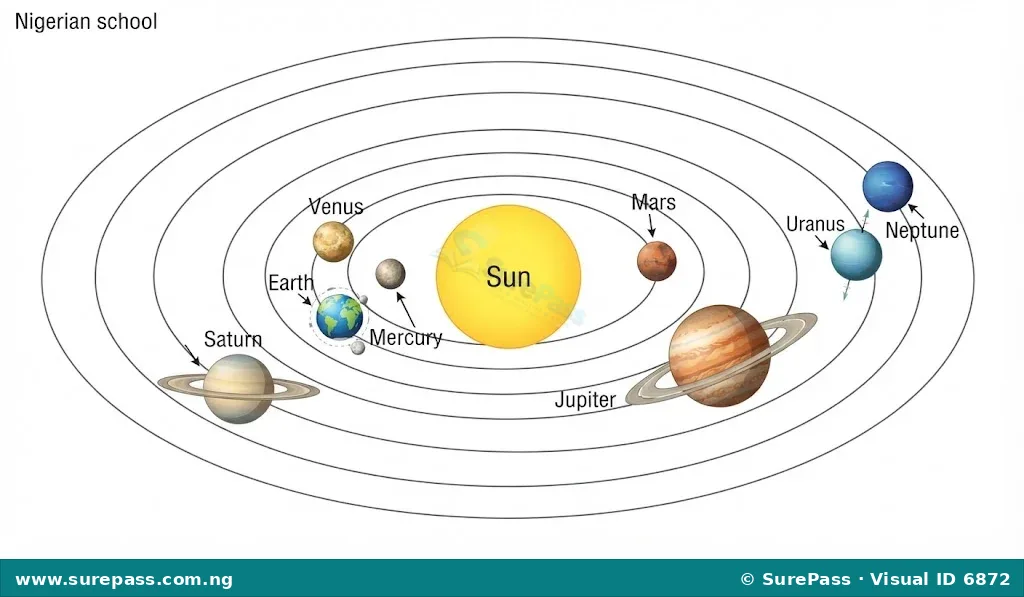
There are eight planets in our solar system, each with its own unique characteristics. They are listed in order of their distance from the Sun:
- Mercury: The smallest planet and closest to the Sun. It has a very hot surface during the day and extremely cold temperatures at night.
- Venus: Known as Earth’s “sister planet” due to its similar size, but it has a thick, toxic atmosphere and extremely high surface temperatures.
- Earth: Our home planet, unique for its abundant liquid water and ability to support life.
- Mars: Often called the “Red Planet” due to its reddish appearance. It has a thin atmosphere and polar ice caps.
- Jupiter: The largest planet in the solar system, a gas giant with a distinctive Great Red Spot, which is a giant storm.
- Saturn: Famous for its prominent system of rings, which are made of ice particles and rock fragments. It is also a gas giant.
- Uranus: An ice giant that rotates on its side, giving it a unique appearance. Its atmosphere contains methane, giving it a blue-green colour.
- Neptune: The farthest planet from the Sun, an ice giant known for its strong winds and cold, dark conditions.
The diagram below illustrates the planets of the solar system in their approximate order from the Sun.
The Earth: Size and Shape
The Earth is the third planet from the Sun and the only known celestial body to support life. Its size and shape are fundamental to understanding many geographical phenomena.
Size of the Earth
The Earth is a large planet, though not the largest in the solar system. Its equatorial diameter is approximately 12,756 kilometres, and its polar diameter is about 12,714 kilometres. This means the Earth is slightly wider at the equator than it is from pole to pole. The total surface area of the Earth is about 510 million square kilometres, with roughly 71% covered by water and 29% by land.
Shape of the Earth
The Earth’s shape is often described as a sphere or, more accurately, an oblate spheroid or geoid. An oblate spheroid is a sphere that is slightly flattened at the poles and bulges at the equator. This slight bulge is caused by the Earth’s rotation. While it is not a perfect sphere, for most geographical studies, it is considered spherical.
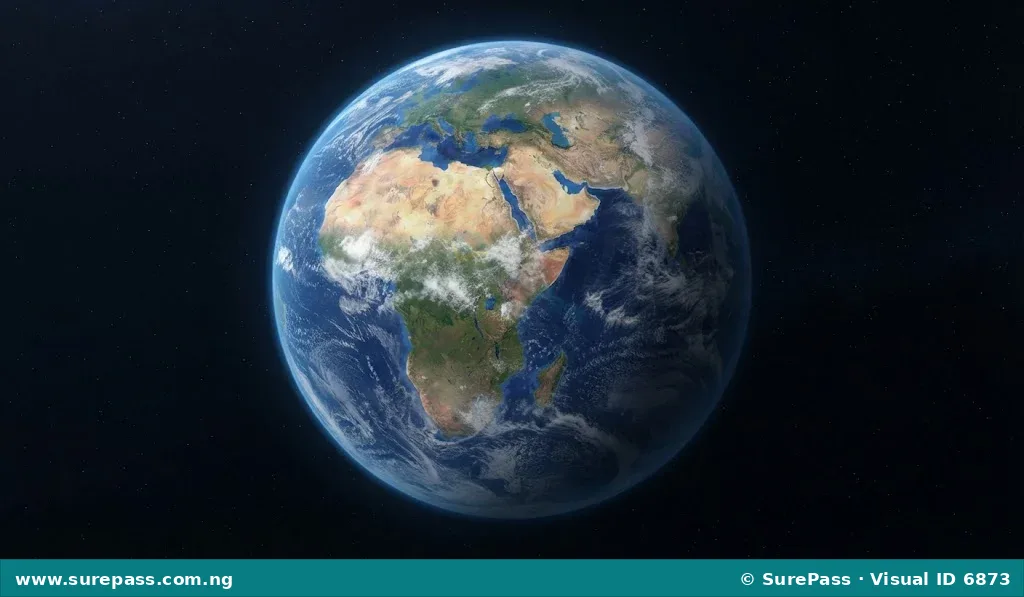
Observe the image below, which shows the Earth from space, highlighting its spherical appearance.
Proofs that the Earth is Spherical
For centuries, people debated the true shape of the Earth. Today, there is overwhelming evidence that the Earth is spherical. The various proofs include:
- Circumnavigation of the Earth: Explorers like Ferdinand Magellan proved that it is possible to travel continuously in one direction and return to the starting point. This would not be possible if the Earth were flat.
- Ship’s Visibility: When a ship sails away from an observer, its hull disappears first, followed by its mast. Similarly, when a ship approaches, its mast becomes visible before its hull. This phenomenon can only be explained by the curvature of the Earth’s surface.
- Lunar Eclipse: During a lunar eclipse, the Earth passes directly between the Sun and the Moon, casting a shadow on the Moon. This shadow is always circular, regardless of the Earth’s orientation. Only a spherical object can consistently cast a circular shadow.
- Sunrise and Sunset at Different Times: The Sun rises and sets at different times in different parts of the world. For example, when it is sunrise in Lagos, it is still night in London. This is because the spherical Earth rotates, causing different parts of its surface to be illuminated by the Sun at different times.
- Photographs from Space: Modern technology, including satellites and space missions, has provided countless photographs and videos of the Earth from space. These images clearly show the Earth as a sphere.
- Horizon Appears Curved: When observed from a high altitude, such as from an aeroplane or a tall building, the horizon appears curved. This curvature is a direct result of the Earth’s spherical shape.
Position of the Sun and Other Planets
The Sun is the central and most massive object in our solar system. All the planets, including Earth, revolve around the Sun. The Sun’s immense gravitational pull keeps the planets in their orbits.
The planets are arranged in a specific order based on their average distance from the Sun. This order is:
- Mercury (closest to the Sun)
- Venus
- Earth
- Mars
- Jupiter
- Saturn
- Uranus
- Neptune (farthest from the Sun)
Each planet follows its own distinct orbital path around the Sun. The inner planets (Mercury, Venus, Earth, Mars) are relatively small and rocky, while the outer planets (Jupiter, Saturn, Uranus, Neptune) are much larger gas or ice giants. This arrangement and the continuous motion of the planets around the Sun define the structure and dynamics of our solar system.



0 comments
Open the discussion when you need it. Comments stay collapsed until requested so the initial article remains light.