


ARTICLE CONTENTSOn this page 6 sections
Rotation and Revolution of the Earth
Performance Objectives
By the end of the lesson, students should be able to:
- explain Earth’s rotation and revolution;
- identify the effects of Earth’s rotation;
- identify the effects of Earth’s revolution.
The Earth is constantly in motion, performing two main types of movement: rotation and revolution. These movements are fundamental to understanding many natural phenomena observed on our planet, such as day and night, time differences, and the changing seasons.
Meaning of Earth’s Rotation
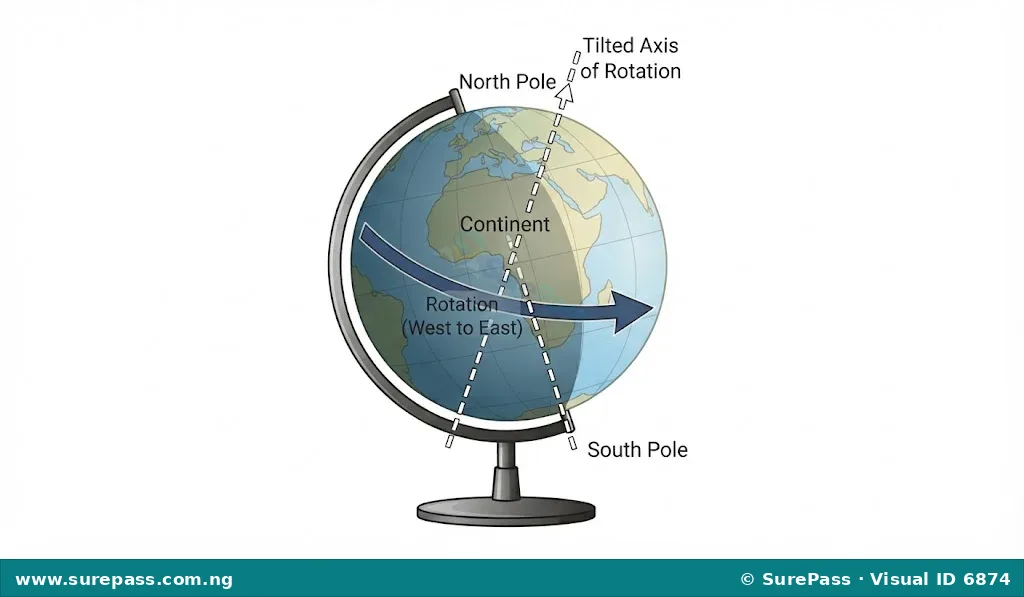
Earth’s rotation is the spinning of the Earth on its own axis.
The Earth’s axis is an imaginary line passing through the North Pole, the centre of the Earth, and the South Pole. The Earth rotates from west to east, completing one full rotation in approximately 24 hours. This period is what defines one day.
Effects of Earth’s Rotation
The rotation of the Earth has several important effects that directly influence life on our planet. These effects include the occurrence of day and night and the creation of time differences across the globe.
Day and Night
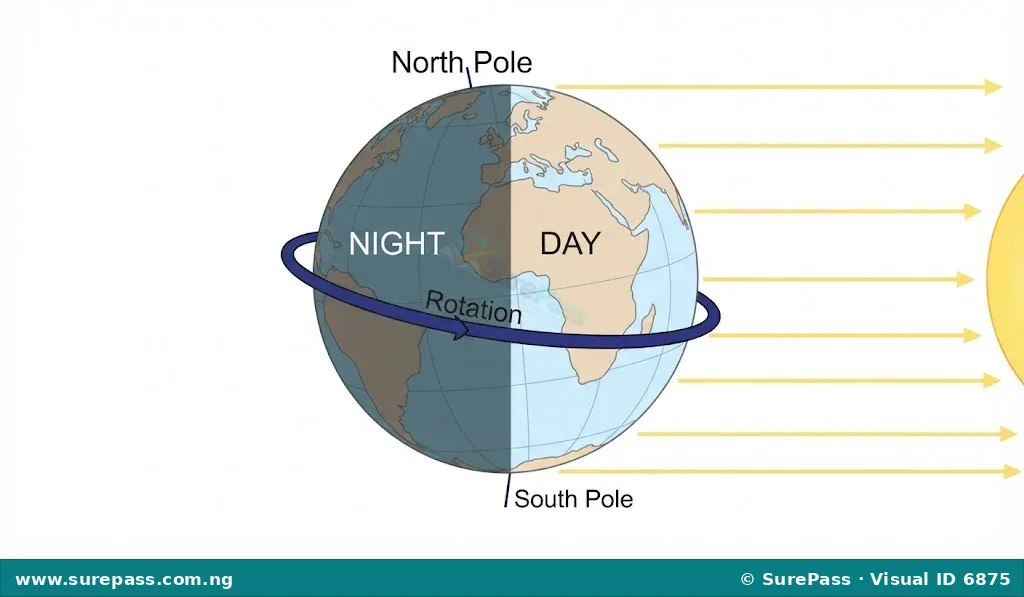
The most noticeable effect of Earth’s rotation is the regular cycle of day and night.
As the Earth rotates, only one half of the planet faces the Sun at any given time. This half receives sunlight and experiences day. The other half, which is turned away from the Sun, is in darkness and experiences night. As the Earth continuously spins, different parts of its surface are exposed to the Sun’s rays, causing the transition from day to night and back again.
Imagine holding a globe and shining a flashlight on it. Only the part of the globe illuminated by the flashlight experiences “day,” while the other side is in “night.” As you slowly spin the globe, different areas move into and out of the light, simulating the cycle of day and night on Earth.
Time Difference
Earth’s rotation also causes differences in time across various locations on the planet.
Since the Earth rotates from west to east, places to the east experience sunrise earlier than places to the west. To manage these time differences, the world is divided into 24 time zones, each approximately 15 degrees of longitude wide. This is because the Earth completes a 360-degree rotation in 24 hours, meaning it rotates 15 degrees every hour (360 degrees / 24 hours = 15 degrees/hour).
The reference point for global time is the Prime Meridian, which passes through Greenwich, London, and is known as Greenwich Mean Time (GMT). As one moves east from the Prime Meridian, time increases by one hour for every 15 degrees of longitude. Conversely, as one moves west, time decreases by one hour for every 15 degrees of longitude.
Meaning of Earth’s Revolution
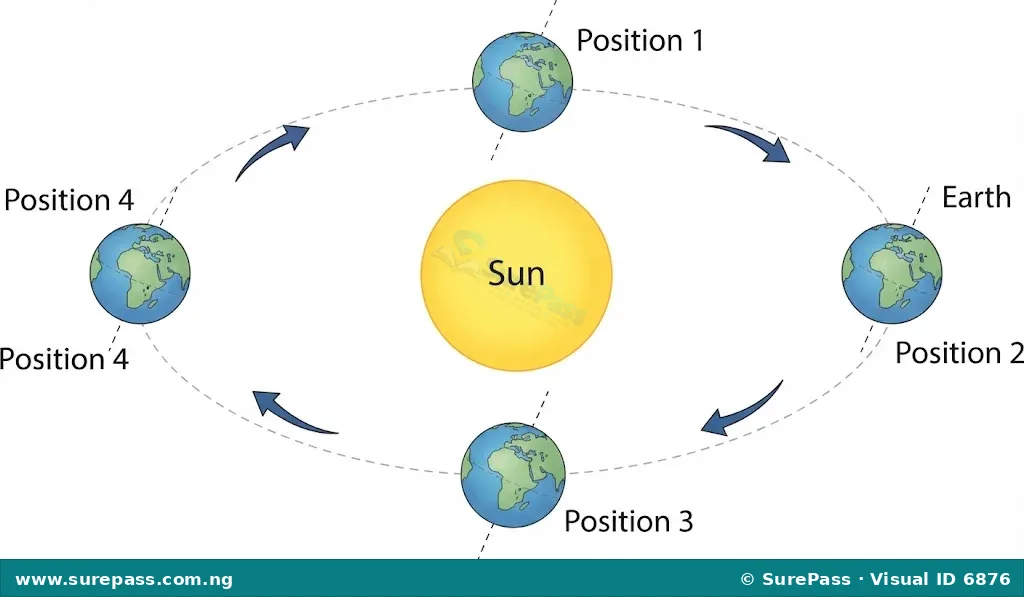
Earth’s revolution is the movement of the Earth in an orbit around the Sun.
The Earth travels in an elliptical (oval-shaped) path around the Sun. One complete revolution takes approximately 365 and a quarter days, which is what defines one year. This extra quarter day accumulates over four years, resulting in a leap year with 366 days (February having 29 days instead of 28).
Effects of Earth’s Revolution
The revolution of the Earth around the Sun, combined with the tilt of its axis, is responsible for several significant phenomena, most notably the changing seasons, equinoxes, and solstices.
Seasons
The most prominent effect of Earth’s revolution and the tilt of its axis is the occurrence of seasons.
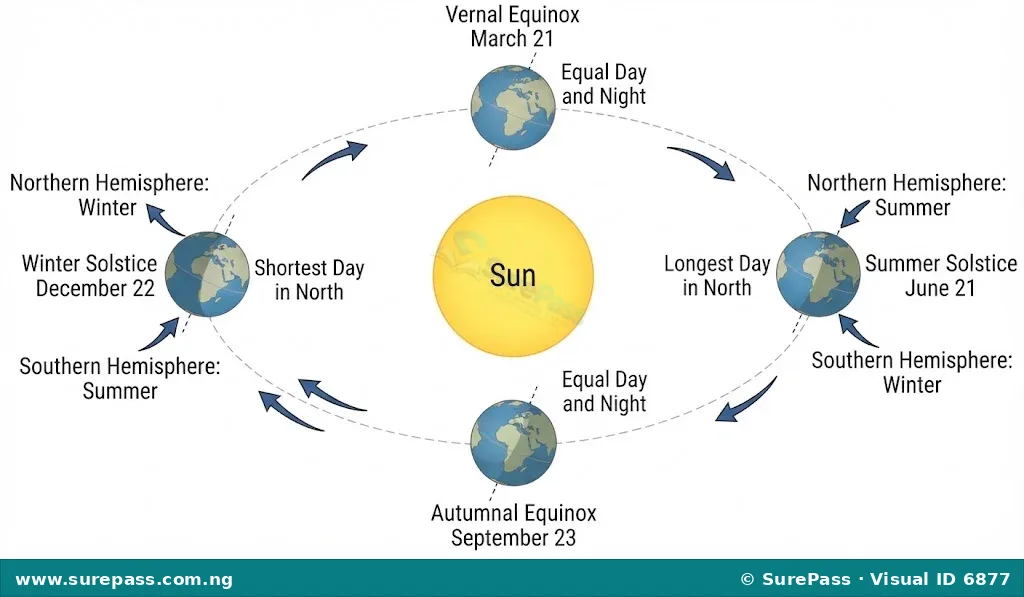
The Earth’s axis is tilted at an angle of approximately 23.5 degrees relative to its orbit around the Sun. As the Earth revolves, different parts of the planet receive more direct sunlight at different times of the year. When a hemisphere is tilted towards the Sun, it receives more direct rays and experiences summer. When it is tilted away, it receives less direct rays and experiences winter.
The four main seasons are:
- Summer: Characterised by longer days, shorter nights, and warmer temperatures. The hemisphere tilted towards the Sun experiences summer.
- Winter: Characterised by shorter days, longer nights, and colder temperatures. The hemisphere tilted away from the Sun experiences winter.
- Spring: A transitional season between winter and summer, with increasing daylight hours and warming temperatures.
- Autumn (Fall): A transitional season between summer and winter, with decreasing daylight hours and cooling temperatures.
Equinoxes
Equinoxes are periods when the Sun’s rays are directly overhead at the Equator, resulting in approximately equal hours of daylight and darkness across most parts of the Earth.
There are two equinoxes each year:
- Vernal (Spring) Equinox: Occurs around March 20th or 21st, marking the beginning of spring in the Northern Hemisphere and autumn in the Southern Hemisphere.
- Autumnal Equinox: Occurs around September 22nd or 23rd, marking the beginning of autumn in the Northern Hemisphere and spring in the Southern Hemisphere.
Solstices
Solstices are periods when the Sun’s rays are directly overhead at either the Tropic of Cancer or the Tropic of Capricorn, leading to the longest or shortest day of the year.
There are two solstices each year:
- Summer Solstice: Occurs around June 20th or 21st. The Northern Hemisphere is tilted most directly towards the Sun, experiencing its longest day and the start of summer. The Southern Hemisphere experiences its shortest day and the start of winter.
- Winter Solstice: Occurs around December 21st or 22nd. The Southern Hemisphere is tilted most directly towards the Sun, experiencing its longest day and the start of summer. The Northern Hemisphere experiences its shortest day and the start of winter.




0 comments
Open the discussion when you need it. Comments stay collapsed until requested so the initial article remains light.