



ARTICLE CONTENTSOn this page 11 sections
Business Ideas and Opportunities
Performance Objectives
By the end of the lesson, students should be able to:
- explain the meanings of business ideas, business opportunities and gainful activities in beauty and cosmetology;
- identify sources of business ideas, opportunities and gainful activities in beauty and cosmetology.
Meanings of Key Concepts in Cosmetology Business
The beauty and cosmetology industry is a dynamic sector that offers numerous pathways for financial independence and career growth. To successfully navigate this industry, a clear understanding of foundational entrepreneurial concepts is required. These concepts include business ideas, business opportunities and gainful activities.
Meaning of Business Idea
A business idea is a concept or thought that can be used to start a commercial enterprise for financial gain.
In cosmetology, a business idea represents the initial creative thought about a product or service that can be offered to solve a beauty-related problem. For example, a person might think of starting a mobile makeup service for brides, producing organic hair oils for natural hair growth, or opening a specialized nail salon in a community. At this stage, the concept is still theoretical and has not yet been tested for market viability.
Meaning of Business Opportunity
A business opportunity is a proven or viable commercial idea that has been analyzed and found to have a high chance of success in a specific market.
An idea becomes an opportunity only when there is a demonstrated demand for it, a target audience willing to pay for it, and a clear path to profitability. For instance, if a cosmetologist notices that there are no salons offering specialized natural hair care in a newly developed residential estate with many families, that gap in the market represents a genuine business opportunity. The cosmetologist can confidently invest resources because the demand is real.
Meaning of Gainful Activities
Gainful activities are productive tasks, jobs or services that generate income or financial rewards for the person performing them.
In the context of beauty and cosmetology, gainful activities are the actual daily operations, services or sales that bring in money. These activities can be carried out as an employee in a salon, as a freelance beauty specialist, or as a business owner. Examples include braiding hair, applying makeup, fixing artificial nails, selling skincare products, and offering facial treatments.
The diagram below illustrates the relationship and progression among these three concepts in the beauty industry.
Distinctions Between the Concepts
Understanding the differences between these three concepts prevents entrepreneurs from investing time and money into unviable ventures. The distinctions can be understood through their characteristics:
The main differences are:
- Feasibility: A business idea is speculative and exists in the mind of the entrepreneur, while a business opportunity is concrete, realistic and backed by market demand.
- Risk Level: Pursuing a raw business idea carries a high risk of failure because the market has not been researched. Pursuing a business opportunity carries a lower risk because the market gap has been verified.
- Action: Gainful activities represent the actual execution phase where services are rendered and income is earned, transforming the opportunity into financial reward.
Sources of Business Ideas in Cosmetology
Generating creative concepts is the first step toward entrepreneurship. Aspiring cosmetologists can find inspiration from several sources.
Common sources of business ideas include:
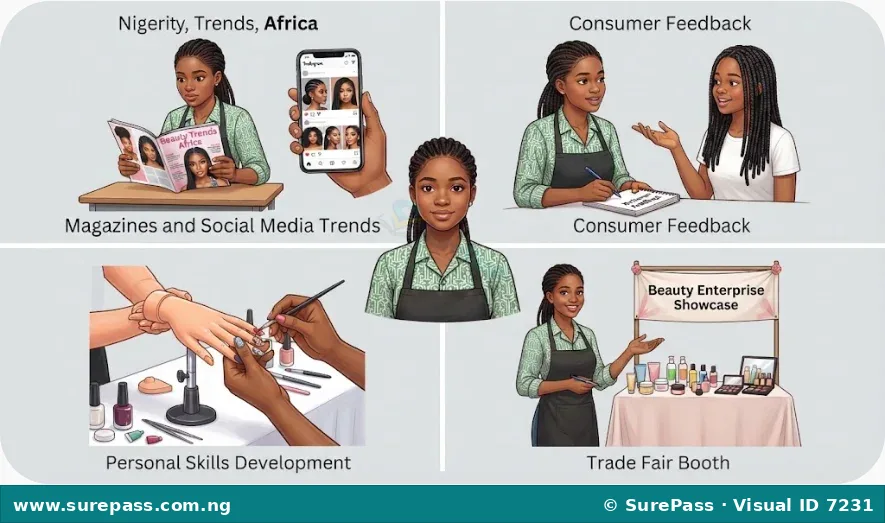
- Personal Skills and Talents: Natural abilities in hair styling, makeup application, nail art or skin massage can easily be developed into a business concept.
- Mass Media and Publications: Fashion magazines, beauty blogs, television shows and social media platforms showcase global beauty trends that can be adapted locally.
- Industrial Exhibitions and Trade Fairs: Attending beauty expos and trade shows exposes individuals to new products, equipment and techniques that can inspire new business models.
- Consumer Complaints and Feedback: Listening to what people complain about regarding existing beauty services can spark ideas. For example, complaints about long waiting times in salons can inspire an appointment-only premium salon.
- Surveys and Market Research: Conducting simple questionnaires in a neighborhood can reveal what beauty products or services residents wish they had access to.
Observe the illustration below showing various sources of beauty business ideas.
Sources of Business Opportunities in Cosmetology
While ideas can come from anywhere, business opportunities are discovered by looking closely at the environment, market trends and economic changes.
Common sources of business opportunities include:
- Under-served Localities (Market Gaps): Newly developed residential areas, university campuses or commercial centers often lack specific beauty services like professional barbing salons, spas or cosmetic retail shops.
- Changes in Consumer Preferences: A shift in consumer taste creates new opportunities. For example, the growing preference for natural, chemical-free skincare products has created a massive opportunity for organic cosmetic production.
- Population Growth and Demographics: An increase in the population of a town or city naturally increases the demand for personal grooming services.
- Technological Advancements: The rise of internet connectivity and mobile applications creates opportunities for online beauty consultations, home-delivery of cosmetics, and digital booking systems.
- Government Policies and Economic Trends: Government support for local manufacturing can make the local production of beauty products, such as black soap or shea butter creams, highly profitable compared to importing foreign brands.
Sources of Gainful Activities in Cosmetology
To engage in gainful activities, individuals must identify where and how they can apply their cosmetology skills to earn a living.
Common sources of gainful activities include:
- Employment in Established Salons and Spas: Working as a hair stylist, makeup artist, manicurist or aesthetician in an existing beauty establishment provides steady income and valuable experience.
- Freelancing and Mobile Services: Offering home-delivery beauty services directly to clients at their residences or event venues, especially for weddings and parties.
- Retailing and Distribution of Beauty Products: Buying cosmetics, hair extensions, skin lotions and salon tools in bulk from manufacturers and selling them to retail consumers.
- Beauty Training and Education: Setting up a training center or offering masterclasses to teach others hair styling, makeup artistry or nail technology for a fee.
- Content Creation and Digital Media: Creating educational beauty videos, product reviews and tutorials on social media platforms to earn income through advertisements and brand sponsorships.
Preparing a Cosmetology Business Idea
To turn a creative concept into a structured plan, an entrepreneur must “prepare out” the business idea. This process involves writing down the details of the concept to evaluate its feasibility before spending money.
The preparation process involves the following steps:
- Identify the Core Product or Service: State clearly what the business will sell or offer. For example, “A mobile bridal makeup service.”
- Define the Target Market: Identify exactly who will buy the product or service. For example, “Brides-to-be and bridesmaids in the local government area.”
- Determine the Required Resources: List the essential tools, equipment and materials needed to start. For example, “Professional makeup kit, ring light, portable chair, and transportation.”
- Analyze the Competition: Identify other businesses offering similar services and determine how to stand out. For example, “Offering a free pre-wedding skin consultation to attract clients.”
- Estimate Startup Costs and Pricing: Calculate how much money is needed to buy the initial tools and decide how much to charge clients to make a profit.
The template below shows a structured worksheet used to prepare a cosmetology business idea.
How to Prepare a Cosmetology Business Idea
This practical exercise guides the development of a structured business idea for a local beauty venture.
The required materials are:
- A writing notebook or sheet of paper
- A pen or pencil
- A ruler
The procedure involves the following steps:
- Draw a table with five rows on the sheet of paper, using the ruler and pen.
- Label the first row as “Business Concept” and write down a specific beauty service or product of interest (e.g., “Organic Shea Butter Hair Cream Production”).
- Label the second row as “Target Market” and write down the specific group of people who need this product (e.g., “People with natural hair, dry scalp, or damaged hair in the school and neighborhood”).
- Label the third row as “Required Resources” and list the raw materials and tools needed (e.g., “Raw shea butter, essential oils, mixing bowls, hand mixer, plastic jars, and labels”).
- Label the fourth row as “Unique Selling Point” and explain why customers will buy from this business instead of competitors (e.g., “The cream is 100% natural, has a pleasant lavender scent, and is highly affordable”).
- Label the fifth row as “Pricing Strategy” and state the estimated cost to produce one unit and the proposed selling price to ensure a profit.
- Review the completed worksheet to ensure the plan is realistic and achievable with the available resources.
Summary
Success in the beauty and cosmetology industry begins with distinguishing between a creative business idea, a viable business opportunity, and the gainful activities that generate income. By identifying opportunities through market gaps and preparing ideas systematically, aspiring beauty entrepreneurs can build sustainable and profitable businesses in their communities.
Questions for Evaluation
Answer the following questions to review the lesson:
- Define the term “business idea” and give one example related to cosmetology.
- Explain the difference between a business idea and a business opportunity.
- What are gainful activities in the context of beauty and cosmetology? List three examples.
- Enumerate four sources of business ideas for an aspiring cosmetologist.
- State three sources of business opportunities in a local community.
- List five key steps involved in preparing a cosmetology business idea.





0 comments
Open the discussion when you need it. Comments stay collapsed until requested so the initial article remains light.