


ARTICLE CONTENTSOn this page 8 sections
Alamomin Rubutu
Performance Objectives
By the end of the lesson, students should be able to:
- give the meaning of punctuation marks (ba da ma’anar alamomin rubutu);
- list the various types of punctuation marks (kawo ire-iren alamomin rubutu);
- identify the correct places to use punctuation marks (gano muhallan da ake amfani da alamomin rubutu);
- explain the importance of punctuation marks (tabbatar da muhimmancin alamomin rubutu).
Ma’anar Alamomin Rubutu (Meaning of Punctuation Marks)
Alamomin rubutu sune alamomi na musamman da ake amfani da su a cikin rubutu domin rarrabe kalmomi, jumloli, ko kuma nuna inda ya kamata a tsaya ko a canza sautin murya yayin karatu.
In written Hausa, just like in English, words alone cannot always convey the exact meaning, tone, or pauses of spoken language. Punctuation marks act as guides that help readers understand where a sentence ends, when a question is being asked, or when a speaker is expressing surprise or excitement.
Ire-iren Alamomin Rubutu da Wuraren da ake Amfani da Su (Types and Uses of Punctuation Marks)
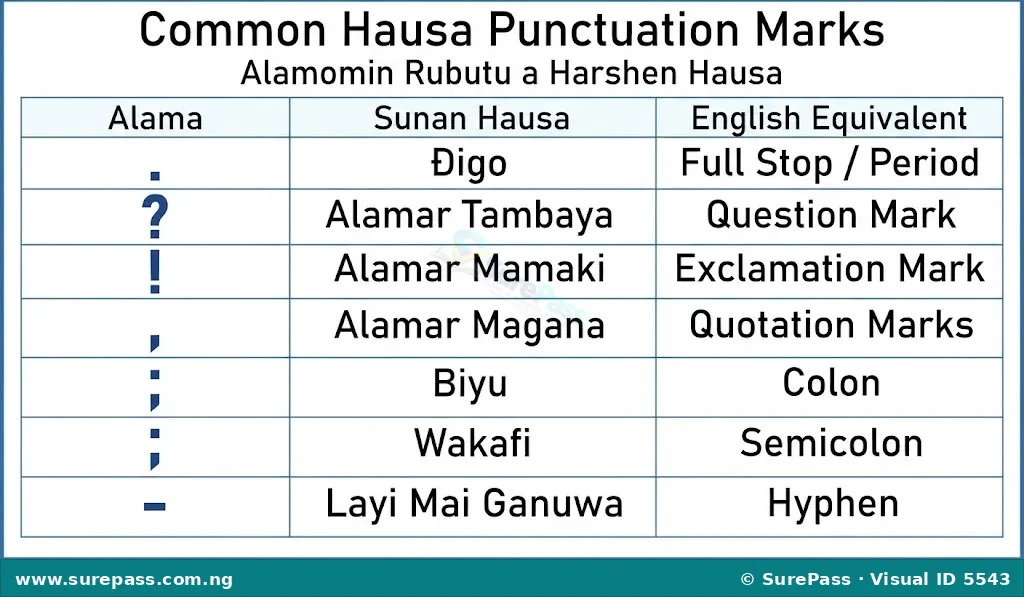
There are several punctuation marks used in Hausa writing. Each mark has a specific name, symbol, and rule for its application.
The primary punctuation marks used in Hausa include:
- Ɗigo / Gurbin Tsayawa (Full Stop / Period)
. - Wakafi (Comma)
, - Alamar Tambaya (Question Mark)
? - Alamar Motsin Rai / Mamaki (Exclamation Mark)
! - Alamar Zance (Quotation Marks)
“ ” - Ɗigo Biyu (Colon)
: - Ɗigo da Wakafi (Semicolon)
; - Giciye / Alamar Raba Kalma (Hyphen)
-
1. Ɗigo / Gurbin Tsayawa (Full Stop) .
The full stop is used to mark the end of a complete statement or sentence. It shows that the thought is finished and the reader should make a complete pause before starting the next sentence. It is also used in abbreviations.
Examples of where to use a full stop include:
- Karshen cikakkiyar jumla (End of a complete sentence):
Audu ya tafi makaranta. (Audu went to school.) - Gajartaccen rubutu (Abbreviations):
M. Aliyu ya zo gidanmu. (Mr. Aliyu came to our house.)
2. Wakafi (Comma) ,
The comma is used to indicate a short pause within a sentence. It helps to separate ideas, clauses, or items in a list so that the sentence does not become confusing.
Examples of where to use a comma include:
- Rarrabe abubuwa daban-daban a lissafi (Separating items in a list):
Na sayi ayaba, lemu, da kankana. (I bought bananas, oranges, and watermelon.) - Bayan kalmar gabatarwa (After introductory words):
Haka ne, zan zo gobe. (Yes, I will come tomorrow.) - Rarrabe jumloli masu alaƙa (Separating related clauses):
Idan ka zo gidanmu, zan ba ka littafi. (If you come to our house, I will give you a book.)
3. Alamar Tambaya (Question Mark) ?
The question mark is placed at the end of any sentence that asks a direct question. It signals to the reader that the sentence requires an answer or is an inquiry.
Examples of where to use a question mark include:
- Tambaya ta kai tsaye (Direct questions):
Ina za ka tafi? (Where are you going?) - Neman bayani (Inquiries):
Wane ne ya ɗauki alƙalamina? (Who took my pen?)
4. Alamar Motsin Rai / Mamaki (Exclamation Mark) !
The exclamation mark is used to express strong emotions such as surprise, anger, fear, joy, or command. It shows that the sentence should be read with emphasis or a raised voice.
Examples of where to use an exclamation mark include:
- Nuna mamaki ko al’ajabi (Expressing surprise):
Iye! Lallai ka iya karatu! (Wow! You really know how to read!) - Nuna tsoro ko firgici (Expressing fear or shock):
Wayyo Allah! (Oh my goodness!) - Bayar da umarni mai ƙarfi (Strong commands):
Tashi tsaye yanzu! (Stand up right now!)
5. Alamar Zance (Quotation Marks) “ ”
Quotation marks are used to enclose the exact words spoken by a person. They separate the speaker’s direct speech from the rest of the sentence.
Examples of where to use quotation marks include:
- Kawo ainihin maganar wani (Direct speech):
Musa ya ce, “Zan zo gobe.” (Musa said, “I will come tomorrow.”) - Nuna sunan littafi ko kasida a cikin rubutu (Highlighting titles or specific terms):
Muna karanta littafin “Ruwan Bagaja”. (We are reading the book “Ruwan Bagaja”.)
6. Ɗigo Biyu (Colon) :
The colon is used to introduce a list of items, an explanation, or a direct quotation that follows a statement.
Examples of where to use a colon include:
- Kafin lissafa abubuwa (Before listing items):
Abubuwan da nake buƙata sune: littafi, alƙalami, da rula. (The things I need are: a book, a pen, and a ruler.) - Kafin kawo zance mai tsawo (Before introducing a long quote or dialogue):
Malamin ya ce: “Kowa ya buɗe littafinsa.” (The teacher said: “Everyone should open their book.”)
7. Ɗigo da Wakafi (Semicolon) ;
The semicolon is used to connect two independent sentences that are closely related in thought. It represents a pause that is longer than a comma but shorter than a full stop.
Examples of where to use a semicolon include:
- Haɗa jumloli masu zaman kansu (Connecting related independent clauses):
Bala ya tafi gona; Audu kuma ya tafi kasuwa. (Bala went to the farm; Audu, on the other hand, went to the market.)
8. Giciye / Alamar Raba Kalma (Hyphen) -
The hyphen is used to join compound words together or to split a word at the end of a line when there is not enough space to write the whole word.
Examples of where to use a hyphen include:
- Haɗa kalmomin lissafi (Joining compound numbers):
shafi na goma-sha-biyu (page twelve). - Kalmomi masu ninki (Reduplicated words):
kusa-kusa (very close) or maza-maza (very quickly).
Muhimmancin Alamomin Rubutu (Importance of Punctuation Marks)
Punctuation marks are essential tools in written communication. Without them, written texts would be difficult to read, and the intended meaning could easily be lost or misunderstood.
The main reasons why punctuation marks are important include:
- Suna sauƙaƙa karatu (They make reading easier): Punctuation marks guide the reader on when to pause, stop, or change their voice, making the text flow naturally.
- Suna bayyana ma’ana ta gaskiya (They clarify meaning): Proper punctuation prevents confusion. For example, a misplaced comma can completely change the meaning of a sentence.
- Suna nuna yanayin mai magana (They show the writer’s tone and emotion): Through marks like the exclamation and question marks, a reader can tell if the writer is asking a question, shouting in anger, or expressing joy.
- Suna tsara rubutu (They structure written work): Punctuation marks organize sentences into logical paragraphs and sections, making the writing look neat and professional.
Dabarun Aiwatarwa (Skills Practice)
To develop proficiency in reading and writing Hausa, learners must practice identifying and applying punctuation marks correctly.
Ƙwarewa a Karatu (Reading Proficiency Practice)
Observe how the absence of punctuation marks makes a passage difficult to read, and how adding them restores clarity.
Passage without punctuation (Kuskure):
musa ya zo gidanmu jiya ya tambaye ni ina babana yake na gaya masa yana gona sai ya ce lallai zan tafi can in same shi
Passage with correct punctuation (Daidai):
Musa ya zo gidanmu jiya. Ya tambaye ni, “Ina babana yake?” Na gaya masa yana gona. Sai ya ce, “Lallai zan tafi can in same shi!”
Ƙwarewa a Rubutu (Writing Proficiency Practice)
The following steps should be followed when writing to ensure correct punctuation:
- Start every sentence with a capital letter and end with a full stop, question mark, or exclamation mark depending on the type of sentence.
- Use commas to separate items when listing three or more things.
- Put quotation marks around the exact words spoken by someone.
- Read the written work aloud to identify natural pauses where commas or semicolons should be placed.
Summary of Punctuation Marks
The table below provides a quick reference for the punctuation marks studied in this unit:
| Alama (Symbol) | Sunan Alama da Hausa | English Name | Misali (Example) |
|---|---|---|---|
| . | Ɗigo / Gurbin Tsayawa | Full Stop | Zan tafi gida. |
| , | Wakafi | Comma | Na sayi riga, wando, da hula. |
| ? | Alamar Tambaya | Question Mark | Mene ne sunanka? |
| ! | Alamar Motsin Rai | Exclamation Mark | Madalla! Ka yi ƙoƙari. |
| “ ” | Alamar Zance | Quotation Marks | Ali ya ce, “Ina jin yunwa.” |
| : | Ɗigo Biyu | Colon | Ina son waɗannan: nama da kifi. |
| – | Giciye / Alamar Raba Kalma | Hyphen | goma-sha-biyar |
Evaluation Questions
Answer the following questions to test your understanding of the topic:
- Mene ne ma’anar alamomin rubutu? (What is the meaning of punctuation marks?)
- Kawo alamomin rubutu guda biyar da ka sani tare da alamarsu. (List five punctuation marks you know along with their symbols.)
- A cikin jumloli guda uku, tattauna muhimmancin alamomin rubutu a cikin harshen Hausa. (In three sentences, discuss the importance of punctuation marks in the Hausa language.)
- Sanya alamomin rubutu da suka dace a cikin wannan jumla:
ali ya ce ina son cin shinkafa wake da nama




0 comments
Open the discussion when you need it. Comments stay collapsed until requested so the initial article remains light.