


ARTICLE CONTENTSOn this page 8 sections
Rubutacciyar Waƙa
Performance Objectives
By the end of the lesson, students should be able to:
- Explain the meaning of written poetry (bayanin rubutacciyar waƙa).
- Identify and analyze the features of written poetry (tantance rubutacciyar waƙa).
- Give examples of written poetry (kawo misalan rubutacciyar waƙa).
- Write a short written poem in standard Hausa (rubuta rubutacciyar waƙa).
Meaning of Written Poetry (Ma’anar Rubutacciyar Waƙa)
Written poetry (rubutacciyar waƙa) is a form of Hausa literature that is composed, written down on paper or digital media, and preserved in text form before it is read, recited, or sung.
Unlike oral poetry (waƙar baka) which is composed spontaneously and passed down by word of mouth, written poetry is carefully planned, structured, and recorded. The writer of a poem is known as a poet (marubucin waƙa or mawaƙi). In Hausa literary history, written poetry began with the use of Ajami (Hausa written using Arabic characters) before transitioning to Boko (Hausa written using Roman characters).
How to Identify and Analyze Written Poetry (Yadda Ake Tantance Rubutacciyar Waƙa)
Written poetry has specific structural features that distinguish it from prose (zube) and oral poetry. The main features used to identify and analyze written poetry include:
- Baiti (Stanza): This is a group of lines that forms a complete unit within a poem. A stanza can consist of two lines (ɗan bango), three lines (tastiri), four lines (tarbi’i), or five lines (takhmini).
- Kafiya (Rhyme Scheme): This refers to the matching sound or syllable at the end of each line within a stanza. It gives the poem a musical flow and consistency.
- Wazani (Meter or Rhythm): This is the pattern of heavy and light syllables that creates the rhythm of the poem when recited.
- Marubuci (Author): Written poetry always has a known author whose name is often mentioned at the beginning or the end of the poem.
- Amshi (Refrain or Chorus): This is a line or phrase that is repeated at the end of each stanza, often sung by a chorus or the audience.
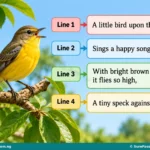
The diagram below illustrates the basic structure of a Hausa written poem stanza, showing the lines and the rhyme endings.
Examples of Written Poetry (Misalan Rubutacciyar Waƙa)
Below is an example of a simple written poem about the importance of education (Ilimi), composed in standard Hausa:
Waƙar Ilimi (The Poem of Education)
Baiti 1:
Ilimi haske ne na rayuwa,
Yana fitar da mu ga duhuwa.
Baiti 2:
Wanda bai bincika ya koya ba,
Ba zai taɓa samun ɗaukaka ba.
Baiti 3:
Mu dage mu nemi ilimi da wuri,
Domin mu amfani kowane gari.
Analysis of the Poem (Tantance Waƙar)
The poem above can be analyzed using the following structural details:
- Jigo (Theme): The theme of the poem is the importance of education (Ilimi).
- Tsarin Baiti (Stanza Structure): The poem consists of three stanzas (baiti uku). Each stanza has two lines (ɗan bango).
- Kafiya (Rhyme Scheme):
- Stanza 1 ends with the rhyming syllable “-wa” (rayuwa / duhuwa).
- Stanza 2 ends with the rhyming syllable “-ba” (ba / ba).
- Stanza 3 ends with the rhyming syllable “-ri” (wuri / gari).
Importance of Written Poetry (Muhimmancin Rubutacciyar Waƙa)
Written poetry plays several roles in Hausa society. The main benefits of written poetry include:
- Ilimantarwa (Education): It is used to teach moral lessons, religious knowledge, and academic subjects.
- Adana Al’ada da Tarihi (Preservation of Culture and History): It records historical events, cultural values, and societal changes for future generations.
- Nishaɗantarwa (Entertainment): The rhythmic flow and musical nature of poetry provide entertainment when read or sung.
- Gargaɗi da Tsawatarwa (Warning and Correction): It is used to correct bad behavior, warn against social vices, and guide the community toward good deeds.
- Haɓaka Harshe (Language Development): It helps to preserve and enrich the Hausa language through the use of creative vocabulary and idioms.
How to Write a Simple Written Poem (Yadda Ake Rubuta Rubutacciyar Waƙa)
Writing a poem requires creativity, careful selection of words, and a clear structure. The process of writing a simple Hausa poem involves the following steps:
- Zabar Jigo (Choosing a Theme): Decide on the topic of the poem, such as education (ilimi), cleanliness (tsafta), or respect for parents (biyayya ga iyaye).
- Zabar Tsarin Baiti (Choosing the Stanza Structure): Decide whether each stanza will have two lines (ɗan bango) or more. For beginners, a two-line stanza is easiest.
- Zabar Kafiya (Selecting a Rhyme Scheme): Choose a repeating sound or syllable to end the lines in each stanza (for example, ending lines with “-ma”, “-ta”, or “-ka”).
- Tsara Layukan Waƙa (Drafting the Lines): Write the lines using standard Hausa (ingantacciyar Hausa) while ensuring they have a rhythmic flow.
- Gyara da Tace Waƙa (Editing and Refining): Read the poem aloud to check if the rhythm flows smoothly and the rhyme scheme is consistent.
Practical Writing Exercise (Aikin Rubutu)
To practice writing, learners can complete the following two-stanza poem about cleanliness (tsafta) by choosing the correct rhyming words from the options provided in brackets:
Waƙar Tsafta (The Poem of Cleanliness)
Baiti 1:
Mu wanke jikinmu da safe da yamma,
Domin mu guje wa cututtuka duka __ (kuma / gari).
Baiti 2:
Tsafta tana kawo lafiyar jiki,
Mu share gidanmu da duk __ (ɗaki / hanya).
The correct rhyming words to complete the poem are “kuma” for Stanza 1 (to rhyme with “yamma”) and “ɗaki” for Stanza 2 (to rhyme with “jiki”).
Evaluation Questions
Answer the following questions to test your understanding of the lesson:
- Menene ma’anar rubutacciyar waƙa? (What is the meaning of written poetry?)
- Kawo hanyoyi guda uku da ake amfani da su wajen tantance rubutacciyar waƙa. (Give three ways used to identify/analyze written poetry.)
- Kawo muhimmancin rubutacciyar waƙa guda uku ga al’umma. (Give three benefits of written poetry to the society.)
- Rubuta waƙa mai baiti biyu a kan jigon “Biyayya ga Iyaye” (Respect for Parents) ta amfani da ingantacciyar Hausa. (Write a two-stanza poem on the theme “Respect for Parents” using standard Hausa.)

0 comments
Open the discussion when you need it. Comments stay collapsed until requested so the initial article remains light.