



ARTICLE CONTENTSOn this page 9 sections
Wasan Kwaikwayo
Performance Objectives
By the end of the lesson, students should be able to:
- bayyana ma’anar wasan kwaikwayo (explain the meaning of drama);
- tantance wasan kwaikwayo (analyze and distinguish drama);
- kawo ire-iren wasan kwaikwayo (list the types of drama);
- aiwatar da wasan kwaikwayo a zahiri (perform drama practically).
Ma’anar Wasan Kwaikwayo (Meaning of Drama)
Wasan kwaikwayo is a form of literature where stories, ideas, or real-life events are acted out by people using speech, actions, and gestures before an audience.
The term “kwaikwayo” in Hausa means to imitate or copy. Therefore, in a play, actors pretend to be other people, animals, or objects to tell a story, pass a message, or entertain the public. The actors speak and behave like the characters they are representing, making the story feel real to those watching.
Tarihin Wasan Kwaikwayo (History of Drama)
The history of drama in Hausaland is divided into two main periods: traditional drama and modern drama.
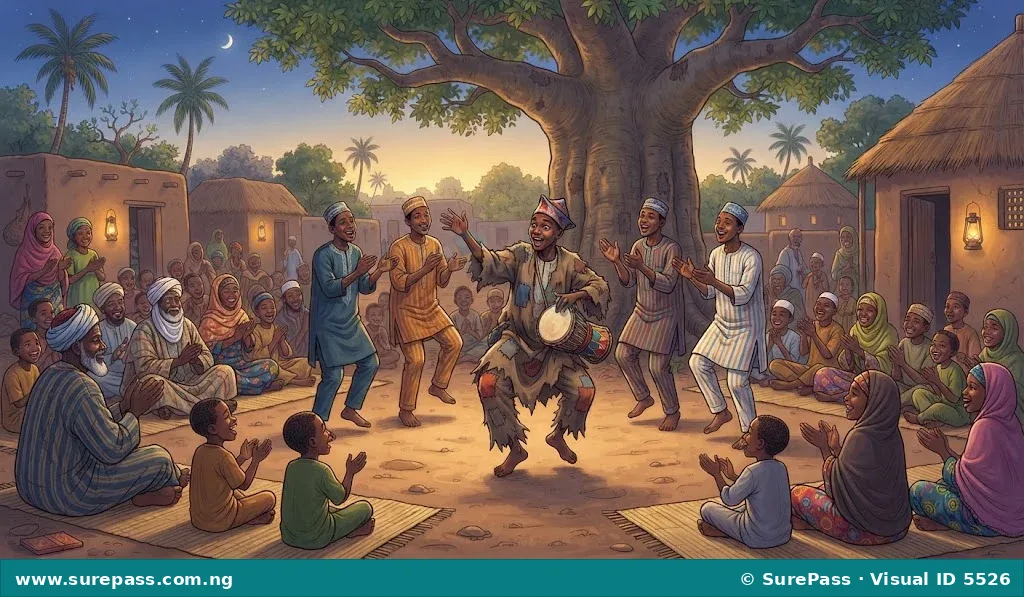
Traditional Hausa drama originated from cultural festivals, religious ceremonies, and occupational displays. Long before books and television were introduced, Hausa people gathered in village squares to watch performances. These performances were not written down in books but were passed from one generation to another through practice.
The main historical stages of Hausa drama are:
- Wasan Gargajiya (Traditional Performances): These include occupational displays like Wasan Tauri (displays of invulnerability by hunters and warriors) and Wasan Dambe (traditional boxing). It also includes seasonal festivals like Tashe, which is performed by youths during the month of Ramadan.
- Wasan Kwaikwayo na Zamani (Modern Drama): This began with the introduction of formal education and western-style theatres. Writers started writing plays in books, known as wasan kwaikwayo na littafi. Later, with the arrival of radio and television (talabijin), drama expanded into broadcast plays that reach millions of homes.
Ire-iren Wasan Kwaikwayo (Types of Drama)
Drama can be classified into different types based on the style of presentation, the mood of the story, and the medium of performance.
The primary types of drama include:
- Wasan Barkwanci (Comedy): This is a funny play designed to make the audience laugh. Although it is humorous, it often teaches important moral lessons about society.
- Wasan Tausayi ko Makoki (Tragedy): This is a serious play with a sad ending. It usually depicts the struggles of a main character who faces difficult challenges and ends up failing, suffering, or dying due to a mistake or bad choice.
- Wasan Gauraye (Tragicomedy): This type of play blends both funny and sad elements. It may start with serious or sad events but ends on a happy note.
- Wasan Kwaikwayo na Gargajiya (Traditional Drama): These are unwritten plays performed during cultural events, festivals, or ceremonies, relying heavily on oral tradition and improvisation.
- Wasan Kwaikwayo na Zamani (Modern Drama): These are written plays performed on a modern stage (dandamali), television (talabijin), or recorded as home videos.
Tantance Wasan Kwaikwayo (Analyzing and Distinguishing Drama)
To analyze or distinguish drama from other forms of literature, such as prose (zube) or poetry (waka), learners must look at its unique features. Drama is written to be performed, not just to be read.
The key elements used to analyze drama are:
- ’Yan Wasa (Characters/Actors): These are the people who act out the roles in the play. They make the story move forward through their actions.
- Tattaunawa (Dialogue): This is the conversation between the characters. In a drama book, the story is told through what the characters say to each other, rather than through long paragraphs of description.
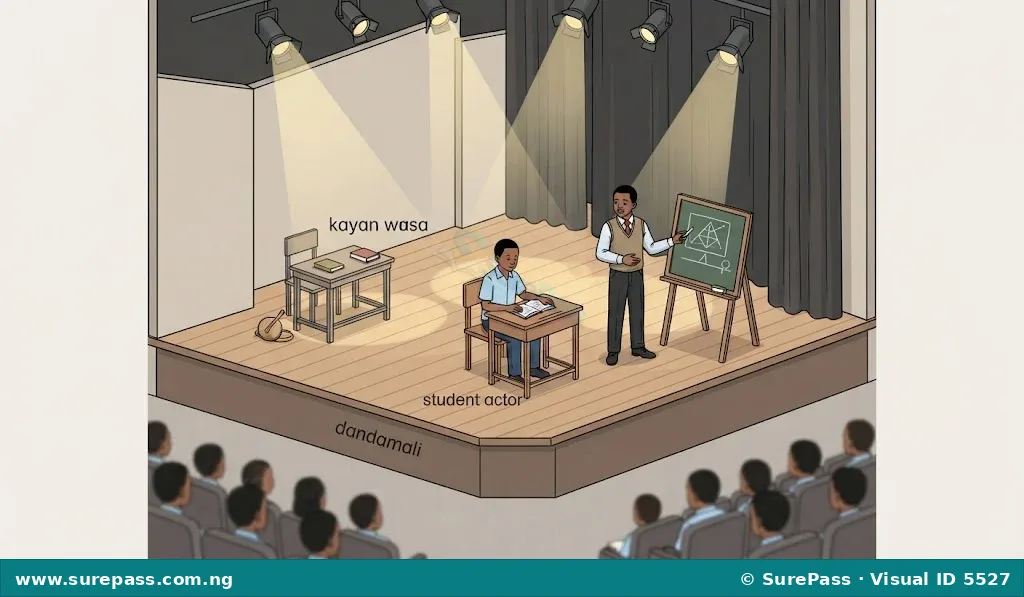
- Dandamali (Stage/Setting): This is the physical space where the play is performed. It can be a modern theatre stage, a school classroom, or an open village square.
- Kayan Wasa (Props and Costumes): These are the clothes, tools, and objects used by the actors. For example, an actor playing the role of a king will wear a crown and hold a staff, while an actor playing a farmer will hold a hoe.
- Tsarin Labari (Plot): This is the sequence of events in the play, from the beginning, through the middle where the conflict arises, to the end where the conflict is resolved.
Gudanar da Wasan Kwaikwayo (Performing and Writing Drama)
Performing drama requires two main skills: writing the script (iya rubutu) and showcasing artistic talent on stage (tallata fasaha).
Iya Rubutu (Scriptwriting Skills)
A drama script is the written guide that actors follow. It contains the names of the characters, what they say, and instructions on how they should move or feel.
The steps for writing a simple drama script are:
- Write the title of the play at the top.
- List the characters (‘yan wasa) and give a brief description of who they are.
- Write the name of the character speaking in bold capital letters on the left side of the page.
- Put stage directions in brackets to show actions, emotions, or movements.
Observe the script format below.
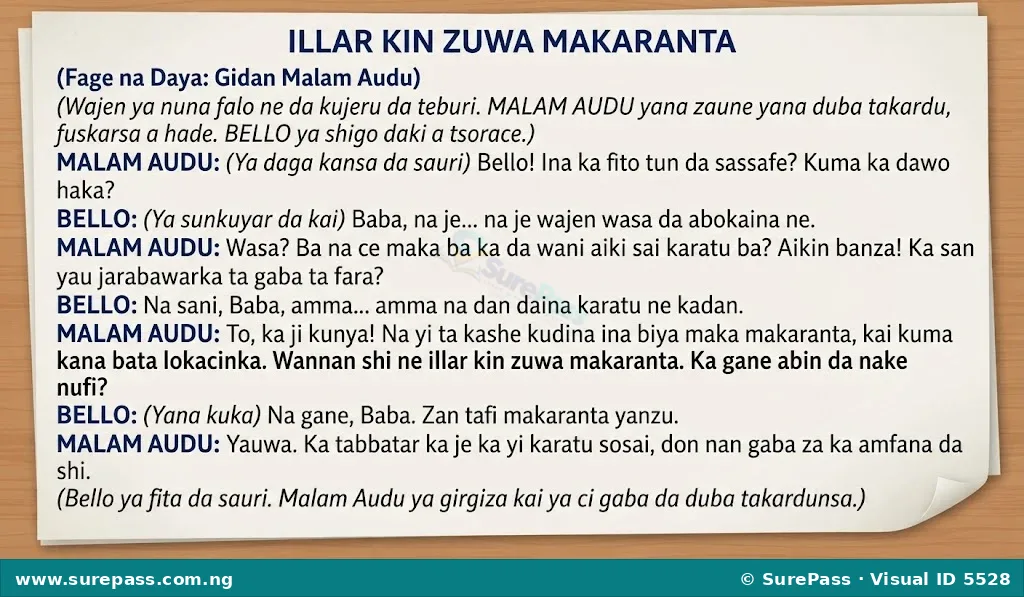
Misalin Rubutun Wasan Kwaikwayo (Sample Drama Script)
Guda: Illar Kin Zuwa Makaranta (The Danger of Refusing to Go to School)
Abubuwan da ke faruwa: Malam Audu yana fushi da ɗansa Bello wanda ya gudu daga makaranta.
MALAM AUDU: (Yana tsaye a tsakar gida, rike da bulala, yana fushi) Bello! Bello! Fito fili yanzu nan!
BELLO: (Ya fito daga daki yana tsoron uban, yana sosa keya) Gani baba. Lafiya kake kirana da fushi haka?
MALAM AUDU: (Yana nuna shi da yatsa) Yau malamin ku ya aiko mini da sako cewa ba ka zuwa makaranta. Ina kake zuwa idan ka fita da safe?
BELLO: (Yana kuka kasa-kasa) Yi hakuri baba. Ina zuwa gidan abokina ne mu yi wasa.
MALAM AUDU: (Cikin bacin rai) Wasa? Shin baka san cewa ilimi shi ne hasken rayuwa ba? Idan ba ka yi karatu ba, yaya za ka taimaki kanka da al’ummarka a nan gaba?
BELLO: (Ya durkusa a kasa) Na tuba baba. Ba zan sake wasa da makaranta ba. Zan rika zuwa kullum.
Tallata Fasaha (Artistic Display and Performance)
Performing a play on stage (dandamali) allows students to display their talents, build confidence, and communicate messages clearly to an audience.
The procedure for performing a play in the classroom involves the following steps:
- Zabar Labari (Selecting a Story): Choose a simple story or script that has a clear moral lesson.
- Raba Matsayi (Casting): Assign roles to different students based on who fits each character best.
- Haddace Magana (Memorizing Lines): Actors must read the script repeatedly to memorize their dialogue and understand their characters’ emotions.
- Gwajin Wasa (Rehearsal): Practice the movements, speech, and expressions repeatedly before the actual performance.
- Kayan Wasa (Props and Costumes): Gather simple items like books, bags, traditional hats, or walking sticks to make the performance realistic.
- Aiwatarwa (Performance): Perform the play on the stage or in front of the classroom, speaking clearly and loudly so the audience can hear.
Summary
Wasan kwaikwayo is an important part of Hausa literature that combines entertainment with education. By understanding its history, types, and elements, learners can appreciate cultural values and develop creative writing and acting skills.
Questions for Evaluation
Answer the following questions based on the lesson:
- Mene ne ma’anar wasan kwaikwayo? (What is the meaning of drama?)
- Kawo bambanci tsakanin wasan kwaikwayo na gargajiya da na zamani. (State the difference between traditional and modern drama.)
- Kawo ire-iren wasan kwaikwayo guda uku da ka sani. (List three types of drama that you know.)
- Mene ne amfanin dandamali da kayan wasa a lokacin gudanar da wasan kwaikwayo? (What is the use of a stage and props during a drama performance?)
- A matsayinku na dalibai, ku rubuta gajeren wasan kwaikwayo mai dauke da mutane biyu, sannan ku gudanar da shi a gaban aji. (As students, write a short drama script featuring two characters, then perform it in front of the class.)


0 comments
Open the discussion when you need it. Comments stay collapsed until requested so the initial article remains light.