



ARTICLE CONTENTSOn this page 9 sections
Adadi
Performance Objectives
By the end of the lesson, students should be able to:
- bayyana ma’anar adadi;
- kawo rabe-raben adadi;
- nuna misalan aikin adadi;
- tantance adadi a cikin kalmomi.
Ma’anar Adadi da Yadda Ake Gane Shi
Adadi is the grammatical term used in the Hausa language to denote the number of nouns, pronouns, or objects being referred to in speech or writing.
In Hausa grammar, every noun or pronoun carries a grammatical number. This helps speakers and writers to express whether they are referring to a single entity or more than one entity. Understanding grammatical number is essential for constructing correct sentences, as other parts of a sentence must agree with the number of the noun.
The grammatical number of a word is recognized through several indicators:
- The morphological form of the word, which changes when moving from singular to plural.
- The suffixes or endings attached to the noun.
- The pronoun indicators used alongside the noun in a sentence.
Rabe-raben Adadi (Types of Grammatical Number)
In the Hausa language, grammatical number is divided into two distinct categories. These are Tilo (Singular) and Jam’i (Plural).
1. Tilo (Singular Number)
Tilo is the form of a noun, pronoun, or modifier that refers to only one person, place, animal, or thing.
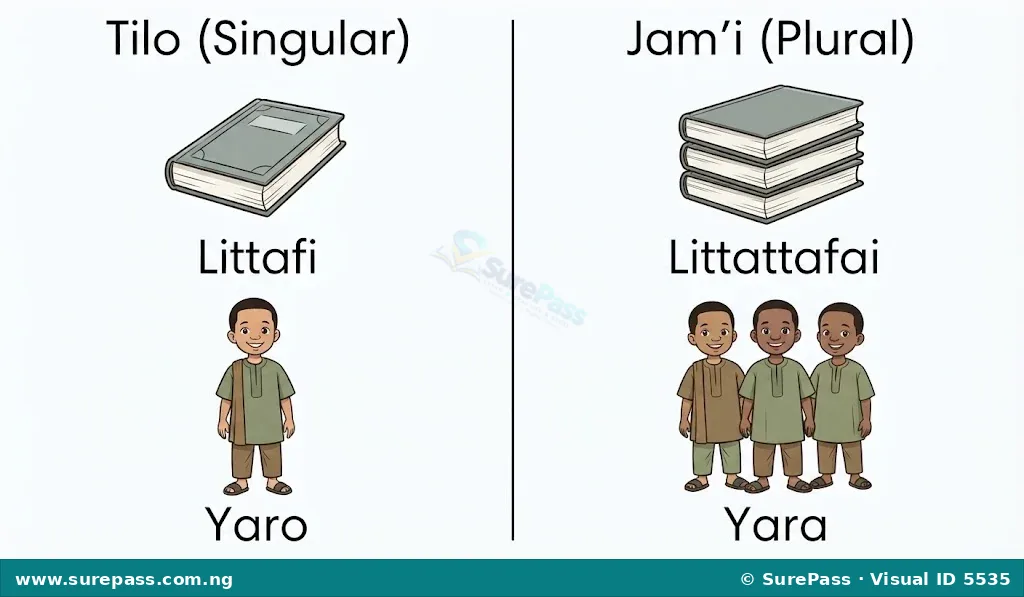
Whenever a single object is spoken about, the noun remains in its basic, singular form. For example, a single writing tool is referred to as biro (pen), and a single student is referred to as ɗalibi (student).
2. Jam’i (Plural Number)
Jam’i is the form of a noun, pronoun, or modifier that refers to more than one person, place, animal, or thing.
When there are two or more objects, the noun must change from its singular form to its plural form. This change is often achieved by altering the internal vowels of the word, adding specific plural suffixes, or changing the word entirely. For example, the plural of biro (pen) is birowan (pens), and the plural of ɗalibi (student) is ɗalibai (students).
Misalan Adadi Cikin Kalmomi (Examples of Number in Words)
The Hausa language employs various patterns to form plurals from singular nouns. The table below presents common nouns in their singular (Tilo) and plural (Jam’i) forms, along with their English translations:
| Tilo (Singular) | Jam’i (Plural) | English Meaning (Singular / Plural) |
|---|---|---|
| Littafi | Littattafai | Book / Books |
| Kujera | Kujeru | Chair / Chairs |
| Gida | Gidaje | House / Houses |
| Yaro | Yara | Boy / Boys |
| Yarinya | Yammata | Girl / Girls |
| Mota | Motoci | Car / Cars |
| Saniya | Shanu | Cow / Cows |
| Kaza | Kaji | Chicken / Chickens |
| Hula | Huluna | Cap / Caps |
| Tebur | Teburori | Table / Tables |
Aikin Adadi (The Function of Number in Sentences)
Grammatical number plays a vital role in sentence construction. In Hausa, the subject of a sentence must agree in number with the pronoun indicators and verbs that follow it. This grammatical agreement is known as daidaito.
The following examples demonstrate how grammatical number functions within sentences:
Examples of singular sentence agreement (Aikin Tilo):
- Yaro ya zo. (The boy came.) – The singular subject yaro agrees with the singular masculine pronoun indicator ya.
- Kujera ta karye. (The chair is broken.) – The singular subject kujera agrees with the singular feminine pronoun indicator ta.
- Littafi yana kan tebur. (The book is on the table.) – The singular subject littafi agrees with the singular pronoun indicator yana.
Examples of plural sentence agreement (Aikin Jam’i):
- Yara sun zo. (The boys came.) – The plural subject yara agrees with the plural pronoun indicator sun.
- Kujeru sun karye. (The chairs are broken.) – The plural subject kujeru agrees with the plural pronoun indicator sun.
- Littattafai suna kan tebur. (The books are on the table.) – The plural subject littattafai agrees with the plural pronoun indicator suna.
Tantance Adadi a Cikin Kalmomi (Identifying Number in Words)
To identify whether a Hausa word is singular (Tilo) or plural (Jam’i), certain structural features must be analyzed. Plural words in Hausa often carry distinct endings or suffixes that do not exist in their singular forms.
Common plural endings used to identify Jam’i include:
- The -ai ending: Seen in words like littattafai (books) and ɗalibai (students).
- The -aje ending: Seen in words like gidaje (houses) and kwanduna (baskets – ending in -una).
- The -oci ending: Seen in words like motoci (cars) and itace (wood) which becomes itatuwa (trees/woods).
- The -eru or -u ending: Seen in words like kujeru (chairs) and goyoyi (babies).
By observing these endings and checking if the word refers to one or many, learners can easily distinguish between Tilo and Jam’i.
Summary of Key Points
The main concepts discussed in this unit are:
- Adadi refers to grammatical number in the Hausa language, indicating whether a noun is singular or plural.
- Tilo represents the singular form, which refers to only one item or person.
- Jam’i represents the plural form, which refers to more than one item or person.
- Plural nouns in Hausa are formed using various suffix patterns such as -ai, -aje, -oci, and -u.
- Sentences must maintain agreement (daidaito) between the subject noun and the pronoun indicators based on grammatical number.
Evaluation Guide
Answer the following questions to test the understanding of the topic:
- Bayyana ma’anar adadi a cikin harshen Hausa.
- Kawo rabe-raben adadi guda biyu da ake da su a Hausa.
- Nuna misalan aikin adadi ta hanyar rubuta jumloli guda biyu na Tilo da jumloli guda biyu na Jam’i.
- Tantance ko wadannan kalmomi Tilo ne ko Jam’i:
- Kujeru
- Mota
- Shanu
- Littafi
- Gidaje



0 comments
Open the discussion when you need it. Comments stay collapsed until requested so the initial article remains light.