


ARTICLE CONTENTSOn this page 6 sections
Introducing Nouns and Pronouns
Performance Objectives
By the end of the lesson, students should be able to:
- explain the meanings of nouns and pronouns;
- identify Nouns and pronouns; and
- correctly use nouns and pronouns in sentences.
What Are Nouns?
A noun is a word that names a person, an animal, a place, or a thing.
Nouns help people talk about everything around them. They give names to specific things and general things.
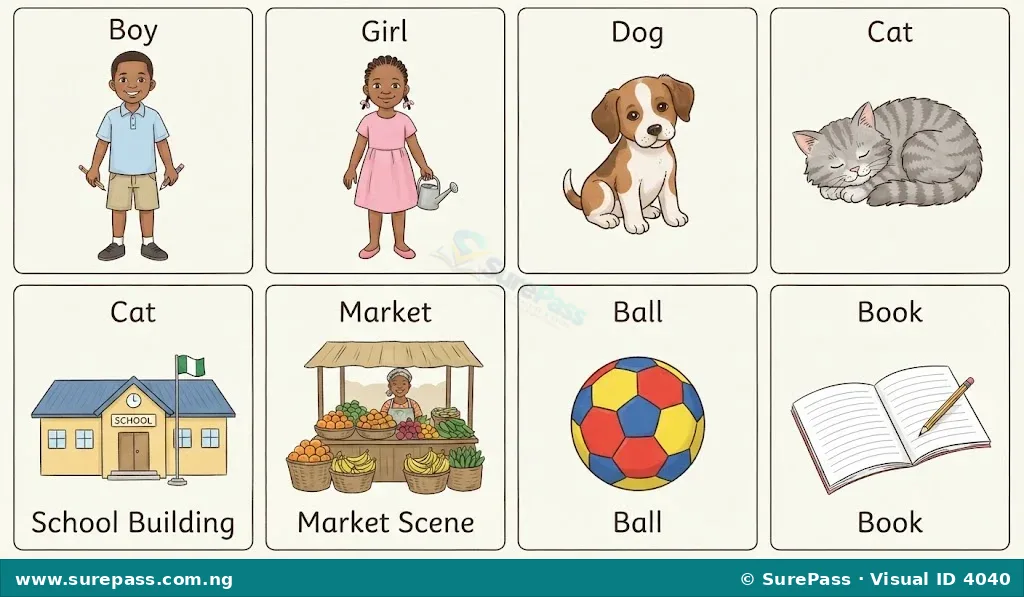
Examples of nouns include:
- People: Hauwa, boy, girl, teacher, mother, father, doctor
- Animals: dog, cat, goat, hen, fish, bird
- Places: Lagos, house, school, market, church, park, Nigeria, Abuja
- Things: book, ball, table, chair, pen, car, food, water
When someone says “Hauwa is playing with a ball,” both “Hauwa” and “ball” are nouns. “Hauwa” names a person, and “ball” names a thing.
What Are Pronouns?
A pronoun is a word that takes the place of a noun.
Pronouns are used to avoid repeating the same noun many times in sentences. They make sentences sound smoother and easier to understand.
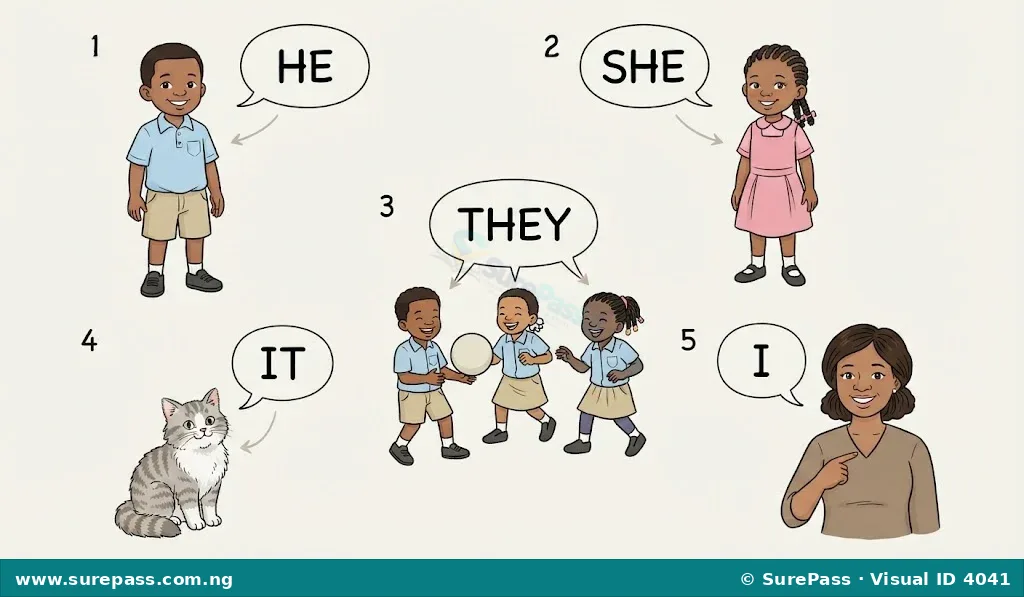
Examples of pronouns include:
- I
- you
- he
- she
- it
- we
- they
Instead of saying “Hauwa is playing. Hauwa is happy,” people can say “Hauwa is playing. She is happy.” The word “She” takes the place of “Hauwa.”
Identifying Nouns and Pronouns
Identifying nouns and pronouns means finding them in sentences. Nouns name things, and pronouns stand in for those names.
Look at the following sentences and identify the nouns and pronouns:
- The boy ran to the school.
- She loves to eat rice.
- It is a big dog.
- They went to the market.
- I have a new book.
- He plays with a ball.
In the first sentence, “boy” and “school” are nouns. In the second sentence, “She” is a pronoun and “rice” is a noun.
Using Nouns and Pronouns in Sentences
Nouns and pronouns are important for making complete sentences. They tell who or what the sentence is about, or who or what receives the action.
Using Nouns in Sentences
Nouns can be used to start a sentence or to complete a sentence. They name the person, animal, place, or thing involved.
Examples of nouns used in sentences include:
- The teacher is teaching.
- The dog barks loudly.
- My house is red.
- I like to read a book.
- Lagos is a big city.
Using Pronouns in Sentences
Pronouns help to make sentences shorter and avoid repetition. They stand in for nouns that have already been mentioned or are understood.
Examples of pronouns used in sentences include:
- He is my friend. (He replaces a boy’s name, like Emeka)
- She sings a song. (She replaces a girl’s name, like Amaka)
- It is a beautiful flower. (It replaces a thing, like “the flower”)
- We are going to play. (We replaces a group of people, like “My friends and I”)
- They are happy children. (They replaces a group of people, like “The children”)
- I am a student. (I refers to the person speaking)
- You are a good helper. (You refers to the person being spoken to)
Using nouns and pronouns correctly helps to speak and write clearly.




0 comments
Open the discussion when you need it. Comments stay collapsed until requested so the initial article remains light.