


ARTICLE CONTENTSOn this page 6 sections
Writing of Letters (A-Z)
Performance Objectives
By the end of the lesson, students should be able to:
- Demonstrate pre-writing skills
- Write all the letters of the English alphabet
Writing is an important skill that helps people share their thoughts, ideas and stories. It allows us to communicate with others even when they are not physically present. Learning to write starts with simple steps and practice.
Pre-Writing Skills
Pre-writing skills are the basic abilities that children develop before they can write letters clearly. These skills help to strengthen the hand muscles, improve hand-eye coordination and prepare the hand for holding a pencil and forming letters.
Good Pencil Grasp
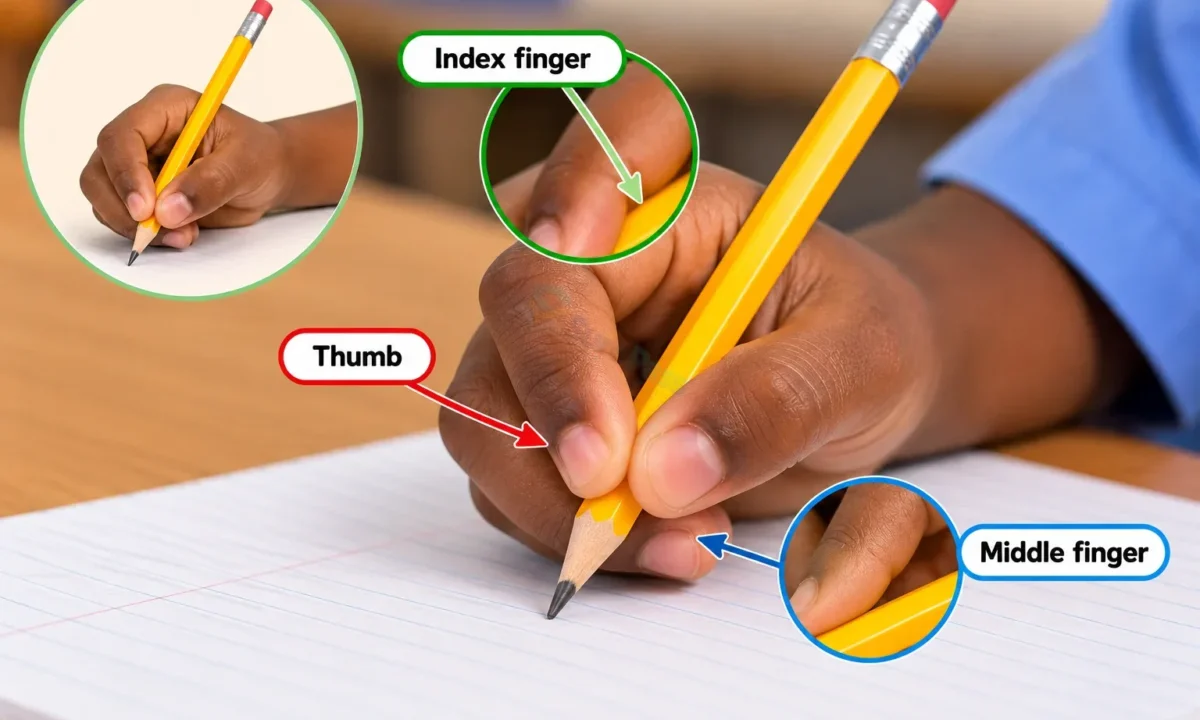
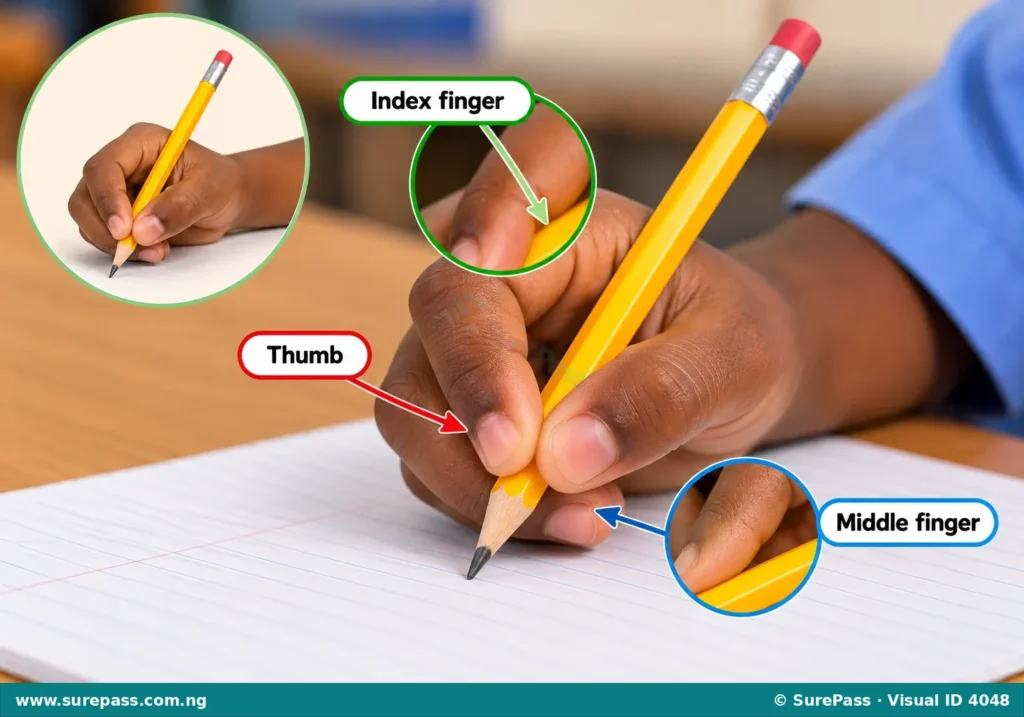
A good pencil grasp means holding the pencil in a way that allows for control and comfort while writing. Holding the pencil correctly helps to make writing easier and clearer.
The correct way to hold a pencil is often called the “tripod grasp”. This involves holding the pencil with the thumb, index finger and middle finger. The pencil rests on the middle finger, while the thumb and index finger hold it firmly near the tip.
Tracing, Scribbling and Drawing
Tracing, scribbling and drawing are fun activities that help to develop fine motor skills needed for writing. These activities build control over hand movements and prepare the hand for forming letters.
Tracing
Tracing involves drawing over existing lines, shapes or letters. This helps children learn the correct strokes and directions for forming different shapes and letters without having to create them from scratch.
Scribbling
Scribbling is making random marks on paper. Controlled scribbling, where a child tries to stay within a certain area or make specific types of marks (like circles or lines), helps to develop hand control and coordination.
Drawing Shapes and Lines
Drawing basic shapes and lines is a very important pre-writing skill. It teaches the hand to make the different movements needed for letters. Many letters are made up of straight lines, curved lines and simple shapes.
Examples of shapes and lines to practice drawing include:
- Straight lines (vertical, horizontal, diagonal)
- Curved lines (like a rainbow or a smile)
- Circles
- Squares
- Triangles
Air-Writing
Air-writing is the practice of forming letters or shapes in the air using a finger or the whole hand. This activity helps children to feel the movement and direction of each stroke before putting it on paper. It also helps to remember the shape of each letter.
Practising Pre-Writing Skills
Practising these skills regularly helps to build confidence and strength for writing.
How to Practice Tracing and Drawing
The procedure involves the following steps:
- Sit comfortably at a table with good lighting.
- Hold the pencil correctly using the tripod grasp.
- Place a tracing worksheet or a piece of paper with drawn lines and shapes in front of you.
- Carefully draw over the lines, shapes or letters, trying to stay exactly on the given path.
- For drawing, try to copy the shapes and lines next to the examples.
- Focus on making smooth, controlled movements.
How to Practice Air-Writing
The procedure involves the following steps:
- Stand or sit in an open space.
- Lift your index finger or your whole hand into the air.
- Imagine a large letter or shape in front of you.
- Slowly move your finger or hand to draw the letter or shape in the air.
- Say the name of the letter or shape as you draw it.
- Practice both capital and small letters.
Writing Letters of the Alphabet
The English alphabet has 26 letters. Each letter has a capital (uppercase) form and a small (lowercase) form. Learning to write these letters clearly and correctly is an important step in learning to write words and sentences.
Writing legibly means writing clearly enough for others to read easily. This involves forming letters correctly, spacing them well and keeping them on the line.
Writing Capital Letters (A-Z)
Capital letters are often used at the beginning of sentences and for proper names. Each capital letter has a specific way to be formed, starting from a particular point and moving in certain directions.
Here are the capital letters of the English alphabet:
- A
- B
- C
- D
- E
- F
- G
- H
- I
- J
- K
- L
- M
- N
- O
- P
- Q
- R
- S
- T
- U
- V
- W
- X
- Y
- Z
Writing Small Letters (a-z)
Small letters are used most often in writing words. Like capital letters, each small letter has a correct way to be formed, with specific starting points and stroke directions.
Here are the small letters of the English alphabet:
- a
- b
- c
- d
- e
- f
- g
- h
- i
- j
- k
- l
- m
- n
- o
- p
- q
- r
- s
- t
- u
- v
- w
- x
- y
- z
Practising Letter Writing
Regular practice helps to make your handwriting neat and legible.
How to Practice Writing Letters
The procedure involves the following steps:
- Sit comfortably at a table with good lighting.
- Hold your pencil correctly.
- Use a handwriting book or a lined paper.
- Start with capital letters, writing each letter several times. Pay attention to the starting point and the direction of your strokes.
- Then, practice small letters in the same way.
- Try to keep your letters the same size and on the line.
- Practice writing letters that look similar together, such as ‘b’ and ‘d’, to learn their differences.
- Practice writing your name and the names of your friends or family members.



0 comments
Open the discussion when you need it. Comments stay collapsed until requested so the initial article remains light.