


ARTICLE CONTENTSOn this page 7 sections
Introducing Simple Verbs
Performance Objectives
By the end of the lesson, students should be able to:
- explain the meaning of a verb;
- Identify verbs;
- Construct sentences with verbs.
What Is a Verb?
A verb is a word that shows an action or a doing word. It tells what someone or something is doing.
Verbs are very important in sentences because they make the sentence complete. Without a verb, a sentence cannot tell us what is happening.
Common Action Verbs
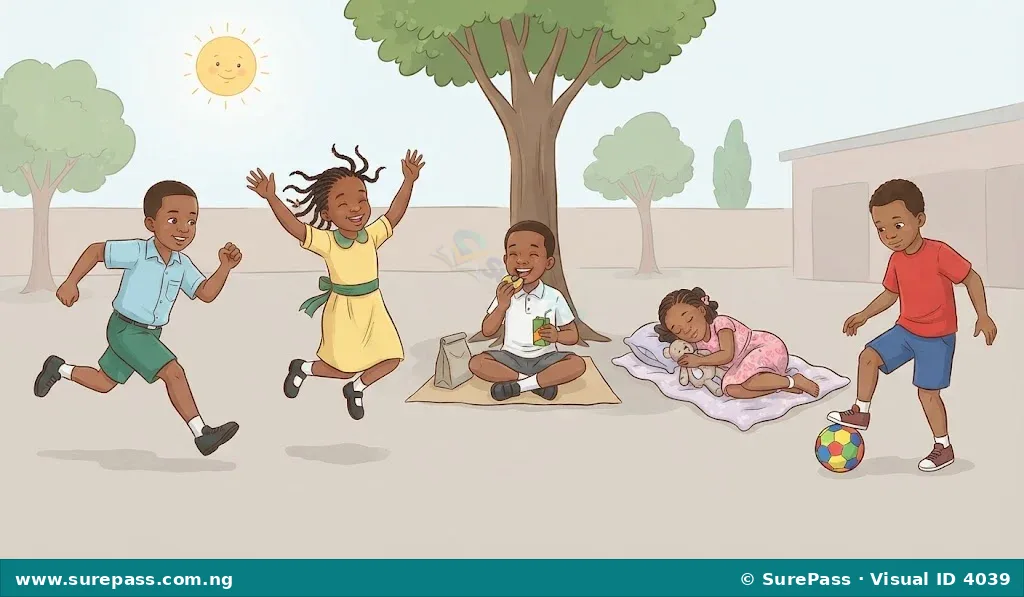
Many words are verbs. They describe actions that people or animals do every day. These are called action verbs.
Some common action verbs include:
- Run: This verb means to move quickly on foot.
- Jump: This verb means to push off the ground with the feet and rise into the air.
- Eat: This verb means to put food into the mouth and swallow it.
- Sleep: This verb means to rest the body and mind, usually with closed eyes.
- Play: This verb means to engage in an activity for enjoyment and recreation.
Constructing Sentences with Verbs
Verbs help to build sentences. They tell us what the subject of the sentence is doing. A simple sentence often has a person or thing (the subject) and an action word (the verb).
Here are some examples of sentences using the action verbs:
- The boy runs fast.
- The girl jumps high.
- I eat rice.
- The baby sleeps soundly.
- Children play football.
In these sentences, the bold words are the verbs. They show the action being performed.
Practice: Identifying Verbs
Read the following sentences. The verb in each sentence tells what action is happening.
- Birds fly in the sky.
- Fish swim in the water.
- My mother cooks delicious food.
- The teacher writes on the board.
- We sing a song.
Verbs and Time (Tenses)
Verbs can also tell us when an action happens. This is called tense. For Primary 1, we will learn about three simple times: now (present), before (past), and later (future).
Actions Happening Now (Present Tense)
When an action is happening right now, or happens regularly, we use the present tense. Words like “now” or “today” often go with these actions.
Examples of actions happening now:
- I eat my food now.
- She runs today.
- They play outside.
Actions That Happened Before (Past Tense)
When an action has already finished, it happened in the past. Words like “yesterday” or “before” tell us it is past tense.
Examples of actions that happened before:
- I ate my food yesterday.
- She ran before.
- They played outside.
Actions That Will Happen Later (Future Tense)
When an action has not happened yet but will happen, it is in the future. We often use the word “will” to show future actions. Words like “tomorrow” or “later” tell us it is future tense.
Examples of actions that will happen later:
- I will eat my food tomorrow.
- She will run later.
- They will play outside.
Speaking Using Appropriate Verbs
Using verbs correctly helps people understand what you are saying and when it happened. Practice speaking sentences using different verbs and tenses.
Activity: What Did You Do?
This activity helps in speaking about actions in different tenses.
The procedure involves the following steps:
- Think of an action you did yesterday, an action you are doing now, and an action you will do tomorrow.
- Use simple sentences to describe these actions.
- For example, a child might say:
- “Yesterday, I played with my friends.” (Past)
- “Now, I read my book.” (Present)
- “Tomorrow, I will jump rope.” (Future)
- Practice saying these sentences clearly, making sure to use the correct verb for the time of the action.

0 comments
Open the discussion when you need it. Comments stay collapsed until requested so the initial article remains light.