


ARTICLE CONTENTSOn this page 12 sections
Common signs and symbols
Performance Objectives
By the end of the lesson, students should be able to:
- identify and name common signs and symbols;
- describe common signs and symbols;
- use common signs and symbols in context;
- explain the meaning of road traffic and safety signs and symbols;
- discuss the importance of road traffic and safety signs and symbols.
What Are Signs and Symbols?
Signs and symbols are special pictures, marks, or short writings that tell people something important. They help people understand messages quickly without needing many words.
Signs are often pictures or drawings that show what to do or where to go. Symbols are often small marks or letters that stand for bigger ideas or words.
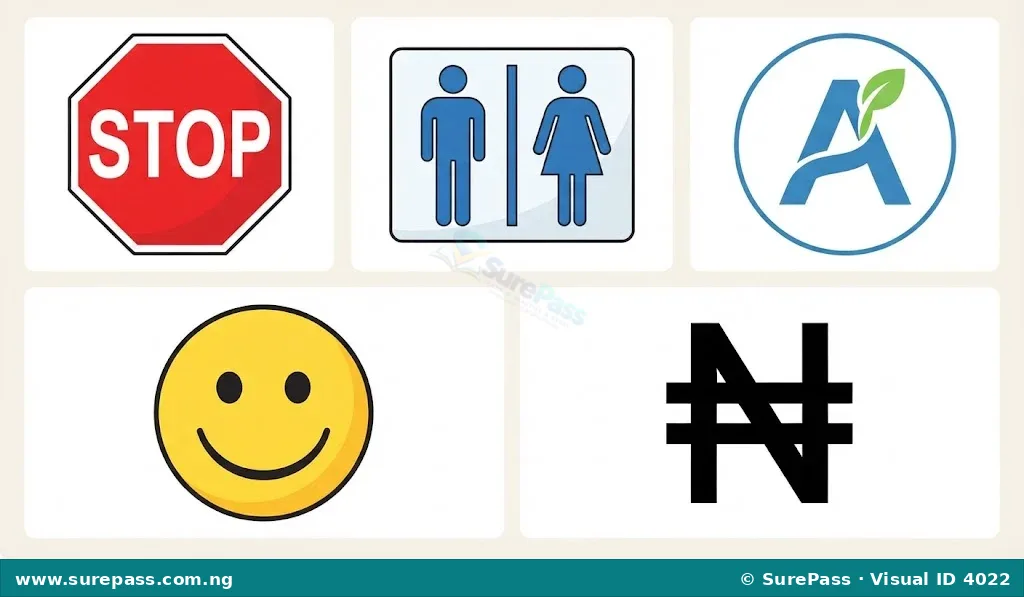
Identifying Common Signs
Many signs use pictures to give messages. These pictures are easy to understand, even for young children.
Common signs that people see every day include:
- Stop Sign: This is a red, eight-sided sign with the word “STOP” written on it. It tells drivers and pedestrians to stop moving.
- Restroom Signs: These signs often show simple pictures of a boy or a girl. They tell people where to find the toilet.
- School Crossing Sign: This sign shows two children walking. It tells drivers to be careful because children might be crossing the road.
- Hospital Sign: This sign often shows a white ‘H’ on a blue background. It tells people where a hospital is located.
Understanding Logos and Icons
Logos are special pictures or designs that represent a company, a school, or a group. They help people recognise different places or products.
Icons are small pictures on phones, computers, or other devices. They show what an application or button does.
For example, a picture of a camera icon means you can take photos. A picture of a phone icon means you can make calls.
Symbolic Representation
Symbolic representation means that one thing stands for another. A picture or a mark can represent a whole word or idea.
For instance, a picture of a burning fire can be a symbol for “danger” or “hot.” A picture of a heart can be a symbol for “love.”
Meaning and Interpretation of Abbreviations
Abbreviations are short ways of writing words. They help people write and read faster.
Common abbreviations include:
- Mr: This is a short way to write “Mister.” It is used before a man’s name, like Mr. Ade.
- Mrs: This is a short way to write “Mistress.” It is used before a married woman’s name, like Mrs. Obi.
- Dr: This is a short way to write “Doctor.” It is used before the name of a person who is a doctor, like Dr. Musa.
- Rev.: This is a short way to write “Reverend.” It is used before the name of a religious leader, like Rev. Father John.
Word Endings as Symbols
Some letters added to the end of words can also act like symbols because they change the meaning of the word. These are called word endings.
Examples of word endings include:
- -s: When “-s” is added to a word, it often means there is more than one. For example, “cat” means one cat, but “cats” means many cats.
- -ed: When “-ed” is added to a word, it often means something happened in the past. For example, “walk” means to move, but “walked” means moved before.
- -es: This ending is also used to show more than one, especially for words ending in ‘s’, ‘x’, ‘z’, ‘ch’, ‘sh’. For example, “box” means one box, but “boxes” means many boxes.
- -ing: When “-ing” is added to a word, it often means something is happening right now. For example, “play” means to have fun, but “playing” means having fun now.
Meaning and Interpretation of Common Symbols
Many symbols are used in everyday life, especially in numbers and writing.
Common symbols and their meanings include:
- ₦: This is the symbol for Naira, the money used in Nigeria.
- K: This is the symbol for Kobo, which is a smaller unit of Nigerian money.
- -: This symbol means “minus” or “take away.” It is used in subtraction.
- +: This symbol means “plus” or “add.” It is used in addition.
- =: This symbol means “equals.” It shows that two things are the same.
- ÷: This symbol means “divide.” It is used in division.
- ×: This symbol means “multiply” or “times.” It is used in multiplication.
- %: This symbol means “percent.” It shows a part of a whole.
- &: This symbol means “and.” It joins two words or ideas.
- #: This symbol is called a “hash” or “number sign.” It can be used to mark numbers or for other purposes.
- *: This symbol is called an “asterisk.” It can be used to mark something important or for multiplication.
Understanding Emojis
Emojis are small pictures or icons used in messages to show feelings or ideas. They help people express themselves when they are writing.
Examples of emojis include:
- A smiley face emoji 😊 shows happiness.
- A sad face emoji 😔 shows sadness.
- A thumbs-up emoji 👍 shows agreement or approval.
- A heart emoji ❤️ shows love or care.
Road Traffic and Safety Signs and Symbols
Road traffic and safety signs are very important. They help keep people safe on the roads and in public places. These signs tell drivers, cyclists, and pedestrians what they should do.
Explaining the meaning of road traffic and safety signs and symbols:
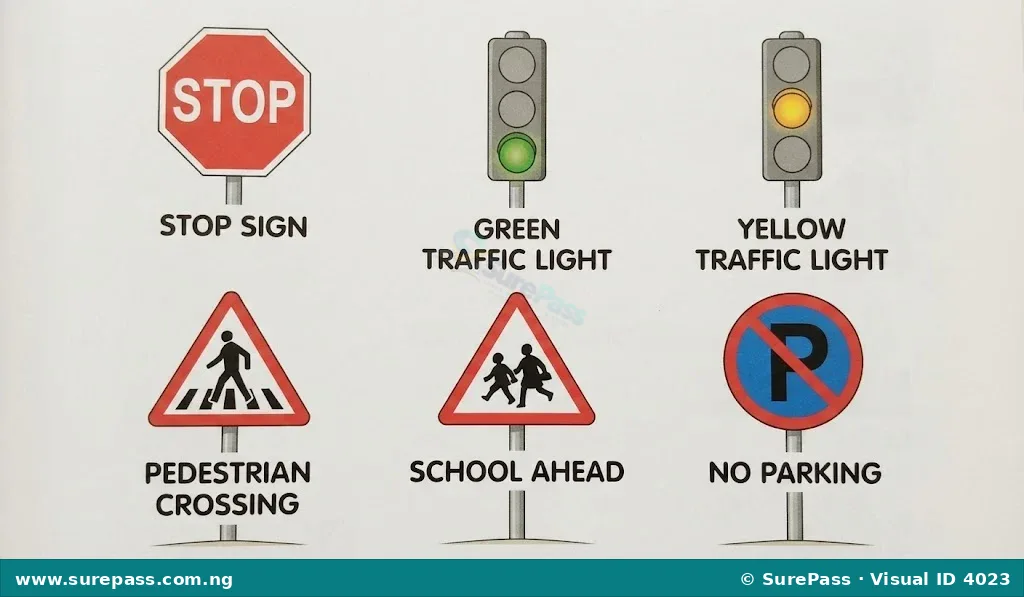
- Stop Sign: This red sign means all vehicles and pedestrians must stop completely before moving again when it is safe.
- Go (Green Traffic Light): A green light means vehicles and pedestrians can move forward if the path is clear.
- Wait (Yellow Traffic Light): A yellow light means vehicles should prepare to stop, and pedestrians should wait.
- Pedestrian Crossing Sign: This sign shows a person walking on stripes. It means there is a safe place for people to cross the road.
- School Ahead Sign: This sign shows children walking. It warns drivers that they are near a school and should drive slowly and carefully.
- No Parking Sign: This sign is a blue circle with a red line across it and a ‘P’. It means vehicles are not allowed to park in that area.
- Danger Sign: This sign often has a black exclamation mark (!) on a yellow background. It warns people about a dangerous area.
Importance of Road Traffic and Safety Signs
Road traffic and safety signs are very important for many reasons:
- They keep people safe: Signs warn people about dangers and tell them how to avoid accidents.
- They help traffic flow: Signs tell drivers when to stop, go, or slow down, which helps cars move smoothly.
- They guide people: Signs show people where to go, like where a hospital is or where they can cross the road.
- They prevent confusion: Everyone understands what the signs mean, so there is less confusion on the road.
Using Signs and Symbols in Context
Understanding signs and symbols helps people make good choices and stay safe. For example:
- When a child sees a “STOP” sign, they know to stop before crossing the road.
- When a driver sees a “School Ahead” sign, they know to drive slowly and watch out for children.
- When someone sees a “Restroom” sign, they know where to find the toilet.
- When a person reads “Mr. Obi,” they know it is a man’s name.
- When a child sees a happy face emoji, they know the sender is feeling happy.


0 comments
Open the discussion when you need it. Comments stay collapsed until requested so the initial article remains light.