



ARTICLE CONTENTSOn this page 9 sections
Insha’i
Performance Objectives
By the end of the lesson, students should be able to:
- Bayyana ma’anar insha’i (Explain the meaning of essay).
- Kawo ire-iren insha’i (Give the types of essay).
- Bayyana muhimmancin insha’i (Explain the importance of essay).
- Karanta insha’i (Read an essay).
Ma’anar Insha’i (Meaning of Essay)
Insha’i is the systematic arrangement of thoughts, ideas, feelings, or experiences in written form using clear, organized, and grammatically correct language.
In Hausa language studies, Insha’i refers to composition or essay writing. It is a creative process where a writer carefully selects words, constructs sentences, and organizes paragraphs to communicate a specific message to a reader. Writing an essay requires clear thinking, a good vocabulary, and a proper understanding of grammatical rules.
Ire-iren Insha’i (Types of Essay)
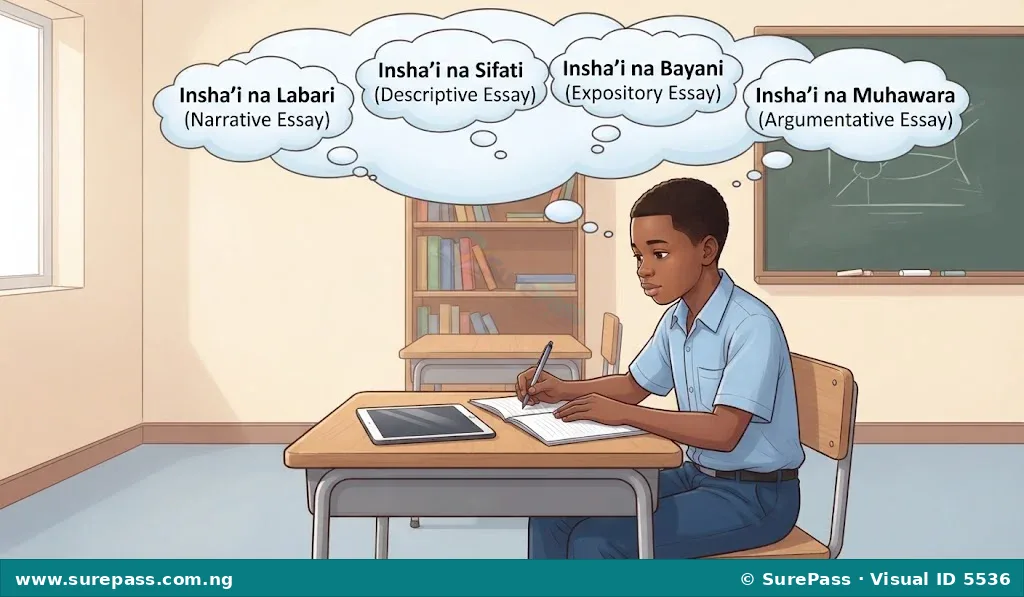
Insha’i is classified into different types based on the purpose of the writing and how the information is presented. The four main types of Insha’i studied at this level are:
- Insha’i na Labari (Narrative Essay): This type of essay is used to tell a story, recount an event, or narrate a personal experience. It usually follows a chronological order, showing what happened from the beginning to the end. Examples include writing about a memorable holiday (Hutu na Musamman) or a football match (Wasan Ƙwallon Ƙafa).
- Insha’i na Sifati (Descriptive Essay): This type of essay is used to describe a person, place, animal, or object in detail. It paints a clear picture in the mind of the reader using descriptive words. Examples include describing one’s school (Makarantata), one’s mother (Mahaifiyata), or a local market (Kasuwar Garinmu).
- Insha’i na Bayani (Expository Essay): This type of essay is used to explain a concept, a process, or how to do something. It focuses on providing factual information and step-by-step explanations. Examples include explaining how to cook a local dish (Yadda Ake Tuwon Shinkafa) or how to play a traditional game.
- Insha’i na Muhawara (Argumentative Essay): This type of essay is used to argue a point, present two opposing sides of an issue, or persuade the reader to agree with a specific point of view. Examples include debating whether a teacher is more important than a doctor (Wa Ya Fi Amfani, Malami Ko Likita?).
Muhimmancin Insha’i (Importance of Essay Writing)
Learning how to write essays in Hausa is highly beneficial for students. The key reasons why Insha’i is important include:
- Haɓaka Dabarun Rubutu (Developing Writing Skills): It helps students practice how to write words, construct sentences, and build paragraphs correctly in the Hausa language.
- Bayyana Ra’ayi (Expressing Thoughts and Ideas): It provides a structured way for students to share their thoughts, feelings, imaginations, and experiences with others.
- Inganta Ƙamus da Nahawu (Improving Vocabulary and Grammar): Regular essay writing encourages students to search for and use new Hausa words, which improves their vocabulary and mastery of Hausa grammar.
- Sadarwa (Effective Communication): It trains students on how to present information clearly and logically, making it easy for readers to understand the message.
- Samun Nasara a Jarabawa (Academic Success): Essay writing is a major component of Hausa language examinations. Mastering Insha’i helps students score high marks in their school tests and external examinations.
Karanta Insha’i (Reading and Understanding an Essay)
To write a good essay, one must first learn how to read and analyze existing essays. Reading helps students understand how paragraphs are structured and how transition words are used to connect ideas.
Below is a simple descriptive essay written in Hausa, followed by its English translation for study purposes.
Makarantata (My School)
Suna na Aminu. Ina karatu a Makarantar Sakandare ta Gwamnati da ke garin Kano. Makarantarmu tana da kyau ƙwarai da gaske. Akwai manyan azuzuwa masu buɗe baki da iska, da kuma babban filin wasa inda muke yin ƙwallon ƙafa. Malamanmu suna da haƙuri kuma suna koyar da mu da kyau. Ina son makarantata sosai domin tana taimaka mini in sami ilimi.
English Translation of the Essay
My name is Aminu. I study at Government Secondary School in Kano. Our school is very beautiful. There are large, well-ventilated classrooms and a big playground where we play football. Our teachers are patient and teach us very well. I love my school very much because it helps me gain knowledge.
An analysis of the essay above reveals three main parts:
- Gabatarwa (Introduction): The first two sentences introduce the writer (Aminu) and the subject of the essay (his school in Kano).
- Gundarin Bayani (Body of the Essay): The middle sentences describe the physical features of the school (large classrooms, playground) and the people in it (patient teachers).
- Kammalawa (Conclusion): The final sentence wraps up the essay by expressing the writer’s feelings toward the school and its importance to his life.
Dabarun Aiwatarwa (Skills and Writing Techniques)
Writing a successful essay requires specific steps and skills. Students should practice these techniques to improve their writing ability (iya rubutu) and comprehension (fahimtar rubutu).
The step-by-step procedure for writing an essay involves the following steps:
- Zaɓar Jigo (Choosing a Topic): Select a topic that is familiar and interesting. For example, “Abokina” (My Friend) or “Garinmu” (Our Town).
- Tattara Bayanai (Brainstorming Ideas): Think about the topic and write down key points, words, and ideas related to it.
- Tsara Bayanai (Organizing Points): Arrange the points in a logical order. Decide what will go into the introduction, the body paragraphs, and the conclusion.
- Rubuta Gabatarwa (Writing the Introduction): Start with a strong opening paragraph that tells the reader what the essay is about.
- Rubuta Gundarin Bayani (Writing the Body): Write one or two paragraphs explaining the main points in detail. Use clear Hausa sentences and appropriate punctuation marks.
- Kammalawa (Concluding the Essay): Write a short final paragraph that summarizes the main points or gives a final thought on the topic.
- Gyara Kuskure (Proofreading and Editing): Read through the completed essay to check for spelling mistakes, grammatical errors, and punctuation issues, then correct them.
Summary of Key Hausa Terms
The following table pairs key Hausa essay-writing terms with their English meanings for quick reference:
| Hausa Term | English Meaning |
|---|---|
| Insha’i | Essay / Composition |
| Insha’i na Labari | Narrative Essay |
| Insha’i na Sifati | Descriptive Essay |
| Insha’i na Bayani | Expository Essay |
| Insha’i na Muhawara | Argumentative Essay |
| Gabatarwa | Introduction |
| Gundarin Bayani | Body of the Essay |
| Kammalawa | Conclusion |
Evaluation Guide
Answer the following questions to test your understanding of the lesson:
- Mene ne ma’anar insha’i? (What is the meaning of Insha’i?)
- Kawo ire-iren insha’i guda huɗu da ka koya. (Give four types of Insha’i that you have learned.)
- Bayyana muhimmancin insha’i guda uku ga ɗalibi. (Explain three benefits of essay writing to a student.)
- Karanta gajeren insha’i na “Makarantata” sannan ka nuna inda gabatarwa da kammalawa suke. (Read the short essay “Makarantata” and point out where the introduction and conclusion are located.)





0 comments
Open the discussion when you need it. Comments stay collapsed until requested so the initial article remains light.