



ARTICLE CONTENTSOn this page 10 sections
Jinsi
Performance Objectives
By the end of the lesson, students should be able to:
- bayyana ma’anar jinsi (explain the meaning of gender);
- kawo rabe-raben jinsi (give the classifications of gender);
- ba da misalan jinsi (give examples of gender);
- rubuta jumloli masu ɗauke da jinsi (write sentences containing gender).
Meaning of Jinsi
Grammatical gender, known as jinsi in Hausa, is the grammatical classification of nouns, pronouns and other associated words into masculine or feminine categories.
In the Hausa language, every noun belongs to a specific gender category. Unlike English, which uses a neutral gender for non-living things (such as “table” or “stone”), Hausa classifies both living and non-living things as either masculine or feminine. Understanding the gender of a noun is essential because it determines how other words, such as pronouns, adjectives and prepositions, behave within a sentence.
Classifications of Jinsi (Rabe-raben Jinsi)
The Hausa language divides grammatical gender into two main classifications:
- Jinsi Namiji (Masculine Gender)
- Jinsi Tamata (Feminine Gender)
1. Jinsi Namiji (Masculine Gender)
Jinsi namiji refers to nouns that represent male living things, as well as non-living things that are grammatically treated as masculine.
In Hausa grammar, most masculine nouns end with vowels other than “-a”, such as “-o”, “-i”, “-u” or “-e”. However, there are exceptions where some nouns ending in “-a” are masculine due to their natural male characteristics.
Examples of masculine nouns include:
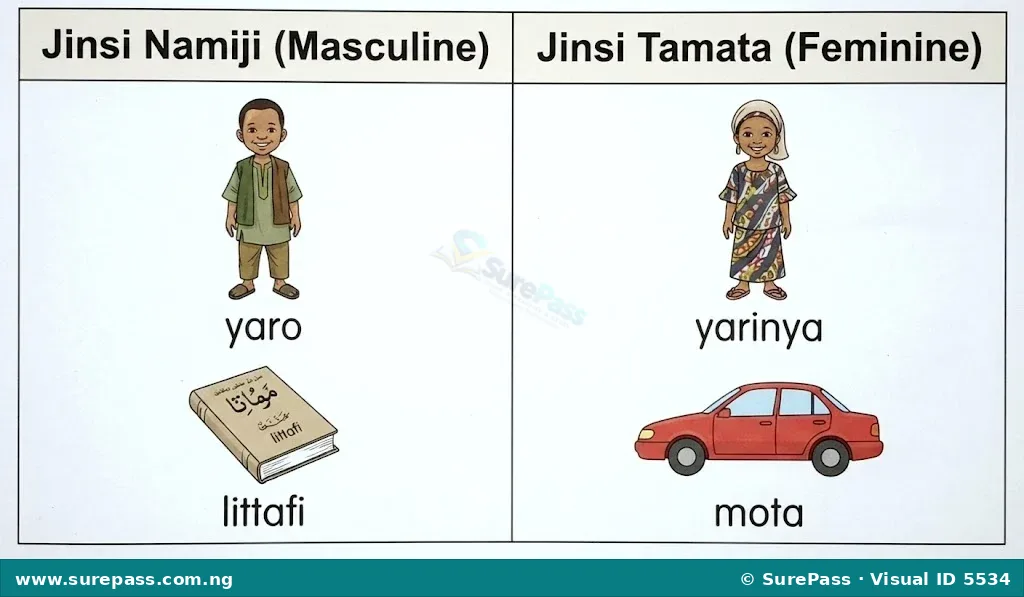
- Yaro (Boy) – ends in “-o”
- Littafi (Book) – ends in “-i”
- Kofi (Cup) – ends in “-i”
- Gari (Town/City) – ends in “-i”
- Uba (Father) – ends in “-a” but is masculine by nature
2. Jinsi Tamata (Feminine Gender)
Jinsi tamata refers to nouns that represent female living things, as well as non-living things that are grammatically treated as feminine.
In Hausa grammar, the vast majority of feminine nouns end with the vowel “-a”. There are very few exceptions where a feminine noun ends in another vowel.
Examples of feminine nouns include:
- Yarinya (Girl) – ends in “-a”
- Mota (Car) – ends in “-a”
- Kujera (Chair) – ends in “-a”
- Saniya (Cow) – ends in “-a”
- Mace (Woman) – ends in “-e” but is feminine by nature
Observe the visual representation below showing the contrast between masculine and feminine nouns in Hausa.
How to Identify Jinsi (Hanyoyin Gane Jinsi)
Grammatical gender in Hausa can be identified using two main methods:
- Jinsi na Halitta (Natural Gender): This is based on the biological sex of living things. Any male human or animal is masculine (e.g., Zaki – Lion, Namiji – Man). Any female human or animal is feminine (e.g., Gimbiya – Princess, Kaza – Hen).
- Ƙarshen Wasali (Vowel Endings): For non-living things, gender is determined by the final vowel of the word. Words ending in “-a” are almost always feminine (e.g., hula – cap, taga – window). Words ending in “-e”, “-i”, “-o” or “-u” are masculine (e.g., bango – wall, gashi – hair).
Examples of Gender in Sentence Construction (Misalan Aikin Jinsi)
Grammatical gender affects how sentences are built in Hausa. It influences the choice of linkers, pronouns and adjectives.
1. Genitive Linkers (Na and Ta)
The linker meaning “of” changes depending on the gender of the noun that comes before it:
- Na is used for masculine nouns (e.g., Littafi na Bello – Bello’s book).
- Ta is used for feminine nouns (e.g., Mota ta Amina – Amina’s car).
2. Pronouns (Wakilin Suna)
Subject and object pronouns must agree with the gender of the noun they represent:
- Masculine singular uses ya (he/it) or shi (him/it) (e.g., Yaro ya zo – The boy came).
- Feminine singular uses ta (she/it) or ita (her/it) (e.g., Yarinya ta zo – The girl came).
3. Adjectives (Sifofi)
Adjectives change their endings to match the gender of the noun they describe:
- Masculine: Dogon yaro (Tall boy) / Farin littafi (White book).
- Feminine: Doguwar yarinya (Tall girl) / Farar takarda (White paper).
Writing Sentences with Jinsi (Rubuta Jumloli)
The table below shows how sentences are structured differently based on whether the subject noun is masculine or feminine:
| Jumlar Namiji (Masculine Sentence) | Jumlar Tamata (Feminine Sentence) | English Translation / Explanation |
|---|---|---|
| Wannan littafi ne. | Wannan mota ce. | This is a book (masc. uses ne) / This is a car (fem. uses ce). |
| Kare ya gudu. | Mage ta gudu. | The dog ran away (masc. pronoun ya) / The cat ran away (fem. pronoun ta). |
| Bello yana da sabon gida. | Amina tana da sabuwar hula. | Bello has a new house (masc. adjective) / Amina has a new cap (fem. adjective). |
| Gidan na Audu ne. | Kujerar ta Maryam ce. | The house is Audu’s (linker na) / The chair is Maryam’s (linker ta). |
Identifying Gender in a Short Story (Tantance Jinsi a Labari)
Read the short Hausa story below carefully to observe how masculine and feminine nouns are used in context.
“Akwai wani yaro mai suna Bello. Yana da mace mai suna Amina. Bello yana da babban littafi. Amina kuma tana da farar mota. Kullum Bello yana zama a kan kujera yana karatu. Amina tana tuka mota zuwa kasuwa.”
The nouns from the story are classified by gender as follows:
- Masculine Nouns (Jinsi Namiji): Yaro (Boy), Bello (Boy’s name), Littafi (Book).
- Feminine Nouns (Jinsi Tamata): Mace (Woman), Amina (Girl’s name), Mota (Car), Kujera (Chair), Kasuwa (Market).
Summary
Grammatical gender (jinsi) is a fundamental part of Hausa grammar. Nouns are divided into masculine (namiji) and feminine (tamata). This classification affects the choice of pronouns, adjectives, linkers and copulas within a sentence. Mastering these rules helps in writing and speaking correct Hausa sentences.
Evaluation Exercises
Answer the following questions to test your understanding of the lesson:
- Bayyana ma’anar jinsi a harshen Hausa (Explain the meaning of gender in the Hausa language).
- Kawo rabe-raben jinsi guda biyu da aka koya (Give the two classifications of gender learned in this lesson).
- Ba da misalan kalmomi guda uku na jinsi namiji da guda uku na jinsi tamata (Give three examples of masculine nouns and three examples of feminine nouns).
- Cike gurbi da kalmar da ta dace tsakanin (na / ta) ko (ne / ce):
- Wannan hula __ Amina ce.
- Littafi __ Bello ya bace.
- Kujera __ ta karye.
- Gari __ da dadi.
- Karanta wannan gajeren labari na kasa, sannan ka fitar da kalmomin jinsi namiji guda uku da na jinsi tamata guda uku:
“Malam Musa ya tafi gona da safe. Ya tuka babur dinsa. Matarsa, mai suna Ladi, ta tsaya a gida tana dafa abinci a tukunya.”



0 comments
Open the discussion when you need it. Comments stay collapsed until requested so the initial article remains light.