


ARTICLE CONTENTSOn this page 9 sections
Ƙa’idojin Rubutun Hausa
Performance Objectives
By the end of the lesson, students should be able to:
- List the rules of Hausa writing.
- Explain the importance of Hausa writing rules.
- Apply Hausa writing rules in writing sentences and short passages.
- Use a computer or mobile device to write Hausa text using the correct writing rules.
Meaning of Hausa Writing Rules
Hausa writing rules (ƙa’idojin rubutun Hausa) are the agreed-upon guidelines and standards used for writing the Hausa language correctly, clearly and uniformly.
These rules were established by language experts and academic bodies to ensure that written Hausa is easily understood by readers everywhere. Just like other major world languages, Hausa has specific guidelines governing capitalization, punctuation, word spacing and the use of special characters.
Types of Hausa Writing Rules
The rules of Hausa writing are divided into several categories. These categories guide how letters, words and punctuation marks are arranged to form correct sentences.
1. Use of Capital Letters (Amfani da Babban Baƙi)
Capital letters are used in specific positions within a text. The main rules for using capital letters in Hausa include:
- Beginning of a sentence: Every new sentence must start with a capital letter. For example: Makaranta tana da kyau. (School is good).
- Proper nouns: Names of specific people, places, countries, languages, days of the week and months must start with a capital letter. Examples include: Ali (person), Kano (place), Najeriya (country), Hausa (language), Litinin (Monday) and Yuni (June).
- Titles of books and headings: The main words in titles of books, essays or headings must begin with capital letters. For example: Magana Jari Ce.
2. Special Hausa Letters (Baƙaƙen Hausa na Musamman)
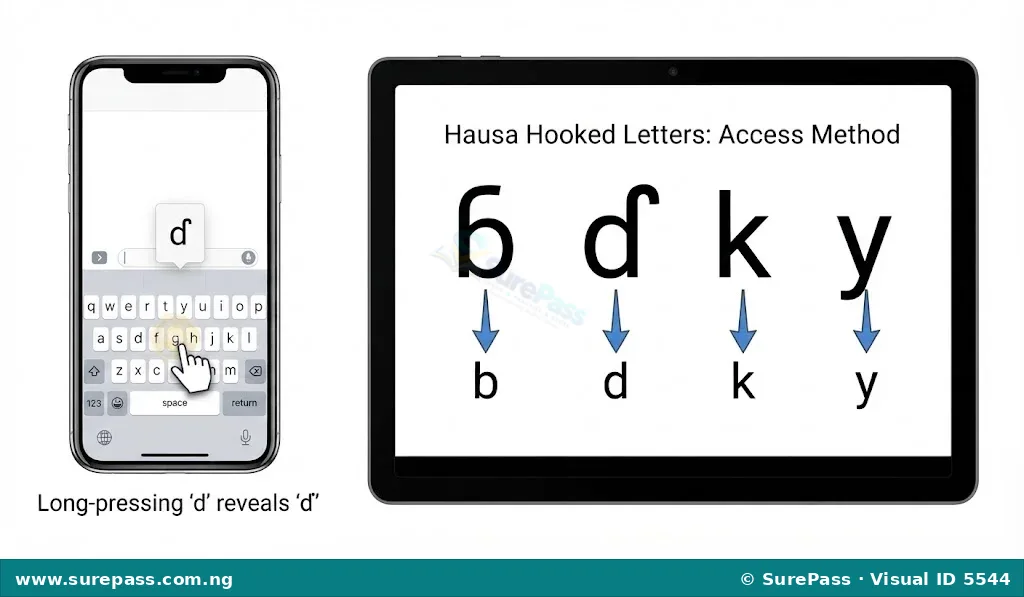
The Hausa alphabet contains unique hooked letters that represent specific sounds. Writing these letters correctly is essential because using a plain letter instead of a hooked letter can completely change the meaning of a word.
The four main hooked letters in Hausa are:
- ɓ (B mai ƙugiya): Used in words like ɓarawo (thief) or ɓata (to spoil). Writing it as a normal ‘b’ changes the sound and meaning.
- ɗ (D mai ƙugiya): Used in words like ɗa (son/child) or ɗaki (room). Writing it as a normal ‘d’ changes the word to da (with/and) or daki (strike).
- ƙ (K mai ƙugiya): Used in words like ƙasa (land/ground) or ƙari (increase). Writing it as a normal ‘k’ changes the word to kasa (to fail) or kari (dog’s bark).
- ƴ or ’y (Y mai ƙugiya/Y tare da lissafi): Used in words like ƴa (daughter) or ƴanci (freedom).
Observe the diagram below to see how these special characters are identified and typed on digital devices.
3. Punctuation Marks (Alamomin Rubutu)
Punctuation marks help readers understand the flow, pauses and emotions in a written passage. The primary punctuation marks used in Hausa are:
- Full Stop (Digo `.`): Placed at the end of a complete statement. Example: Audu ya tafi gona. (Audu went to the farm).
- Comma (Wakafi `,`): Used to indicate a short pause or to separate items in a list. Example: Ina da riga, da wando, da hula. (I have a shirt, trousers and a cap).
- Question Mark (Alamar Tambaya `?`): Placed at the end of a direct question. Example: Ina za ka? (Where are you going?).
- Exclamation Mark (Alamar Motsin Rai `!`): Used to express strong feelings, surprise, anger or a command. Example: Haba! (Oh no!) or Tsaya! (Stop!).
4. Word Spacing and Division (Raba Kalmomi da Haɗa Su)
In Hausa orthography, certain words must be written separately, while others must be joined together. Writing them incorrectly makes the text difficult to read.
The rules for word spacing include:
- Prepositions: Prepositions such as a (at/in), da (with/and), ga (to/towards) and daga (from) must be written separately from the nouns that follow them. For example: a gida (at home), not agida; da safe (in the morning), not dasafe.
- Pronouns and Aspect Markers: Subject pronouns and their tense/aspect markers are written as separate words from the verb. For example: ya zo (he came), not yazo; na tafi (I went), not natafi.
- Genitive Copula (Na and Ta): The particles na (masculine “of”) and ta (feminine “of”) are written as separate words when they stand between two nouns. For example: littafi na Ali (book of Ali), not littafinaAli. However, when shortened and attached to the noun, they are joined: littafin Ali.
Importance of Hausa Writing Rules
Adhering to the established rules of Hausa writing is vital for several reasons. The main benefits of these rules are:
- Ensuring Clarity of Meaning: Correct spelling and punctuation prevent confusion. For example, writing da (with) instead of ɗa (son) can completely change the meaning of a sentence.
- Promoting Uniformity: Standard rules ensure that Hausa speakers from different regions (such as Kano, Sokoto, Katsina or Zaria) can read the same written material without difficulty.
- Facilitating Effective Communication: Proper punctuation helps readers know when to pause, when a question is asked and when an emotion is expressed, making written communication as effective as spoken speech.
- Preserving the Language: Standardized writing rules help preserve the structure and grammar of the Hausa language for future generations and academic study.
- Aiding Digital Typing and Printing: Standard rules make it easier to publish books, newspapers and digital content on computers, tablets and mobile phones.
How to Apply Hausa Writing Rules in Sentences
To write Hausa correctly, a writer must carefully apply capitalization, punctuation, word spacing and hooked letters. Below is a comparison showing how errors can be corrected using the rules of Hausa writing.
The following table shows incorrect sentences and their corrected versions:
| Incorrect Sentence (Kuskure) | Correct Sentence (Daidai) | Explanation of Corrections |
|---|---|---|
| ali ya tafi kano ranar litinin domin ya sayi kifi da daci | Ali ya tafi Kano ranar Litinin domin ya sayi kifi da ɗaci. | Capitalized ‘A’ in Ali, ‘K’ in Kano, ‘L’ in Litinin; changed ‘daci’ to ‘ɗaci’ (bitterness/sharp taste); added a full stop. |
| ina zaka dasafe | Ina za ka da safe? | Capitalized ‘I’ in Ina; separated ‘za ka’ and ‘da safe’; added a question mark. |
| baba ya sayi gida a katsina | Baba ya sayi gida a Katsina. | Capitalized ‘B’ in Baba and ‘K’ in Katsina; separated ‘a’ from ‘Katsina’; added a full stop. |
How to Type Hausa Special Characters on Digital Devices
Modern technology allows learners to write Hausa correctly on computers, tablets and smartphones. This is done by using specific keyboard settings or shortcuts.
Typing on Mobile Phones and Tablets
The procedure for typing Hausa hooked letters on mobile devices involves the following steps:
- Open the settings menu on the mobile device or tablet.
- Go to “Languages & Input” and select “Keyboards”.
- Add “Hausa” to the list of active keyboard languages.
- When typing, long-press the base letter to reveal the hooked character. For example, long-press b to get ɓ, long-press d to get ɗ, long-press k to get ƙ, and long-press y to get ƴ.
Typing on Computers (Windows or macOS)
The procedure for typing Hausa hooked letters on a computer involves the following steps:
- Install the Hausa keyboard layout from the language settings of the operating system.
- Switch the active keyboard language to Hausa using the language bar on the taskbar.
- Use the designated shortcut keys on the physical keyboard to type the special characters (for example, on many Hausa keyboard layouts, pressing the AltGr key combined with ‘b’, ‘d’, ‘k’ or ‘y’ produces the hooked letters ɓ, ɗ, ƙ, ƴ).
- Alternatively, use the “Insert Symbol” function in word processing software like Microsoft Word to select and insert the hooked letters.
Summary
The summary of the key points discussed in this unit includes:
- Hausa writing rules are the standard guidelines that ensure written Hausa is clear, accurate and uniform.
- The main types of rules cover capitalization, the use of special hooked letters (ɓ, ɗ, ƙ, ƴ), punctuation marks and correct word spacing.
- Using these rules prevents confusion, makes reading easier and preserves the standard form of the language.
- Digital devices like computers and smartphones can be configured with Hausa keyboards to enable correct typing of special characters.
Evaluation Questions
Answer the following questions to test your understanding of the lesson:
- Explain what is meant by “ƙa’idojin rubutun Hausa”.
- List the four main hooked letters used in Hausa writing and provide one word as an example for each.
- State three reasons why Hausa writing rules are important.
- Rewrite the following passage, correcting all errors in capitalization, punctuation, word spacing and hooked letters:
“guda biyu daga cikin yaran amina sun tafi makaranta a ranar talata domin su rubuta jarrabawa kowa ya tafi da alkalami da littafi” - Describe the steps required to type the hooked letter ɗ on a mobile phone or tablet.


0 comments
Open the discussion when you need it. Comments stay collapsed until requested so the initial article remains light.