



ARTICLE CONTENTSOn this page 7 sections
Zagin Aikatau
Performance Objectives
By the end of the lesson, students should be able to:
- explain the meaning of zagin aikatau (verb reduplication);
- identify the grammatical environment (muhalli) of zagin aikatau in a sentence;
- give examples of zagin aikatau;
- identify and distinguish zagin aikatau within various sentences.
Meaning of Zagin Aikatau
Zagin aikatau is a grammatical process in the Hausa language where a verb is repeated or doubled, often with a modification to its ending vowels, to show that an action is performed repeatedly, continuously, intensively, or by multiple subjects.
In Hausa grammar, the word “zagi” refers to reduplication or repetition. When applied to verbs (aikatau), it changes the simple form of the verb into a repetitive form. This process helps to express the frequency or intensity of an action without needing to write long explanatory sentences. For instance, instead of saying a person kept buying different things over and over, a single reduplicated verb is used to convey the entire message.
Examples of Zagin Aikatau (Misalan Zagin Aikatau)
To form zagin aikatau, the base verb undergoes a morphological change. Most Grade 1 and Grade 2 verbs in Hausa change their final vowels to “-e-e” when they are reduplicated. Other verbs may simply repeat their base form with minor tonal adjustments.
The following table shows how base verbs are transformed into zagin aikatau along with their English meanings:
| Base Verb (Tushen Aikatau) | English Meaning | Reduplicated Verb (Zagin Aikatau) | Grammatical Meaning |
|---|---|---|---|
| Saya | To buy | Saye-saye | Repeated buying / making various purchases |
| Rubuta | To write | Rubuce-rubuce | Frequent writing / various writings |
| Karanta | To read | Karance-karance | Frequent reading of different materials |
| Kira | To call | Kire-kire | Repeated calling / making multiple calls |
| Duba | To look / examine | Dubace-dubace | Frequent looking / searching through things |
| Tambaya | To ask | Tambaye-tambaye | Frequent questioning / asking multiple questions |
| Tafi | To go | Tafe-tafe | Frequent travelling / moving from place to place |
| Gudu | To run | Gudu-gudu | Running repeatedly or in a hasty manner |
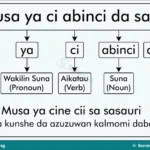
Observe the image below to see a visual representation of this concept.

Grammatical Environment of Zagin Aikatau (Muhallin Zagin Aikatau)
The term “muhalli” refers to the position or grammatical environment where zagin aikatau occurs within a Hausa sentence. Reduplicated verbs do not just appear anywhere; they occupy specific structural positions to perform distinct grammatical functions.
The primary grammatical environments of zagin aikatau include:
- After Continuous Aspect Pronouns (Bayan Wakilin Suna na Lokaci Mai Ci): This is the most common environment. The reduplicated verb functions as a verbal noun immediately following continuous tense markers such as yana (he is), tana (she is), suna (they are), or muna (we are).
- As the Object of a Sentence (A Matsayin Abokin Aiki): In this position, the reduplicated verb acts as the direct object that receives the action of another main verb in the sentence.
- As an Adverbial Modifier (A Matsayin Bayanin Aikatau): Here, the reduplicated verb is used to describe the manner in which another action is being performed.
Identifying Zagin Aikatau in Sentences (Tantance Zagin Aikatau)
To identify zagin aikatau in a sentence, learners must look for repeated verbal structures and analyze their position relative to pronouns and other verbs.
The following examples demonstrate how to identify and analyze zagin aikatau in different sentences:
Example 1: Occurrence after a continuous pronoun
Sentence: Musa yana rubuce-rubuce a cikin daki. (Musa is busy writing various things in the room.)
Analysis: In this sentence, rubuce-rubuce is the zagin aikatau. It occurs immediately after the continuous aspect pronoun yana, which establishes its grammatical environment.
Example 2: Occurrence as a direct object
Sentence: Audu ya fasa kire-kire da daddare. (Audu stopped making repeated calls at night.)
Analysis: In this sentence, kire-kire is the zagin aikatau. It functions as the direct object of the main verb ya fasa (he stopped/cancelled).
Example 3: Occurrence as an adverbial modifier
Sentence: Bala ya shigo gida yana kame-kame. (Bala entered the house making hesitant, clutching movements.)
Analysis: In this sentence, kame-kame is the zagin aikatau. It describes the manner in which Bala entered the house, acting as an adverbial modifier.
The following table provides more sentences for identification practice:
| Sentence (Jumla) | Identified Zagin Aikatau | Base Verb | English Translation of the Sentence |
|---|---|---|---|
| Ladi tana saye-saye a kasuwa. | Saye-saye | Saya | Ladi is making various purchases at the market. |
| Malamin yana tambaye-tambaye. | Tambaye-tambaye | Tambaya | The teacher is asking multiple questions. |
| Suna tafe-tafe tun safe. | Tafe-tafe | Tafi | They have been travelling from place to place since morning. |
| Dalibai suna karance-karance a dakin karatu. | Karance-karance | Karanta | The students are reading various materials in the library. |
Summary of Key Grammatical Rules
When analyzing or forming zagin aikatau, the following rules should be kept in mind:
- The base verb must be a word that denotes an action (aikatau). Nouns or adjectives cannot undergo zagin aikatau.
- The reduplication must show a plural, repetitive, or intensive meaning. Simply repeating a word for emphasis without morphological change (such as “gudu gudu” without vowel modification where required) must be distinguished based on context.
- The grammatical environment (muhalli) determines the exact role the reduplicated verb plays in the sentence, whether as a continuous action, an object, or a description of manner.




0 comments
Open the discussion when you need it. Comments stay collapsed until requested so the initial article remains light.