



ARTICLE CONTENTSOn this page 8 sections
Fihirisa
Performance Objectives
By the end of the lesson, students should be able to:
- bayyana ma’anar fihirisa (explain the meaning of fihirisa);
- bayyana hanyoyin yin fihirisa (explain the methods of indexing);
- kawo nau’o’in abubuwan da ake yi wa fihirisa (identify the types of things that are indexed);
- aiwatar da fihirisa (demonstrate how to create an index).
Ma’anar Fihirisa (Meaning of Indexing)
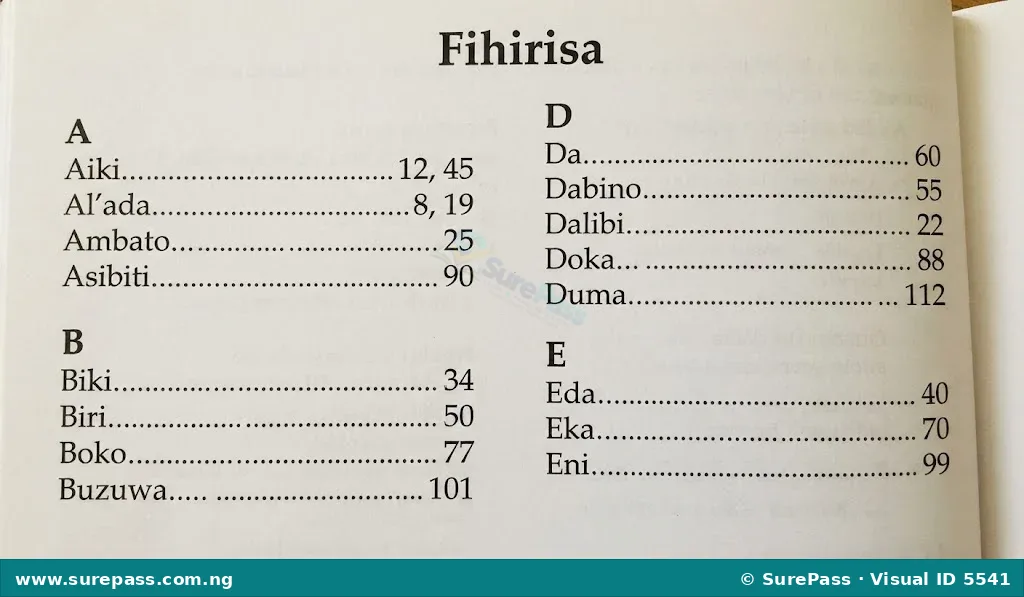
Fihirisa is an alphabetical list of names, subjects, topics, or words with references to the pages or locations where they can be found in a book, document, or collection.
In the Hausa language, fihirisa refers to the systematic arrangement of items to make them easy to find. When a book contains a lot of information, reading through every page to find a specific topic can be difficult. An index, which is usually placed at the back of a book, solves this problem by listing key terms alphabetically alongside their corresponding page numbers.
Observe the image below to see how a typical index page is structured in a textbook.
Abubuwan da ake yi wa Fihirisa (Things That Are Indexed)
Indexing is applied to various materials in schools, libraries, and offices to maintain order and ensure quick access to information.
Common items and materials that require indexing include:
- Littattafai (Books): Textbooks, reference books, and dictionaries use indexes at the back so readers can locate specific terms, definitions, or topics quickly.
- Littattafan Ɗakin Karatu (Library Books): Libraries use index cards or digital catalogues to arrange books by author name, title, or subject matter.
- Fayiloli a Ofis (Office Files): Administrative offices index files alphabetically or by department to make document retrieval easy for workers.
- Rijistar Sunaye (Registers of Names): School attendance registers, directories, and lists of students are indexed alphabetically by surname to help teachers find names easily.
- Kamus (Dictionaries): Words in a dictionary are indexed from letter A to Z to allow users to find meanings without searching through the entire book.
Hanyoyin Yin Fihirisa (Methods of Indexing)
There are different systematic ways to organize information depending on the type of material being indexed.
The main methods used to create an index include:
- Tsarin Haruffa (Alphabetical Method): This is the most common method where items are arranged according to the alphabet from A to Z. In Hausa, words starting with ‘A’ (such as Akwiya) are placed before words starting with ‘B’ (such as Biri).
- Tsarin Jigogi ko Batutuwa (Subject or Topical Method): Items are grouped according to their themes, categories, or subjects before being arranged. For example, grouping all domestic animals together and all wild animals together.
- Tsarin Lambobi ko Lokaci (Numerical or Chronological Method): Items are arranged according to numbers, dates, or the order in which events occurred. This is common in history books and financial records.
Yadda ake Yin Fihirisa (How to Create an Alphabetical Index)
Creating an index requires careful attention to the spelling and the starting letters of the words being organized.
The procedure for creating a simple alphabetical index of words involves the following steps:
- Gather the list of words or names that need to be indexed.
- Identify the first letter of each word in the list.
- Group the words that start with the same letter together.
- Arrange the groups in alphabetical order from A to Z.
- If two or more words start with the same letter, look at the second letter (and third letter if necessary) to determine which word comes first.
- Write down the final sorted list clearly in a notebook.
Consider an unsorted list of Hausa animal names: Kura, Akwiya, Zaki, Biri, Giwa, Damisa.
By applying the alphabetical indexing steps, the words are rearranged as follows:
- Akwiya (starts with A)
- Biri (starts with B)
- Damisa (starts with D)
- Giwa (starts with G)
- Kura (starts with K)
- Zaki (starts with Z)
Observe the flowchart below to understand the step-by-step process of sorting unsorted words into an alphabetical index.
Ayyukan Aji (Class Activity)
To practice indexing, learners can work in small groups to organize their own names alphabetically.
The steps for students to perform indexing among themselves in the classroom are:
- Form groups of five students.
- Write down the surnames of all five group members on a sheet of paper.
- Identify the starting letter of each surname.
- Arrange the surnames in alphabetical order from A to Z.
- Present the completed index to the teacher for evaluation.
Tambayoyin Gwada Fahimta (Review Questions)
Students should answer the following questions to test their understanding of the lesson:
- Menene ma’anar fihirisa? (What is the meaning of fihirisa?)
- Kawo misalan abubuwa guda uku da ake yi wa fihirisa. (Give three examples of things that are indexed.)
- Bayyana hanyoyi guda biyu na yin fihirisa. (Explain two methods of indexing.)
- Tsara wadannan kalmomin Hausa bisa tsarin fihirisa: Mota, Gida, Tulu, Rariya, Kasko, Littafi. (Arrange these Hausa words in alphabetical index order.)




0 comments
Open the discussion when you need it. Comments stay collapsed until requested so the initial article remains light.