


ARTICLE CONTENTSOn this page 9 sections
Sauraron Labarai
Performance Objectives
By the end of the lesson, students should be able to:
- ba da ma’anar labari na gidan rediyo ko talabijin;
- kawo nau’o’in labaran rediyo da na talabijin;
- sauraron labari na rediyo ko na talabijin;
- taƙaita labaran da suka saurara.
Meaning of Radio and Television News (Ma’anar Labari na Rediyo da na Talabijin)
Labari na rediyo da talabijin shi ne sanarwa ko bayani da ake yaɗawa ga jama’a ta hanyar sauti ko hoto da sauti domin sanar da su abubuwan da ke faruwa a cikin gida da waje.
Radio and television news refers to the broadcast of information, events, and reports to the public through sound or both sound and moving images to keep them informed about local and international happenings.
Radio news (labaran rediyo) relies solely on audio. Listeners hear the voice of the newsreader (mai karanta labarai) or reporter (mai ba da rahoto) without seeing them. Television news (labaran talabijin) combines both audio and video. Viewers can see the news presenter, video clips, and pictures of the events being reported.
Information is broadcast through various media outlets. In Nigeria, these media outlets are known as kafafen yaɗa labarai.
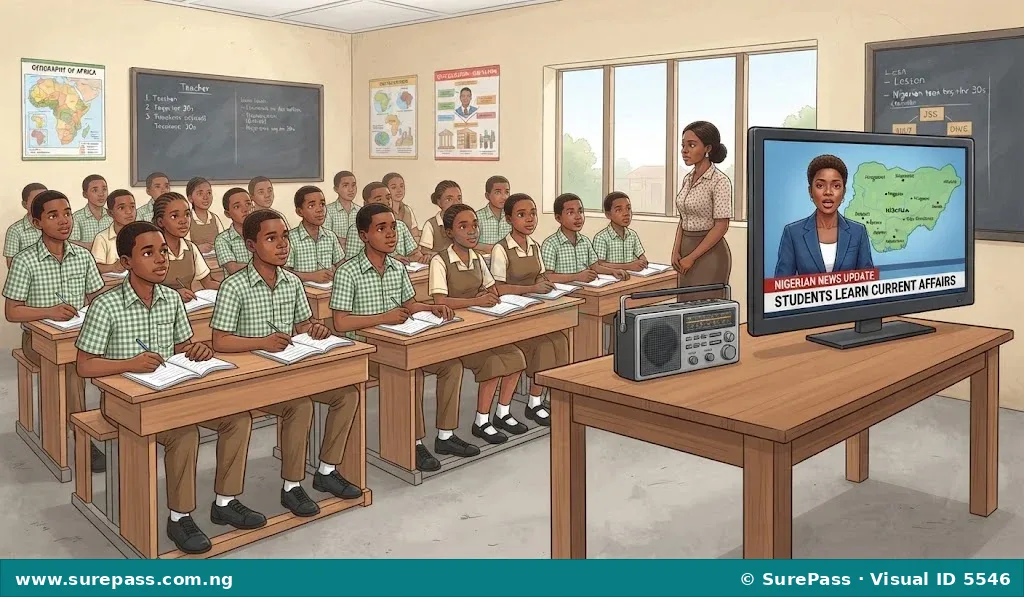
Common examples of media outlets (kafafen yaɗa labarai) in Nigeria and across the world include:
- Gidan Rediyon Tarayya na Kaduna (FRCN Kaduna)
- Gidan Talabijin na Ƙasa (NTA)
- Sashen Hausa na BBC (BBC Hausa Service)
- Sashen Hausa na Muryar Amurka (VOA Hausa Service)
- Gidan Talabijin na Arewa24
- Gidan Rediyon Arewa Radio
Types of Radio and Television News (Nau’o’in Labaran Rediyo da na Talabijin)
News broadcasts are divided into different categories based on the subject matter. This helps the audience find the specific information they need.
The main types of radio and television news include:
- Labaran Cikin Gida (Local or National News): This category covers events happening within Nigeria. Examples include government decisions, community developments, and national celebrations.
- Labaran Ƙasashen Waje (International News): This category covers events happening in other countries around the world, such as elections, natural disasters, or international agreements.
- Labaran Wasanni (Sports News): This category provides updates on local and international sports, including football matches, traditional wrestling (dambe), and athletics.
- Labaran Kasuwanci da Tattalin Arziki (Business and Economic News): This category reports on market prices, farming updates, trade, and financial decisions that affect the economy.
- Labaran Nishadi (Entertainment News): This category focuses on cultural festivals, music, films, and stories about popular artists.
Listening Comprehension Skills (Ƙwarewa a Fahimtar Magana)
Listening comprehension (fahimtar magana) is the ability to listen to spoken Hausa, understand the meaning, and identify the key points. To understand a news broadcast, listeners must pay close attention to specific details.
Key details to listen for in a news broadcast include:
- Wane ko Mene ne (Who or What): The people, groups, or objects that the news story is about.
- Mene ne ya faru (What happened): The actual event or action that took place.
- A ina abun ya faru (Where did it happen): The location or town where the event occurred.
- Yaushe abun ya faru (When did it happen): The time or day of the event.
- Don me ya faru (Why did it happen): The reason behind the event.
Important vocabulary terms commonly heard during Hausa news broadcasts include:
- Mai karanta labarai: The newsreader or presenter.
- Mai ba da rahoto: The reporter who gathers information from the scene of an event.
- Katsalandan: Interruption or interference.
- Rahoton kai-tsaye: Live report.
- Masu sauraro: The listeners (for radio).
- Masu kallo: The viewers (for television).
Summarising News (Ƙwarewa a Taƙaita Magana)
Summarising (taƙaita magana) is the skill of shortening a long speech or text while keeping only the most important points. A good summary must be brief, clear, and accurate.
The steps for summarising a news broadcast are:
- Listen to the entire news item carefully without interruption.
- Write down key words, names of people, places, and the main event during the broadcast.
- Identify the main idea of the news story.
- Write a short sentence or paragraph that combines these key details, leaving out minor details and personal opinions.
Example of a News Broadcast and its Summary
Below is an example of a short news report in Hausa, followed by its English translation, and how it can be summarised.
Original News Report (Cikakken Labari):
“Gwamnatin jihar Kano ta ƙaddamar da sabon shirin dasa bishiyoyi dubu ɗari biyar domin yaƙi da kwararar hamada da kuma samar da inuwa a makarantun firamare da sakandare na jihar. Gwamnan jihar ya yi kira ga ɗalibai da malamai da su kula da bishiyoyin da za a dasa a makarantunsu domin tabbatar da nasarar wannan shiri.”
English Translation of the Report:
“The Kano State government has launched a new project to plant five hundred thousand trees to fight desertification and provide shade in primary and secondary schools across the state. The state governor urged students and teachers to take care of the trees planted in their schools to ensure the success of this project.”
Summary in Hausa (Taƙaitaccen Labari):
“Gwamnatin jihar Kano ta ƙaddamar da shirin dasa bishiyoyi dubu ɗari biyar a makarantu domin yaƙi da kwararar hamada.”
Summary in English:
“The Kano State government has launched a tree-planting campaign in schools to combat desertification.”
How to Listen and Summarise a Live News Broadcast
This practical procedure helps learners develop active listening and summarisation skills using a real radio or television set.
The required materials are:
- A working radio or television set
- A notebook
- A pen or pencil
The procedure involves the following steps:
- Tune the radio or television to a station broadcasting news in Hausa (such as BBC Hausa or NTA Hausa news).
- Sit quietly in a place free from noise and distractions.
- As the newsreader presents the news, write down the names of places, people, and the main event mentioned in the first news item.
- Immediately after the news item ends, write a single sentence that explains what happened, where it happened, and who was involved.
- Read over the written sentence to ensure it is grammatically correct and contains only the main point of the news.
Summary
Radio and television news are essential tools for keeping communities informed. Radio news uses sound, while television news uses both sound and pictures. News can be classified into local, international, sports, business, and entertainment categories. Developing the skills of listening carefully and summarising helps learners understand and share information accurately.
Questions for Evaluation
Answer the following questions to test understanding of the lesson:
- Mene ne ma’anar labari na rediyo da na talabijin?
- Kawo misalan kafafen yaɗa labarai guda uku da ake da su a Najeriya.
- Mene ne bambanci tsakanin labaran cikin gida da labaran ƙasashen waje?
- Kawo nau’o’in labaran rediyo da talabijin guda uku.
- Mene ne ake nufi da taƙaita labari?



0 comments
Open the discussion when you need it. Comments stay collapsed until requested so the initial article remains light.