


ARTICLE CONTENTSOn this page 8 sections
Kalmomin Aikatau
Performance Objectives
By the end of the lesson, students should be able to:
- explain the meaning of verbs (aikatau);
- explain the form/structure of verbs (sigar aikatau);
- give examples of verbs in sentences (misalan aikatau a cikin jumla).
Meaning of Aikatau (Ma’anar Aikatau)
Aikatau is a word that expresses an action, state, occurrence, or process in a sentence.
Aikatau shi ne kalmar da ke nuna aiki, motsi, ko kasancewar wani abu a cikin jumla.
In Hausa grammar, the verb is a crucial part of speech. It tells what the subject of the sentence is doing, has done, or will do. Without a verb, a sentence cannot express a complete action.
Common examples of simple verbs in Hausa include:
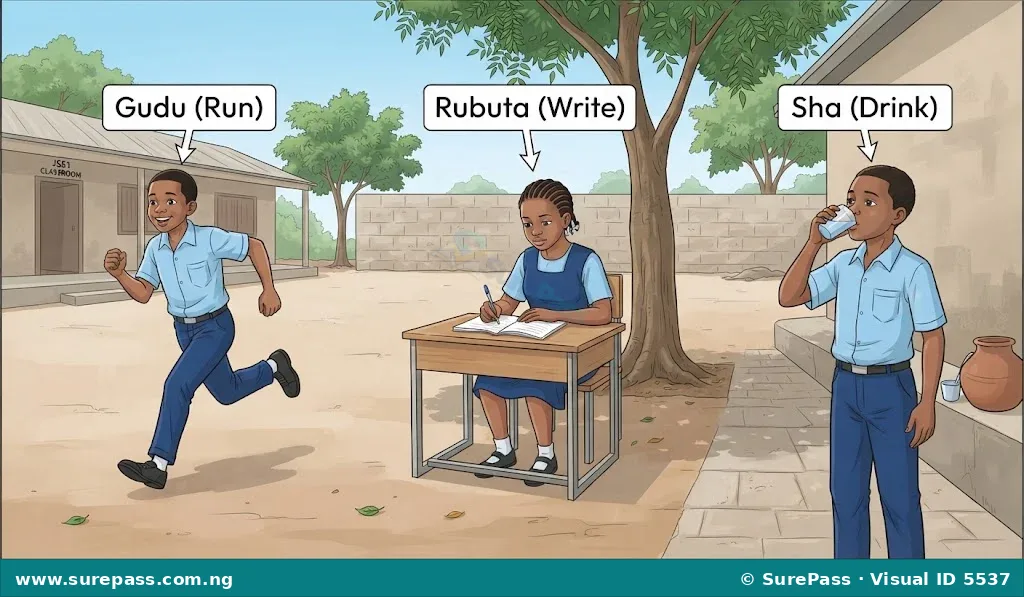
- Ci (to eat)
- Sha (to drink)
- Gudu (to run)
- Kama (to catch)
- Rubuta (to write)
- Karanta (to read)
- Tafi (to go)
- Zama (to sit / to become)
Form and Structure of Hausa Verbs (Sigar Aikatau)
The form of a verb refers to its spelling, structure, and how it ends. In the Hausa language, one of the most important features of verbs is that they almost always end with a vowel (wasali). The five primary vowels in Hausa are a, e, i, o, and u.
The following table shows examples of Hausa verbs, their ending vowels, and their meanings:
| Aikatau (Verb) | Wasalin Ƙarshe (Ending Vowel) | Ma’ana (Meaning) |
|---|---|---|
| Kama | a | to catch |
| Aje | e | to put down / keep |
| Tafi | i | to go |
| Kowo | o | to bring |
| Koyu | u | to be learnable / learned |
Understanding the ending vowel of a verb is important because it can change depending on how the verb is used with objects in a sentence. At this foundational stage, recognizing that Hausa verbs end in these vowels is the key to identifying them in speech and writing.
Examples of Verbs in Sentences (Misalan Aikatau a cikin Jumla)
In a Hausa sentence, the verb usually comes after the subject and its pronoun indicator (wakilin suna mai nuna lokaci). The verb shows the action performed by the subject.
Examples of sentences containing verbs include:
- Audu ya kama zaki. (Audu caught a lion.) – In this sentence, kama (caught) is the verb because it shows the action Audu performed.
- Ali ya ci abinci. (Ali ate food.) – In this sentence, ci (ate) is the verb showing the action of eating.
- Mariya ta sha ruwa. (Mariya drank water.) – In this sentence, sha (drank) is the verb showing the action of drinking.
- Yara suna gudu. (The children are running.) – In this sentence, gudu (run/running) is the verb showing physical movement.
- Malam ya rubuta wasiƙa. (The teacher wrote a letter.) – In this sentence, rubuta (wrote) is the verb showing the action of writing.
Identifying Verbs in a Short Story (Tantance Aikatau a cikin Gajeren Labari)
To build reading and comprehension skills, verbs can be identified within a continuous passage. Below is a short story in Hausa.
Tafiyar Bala zuwa Gona (Bala’s Trip to the Farm)
Wata rana, Bala ya tashi da safe. Ya ɗauki garmarsa, ya tafi gona. A hanya, ya ga tsuntsaye suna rera waƙa. Lokacin da ya isa gona, ya yi aiki ƙwarai. Bayan ya gama aiki, ya sha ruwa, sannan ya dawo gida.
The verbs identified from the story are:
- Tashi (woke up / stood up)
- Ɗauki (took / picked up)
- Tafi (went)
- Ga (saw)
- Rera (sang / to sing)
- Isa (reached / arrived)
- Yi (did / made)
- Gama (finished)
- Sha (drank)
- Dawo (returned / came back)
Summary of Key Points
The main points discussed in this unit are:
- Aikatau (verb) is a word that denotes action, state, or occurrence in a sentence.
- Hausa verbs are characterized by ending with a vowel, such as a, e, i, o, or u.
- In sentences, verbs show what the subject is doing, and they are usually accompanied by pronouns that indicate tense and aspect.
- Verbs can be easily identified in passages by looking for action words.
Evaluation Guide
The evaluation questions are:
- Explain the meaning of the term “aikatau” in your own words.
- Discuss the form of Hausa verbs with regard to their ending vowels, providing three examples.
- Give five examples of simple verbs (sauƙaƙan aikatau) in Hausa and provide their English meanings.
- Construct five original sentences in Hausa, and underline the verb in each sentence.
- Read the short passage below and list all the verbs used in it:
“Kande ta tashi da wuri. Ta wanke fuskarta, ta share daki. Bayan haka, ta dafa abinci ta ba kanwarta.”


0 comments
Open the discussion when you need it. Comments stay collapsed until requested so the initial article remains light.