


ARTICLE CONTENTSOn this page 8 sections
Tools and Consumables: Costing, Sourcing, Stock Records and Tool Usage
Performance Objectives
By the end of the lesson, students should be able to:
- explain the procedure for estimating the cost and sources of materials;
- describe how to maintain stock of commodities in a computer and mobile phone workshop;
- explain the process of keeping records of tool usage.
Estimating Costs and Sourcing Materials
In a computer hardware and GSM repair business, materials are divided into two main categories: tools and consumables. Tools are reusable instruments such as soldering irons, multimeters, hot air rework stations and screwdrivers. Consumables, also referred to as commodities, are items that are used up during the repair process, such as solder wire, flux, jumper wire, isopropyl alcohol, replacement screens, charging ports and batteries.
Cost estimation is the process of forecasting the financial resources required to acquire tools, equipment and consumables for a repair business.
Accurate cost estimation prevents financial losses, ensures competitive pricing for repair services and helps maintain a healthy cash flow in the workshop.
Procedure for Estimating Costs
Estimating the cost of materials requires a systematic approach to ensure that all expenses are accounted for before purchasing. The procedure involves the following steps:
- Identification of Needs: Create a detailed list of the specific tools and consumables required for the workshop based on the volume and types of repairs handled.
- Market Survey and Inquiry: Contact multiple reputable suppliers to obtain price quotations for the required items. This helps in comparing prices and identifying the most cost-effective options.
- Analysis of Hidden Costs: Factor in additional expenses associated with acquiring the materials. These include transportation fares, shipping fees, delivery charges, customs duties for imported items and local taxes.
- Inflation and Contingency Allowance: Add a small percentage (typically 5% to 10%) to the estimated cost to buffer against sudden price fluctuations, inflation or exchange rate variations in the Nigerian market.
- Calculation of Total Cost: Sum up the base prices of the items and all associated hidden costs to arrive at the final estimated cost of procurement.
Sources of Repair Materials
Sourcing refers to the channels and locations where a technician acquires tools and consumables. In Nigeria, repair materials can be sourced from various local and international channels.
Common sources of computer and GSM repair materials include:
- Specialized Local Tech Markets: Major commercial hubs where hardware parts and tools are sold in bulk or retail. Examples include the Computer Village in Ikeja (Lagos State), the GSM Village in Abuja, and the Mile 1/Plaza markets in Port Harcourt (Rivers State).
- Direct Importers and Wholesalers: Large-scale merchants who import tools and components directly from manufacturing countries. Purchasing from them reduces costs but often requires buying in large quantities.
- Online E-commerce Platforms: Local and international online marketplaces where technicians can order specific components. Examples include local platforms like Jumia and Konga, as well as international platforms like AliExpress and Alibaba.
- Authorized Service Centres: Direct manufacturers or authorized distributors of specific brands (such as Samsung, Carlcare for Tecno/Infinix, or HP). These sources provide genuine, high-quality replacement parts, though often at a higher price.
Maintaining Stock of Commodities
Stock maintenance is the systematic process of monitoring, storing and replenishing inventory items to ensure continuous workshop operations without over-investing capital.
In a computer and GSM repair workshop, commodities must be managed carefully. If the workshop runs out of essential consumables like solder wire or charging ports, repairs will be delayed, leading to dissatisfied customers. Conversely, holding too much stock ties up capital that could be used for other business operations.
Key Methods for Maintaining Stock
Effective stock management relies on structured techniques to track inventory levels. The primary methods include:
- Use of Stock Cards (Bin Cards): A physical or digital card kept with each type of item in the store. It records the date, quantity added (stock-in), quantity issued out (stock-out), and the current balance on hand.
- Establishing a Reorder Level (ROL): The specific minimum quantity of an item at which a new order must be placed. For example, if a workshop uses an average of ten micro-USB charging ports a week, the reorder level might be set at five ports to allow time for delivery before the stock runs out completely.
- First-In, First-Out (FIFO) Principle: A stock rotation method where older stock is used before newly received stock. This is particularly important for chemical consumables like soldering flux, battery adhesive and lithium-ion batteries, which can degrade over time.
- Regular Physical Stocktaking: The process of physically counting the items in the workshop at regular intervals (weekly or monthly) and comparing the physical count with the written records to detect discrepancies, theft or damage.
An example of a standard Stock Card (Bin Card) format used in a repair workshop is shown below:
| Date | Transaction Details | Quantity In (+) | Quantity Out (-) | Balance Stock | Technician / Remarks |
|---|---|---|---|---|---|
| 01/11/2023 | Opening Balance | – | – | 50 pcs | Initial stock of USB-C ports |
| 03/11/2023 | Issued for repair | – | 3 pcs | 47 pcs | Used by Lead Tech |
| 05/11/2023 | New Purchase | 30 pcs | – | 77 pcs | Sourced from Computer Village |
| 08/11/2023 | Issued for repair | – | 5 pcs | 72 pcs | Used by Junior Tech |
Record Keeping of Tool Usage
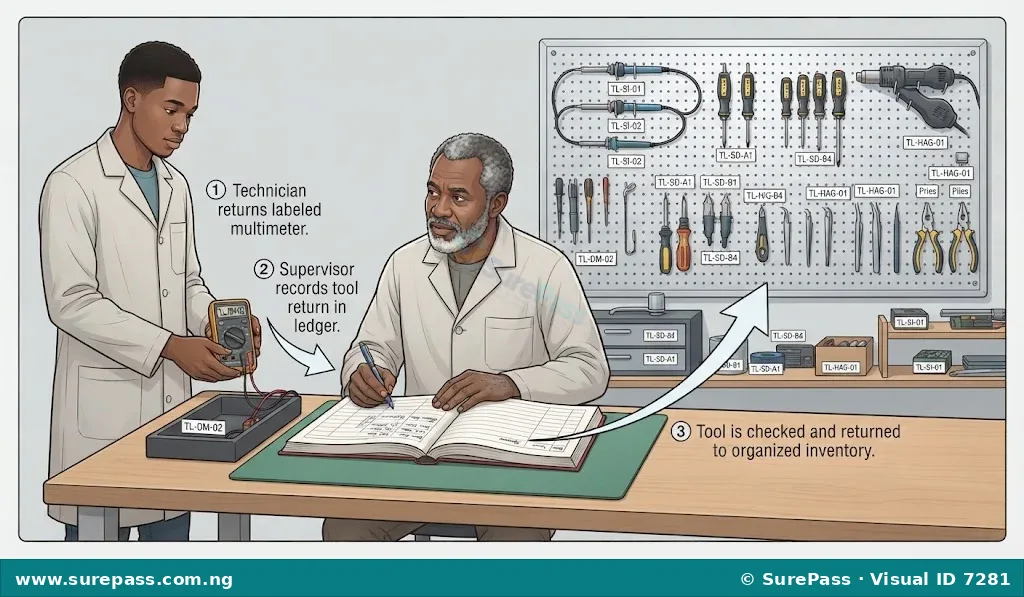
Tool usage record keeping is the systematic documentation of the movement, condition and users of workshop tools over time.
Unlike consumables, tools are long-term assets. However, they are subject to wear, damage, misplacement and theft. Keeping precise records of who uses each tool and when it is returned ensures accountability and helps plan for tool maintenance or replacement.
Importance of Keeping Tool Records
Maintaining a tool usage register provides several benefits to a repair workshop, including:
- Accountability: It identifies the specific technician responsible for a tool at any given time, reducing negligent handling and loss.
- Maintenance Tracking: It helps monitor the wear and tear of tools, indicating when a soldering iron tip needs replacement or when a multimeter needs recalibration.
- Cost Control: It prevents the unnecessary expense of replacing lost tools by ensuring all borrowed items are returned to their designated storage locations.
The Tool Usage Register
The primary document used for tracking tools is the Tool Usage Register. This register can be kept in a physical logbook or managed digitally on a computer. It must capture critical details every time a tool is taken from the storage rack or cabinet.
An example of a Tool Usage Register layout is shown below:
| Tool ID | Tool Name | Borrower’s Name | Date & Time Out | Condition Out | Date & Time In | Condition In | Receiver’s Sign |
|---|---|---|---|---|---|---|---|
| TL-SD-04 | Precision Screwdriver Set | Chidi Okafor | 10/11/2023, 09:00 AM | Good | 10/11/2023, 04:30 PM | Good | A. Ibrahim |
| TL-HA-02 | Hot Air Rework Station | Blessing Udoh | 11/11/2023, 10:15 AM | Good | 11/11/2023, 01:00 PM | Noisy fan | A. Ibrahim |
| TL-MM-01 | Digital Multimeter | Chidi Okafor | 12/11/2023, 11:00 AM | Good | 12/11/2023, 02:15 PM | Good | A. Ibrahim |
How to Keep Records of Tool Usage
This practical procedure outlines how to set up and maintain a tool tracking system in a computer and mobile phone repair workshop.
The required materials for this procedure are:
- A hardbound ledger book or a computer with spreadsheet software (such as Microsoft Excel).
- Permanent markers or adhesive labels for tool identification.
- A ruler and pens (for physical logbooks).
- A designated, lockable tool cabinet or pegboard.
The procedure involves the following steps:
- Label and Categorize All Tools: Assign a unique identification code to every tool in the workshop (for example, TL-SI-01 for Soldering Iron 1, TL-MM-02 for Multimeter 2). Write or engrave this code clearly on the tool.
- Set Up the Register: Draw the columns of the Tool Usage Register in the ledger book or create the sheet in the spreadsheet software, using the columns shown in the standard register table.
- Record Tool Check-Out: Before handing over any tool to a technician, fill in the Tool ID, Tool Name, Borrower’s Name, Date, Time, and the current physical condition of the tool. Ensure the borrower signs the physical book or confirms the digital entry.
- Store Tools Securely: Keep all tools in their designated places on the pegboard or inside the cabinet when they are not in active use.
- Inspect and Record Tool Return: When the technician returns the tool, inspect it carefully for any damage, dirt or missing parts. Record the date and time of return, note the condition (e.g., “Good”, “Damaged tip”, “Needs cleaning”), and sign off to confirm receipt.
- Report and Address Issues: If a tool is returned damaged or is not returned by the end of the workday, flag the entry and report it to the workshop manager for immediate repair, calibration or replacement.
Summary of Key Concepts
The main points covered in this unit include:
- Cost Estimation: A systematic process of calculating the total cost of tools and consumables, taking into account market prices, transportation, taxes and contingency allowances.
- Sourcing: Acquiring materials from reliable channels such as local specialized markets (e.g., Computer Village), direct importers, online platforms and authorized service centres.
- Stock Maintenance: Managing consumables using tools like stock cards, setting reorder levels, applying the FIFO principle and conducting regular physical stocktakes to prevent stockouts or overstocking.
- Tool Usage Records: Documenting the movement and condition of reusable tools in a register to ensure technician accountability, track wear and tear, and prevent financial loss.
Review Questions
Answer the following questions to test your understanding of the topic:
- Define cost estimation in the context of a computer and GSM repair business.
- List four steps involved in the procedure for estimating the cost of repair materials.
- State three major sources where a computer repair technician in Nigeria can source replacement parts.
- What is the difference between tools and consumables? Give two examples of each.
- Explain the purpose of a Stock Card (Bin Card) in a mobile phone repair workshop.
- Describe the First-In, First-Out (FIFO) principle and explain why it is important for chemical consumables.
- Why is it necessary to keep a Tool Usage Register in a workshop with multiple technicians?
- List five key pieces of information that must be recorded in a Tool Usage Register when a tool is borrowed.



0 comments
Open the discussion when you need it. Comments stay collapsed until requested so the initial article remains light.