


ARTICLE CONTENTSOn this page 7 sections
Fibres and fabrics
Performance Objectives
By the end of the lesson, students should be able to:
- explain the meaning of fibre and fabric;
- classify the different types of fibres with examples;
- identify fabrics made from fibres.
Meaning of Fibre and Fabric
A fibre is a tiny, hair-like strand that forms the basic building block of all textile materials.
Fibres are extremely thin and flexible. They are too small to be used directly for clothing in their raw state. To make them useful, these tiny strands are collected and twisted together to form long, continuous threads called yarns.
A fabric is a wearable or usable cloth made by weaving, knitting, or bonding yarns or fibres together.
Fabric is the actual material that tailors and garment makers cut and sew to make clothes, bedsheets, curtains, and school uniforms. The journey from a raw strand to a finished garment follows a specific sequence: raw fibres are spun into yarn, and the yarn is woven or knitted into fabric.
Observe the diagram below to see how fibres are transformed into fabric.
Classification of Fibres
Fibres are grouped into different classes based on where they come from. The two main classes of fibres are natural fibres and artificial fibres.
The classification of fibres is structured as follows:
- Natural fibres, which are obtained directly from plants and animals.
- Artificial fibres, which are man-made through chemical processes in factories.
Natural Fibres
Natural fibres are obtained from nature, specifically from plants and animals. These fibres have been used for thousands of years to make clothing and shelter.
Plant fibres are obtained from different parts of plants, such as seeds, stems, or leaves. Examples of plant fibres include:
- Cotton: Obtained from the seed pod (boll) of the cotton plant. It is the most widely used natural fibre.
- Flax: Obtained from the stem of the flax plant. It is used to make strong, high-quality linen cloth.
- Raffia: Obtained from the leaves of the raffia palm tree, which is common in southern Nigeria.
- Jute: Obtained from the stem of the jute plant. It is a coarse, highly durable fibre.
Animal fibres are obtained from the hair, fleece, or secretions of animals. Examples of animal fibres include:
- Wool: Obtained from the soft fleece or hair of sheep, goats, or camels.
- Silk: Obtained from the cocoon of the silkworm. The silkworm spins this fine thread to protect itself.
- Fur: Obtained from the preserved skins of animals with thick hair, used mainly in very cold climates.
Artificial Fibres
Artificial fibres, also known as synthetic or man-made fibres, do not grow in nature. They are created by scientists and manufacturers using chemicals, petroleum products, and wood pulp in factories.
Common examples of artificial fibres include:
- Rayon: Made from chemically treated wood pulp. It is designed to feel soft and smooth like silk.
- Polyester: A highly durable, wrinkle-resistant fibre made from petroleum chemicals. It is often blended with cotton.
- Nylon: A very strong, lightweight, and elastic fibre used for making ropes, socks, and sportswear.
Identifying Fabrics Made from Fibres
Every fabric inherits its characteristics from the fibre used to make it. Knowing which fibre makes which fabric helps in identifying materials correctly.
The relationship between raw fibres and their corresponding fabrics includes:
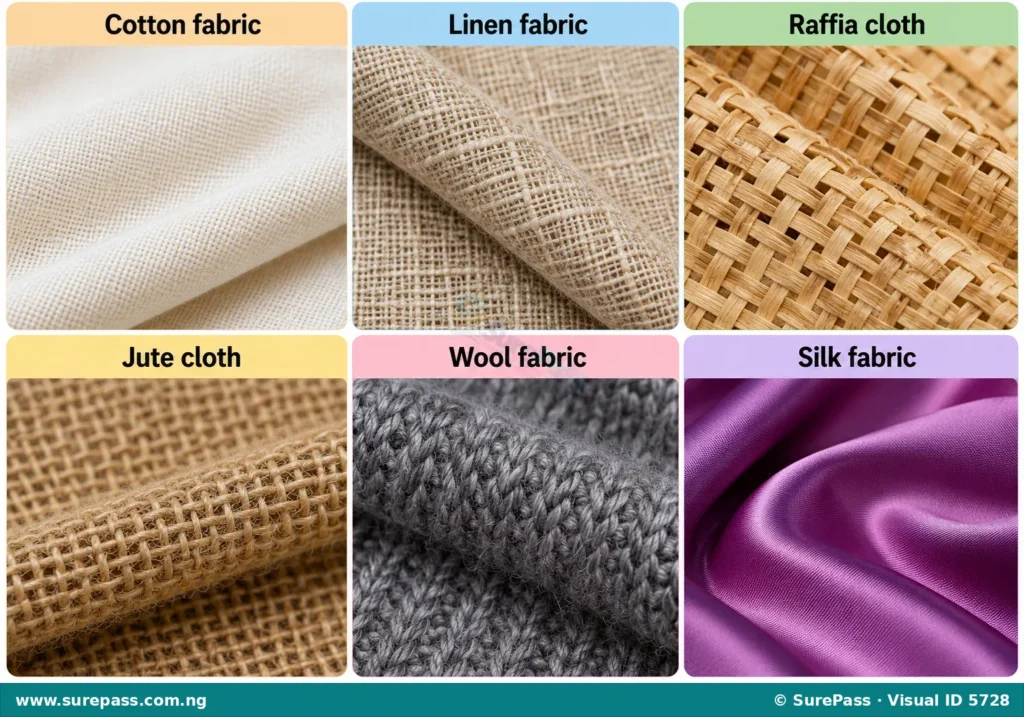
- Cotton Fabric: This fabric is made from cotton fibres. It is soft, highly absorbent, and cool to wear, making it ideal for hot Nigerian weather. It is commonly used for school uniforms, t-shirts, and bedsheets.
- Linen Fabric: This fabric is made from flax fibres. It is very strong, absorbs moisture quickly, and has a slightly stiff texture. It is used for high-quality summer clothing and tablecloths.
- Raffia Cloth: This traditional cloth is made from raffia fibres. It is coarse, stiff, and highly durable. It is used for cultural costumes, mats, bags, and decorative items.
- Jute Cloth: This rough fabric is made from jute fibres. It is commonly known as burlap or sackcloth. In Nigeria, it is widely used to make large sacks for agricultural produce like cocoa, beans, and rice.
- Wool Fabric: This thick fabric is made from wool fibres. It is warm, soft, and bulky. It is used to make sweaters, cardigans, blankets, and winter coats.
- Silk Fabric: This luxurious fabric is made from silk fibres. It is smooth, lightweight, and has a natural shine. It is used for expensive dresses, ties, and ceremonial garments.
Observe the image below to see the visual differences between these fabrics.
Differentiating Fabrics for Proper Utilization
Differentiating fabrics means identifying the differences between various cloths so that the correct one is chosen for a specific purpose. Using the wrong fabric can make a garment uncomfortable, weak, or unsuitable for the weather.
Tailors and garment makers use specific physical tests to differentiate fabrics. The main methods used to identify and sort fabrics include:
- Feeling by Touch (Texture): Wool feels warm and fuzzy; silk feels cool and slippery; cotton feels soft and dry; jute and raffia feel rough and scratchy.
- Visual Inspection (Appearance): Silk has a bright shine; cotton has a dull, matte surface; linen has irregular, thick-and-thin threads visible in the weave.
- Flexibility and Weight: Raffia and jute are stiff and heavy, whereas silk and cotton drape and bend easily.
The table below summarizes how different fabrics are identified and utilized:
| Fabric Name | Fibre Source | Physical Feel (Texture) | Common Uses in Nigeria |
|---|---|---|---|
| Cotton | Cotton plant | Soft, smooth, and light | School uniforms, daily wear, bedsheets |
| Linen | Flax plant | Stiff, cool, and slightly textured | Trousers, shirts, table covers |
| Raffia | Raffia palm | Very rough, stiff, and straw-like | Traditional hats, bags, mats, cultural attire |
| Jute | Jute plant | Coarse, rough, and hairy | Sacks for cocoa and grains, heavy ropes |
| Wool | Sheep fleece | Thick, warm, and fuzzy | Sweaters, cardigans, blankets |
| Silk | Silkworm cocoon | Slippery, smooth, and shiny | Luxury dresses, ties, scarves |
How to Identify and Sort Fabric Samples
This practical activity helps learners develop the skill of identifying and sorting different fabrics based on their physical properties.
The required materials for this activity are:
- Small swatches of cotton, linen, raffia, jute, wool, and silk fabrics (about 10cm by 10cm each).
- A magnifying glass (optional).
- A flat table or workspace.
- An observation notebook and a pen.
The procedure involves the following steps:
- Place the fabric samples on a clean, flat table.
- Pick up the first sample and rub it gently between the thumb and fingers. Note whether it feels soft, rough, warm, or slippery.
- Hold the fabric up to the light to observe its surface. Note whether it is shiny, dull, or has visible coarse threads.
- Gently bend or fold the fabric to test its stiffness. Note whether it is stiff or flexible.
- Compare the observations with the characteristics in the identification table.
- Write down the name of the fabric and its fibre source in the observation notebook.
- Repeat the process for all other fabric samples.
Summary
Fibres are the raw, hair-like strands that are spun into yarn and woven into fabrics. These fibres are classified into natural sources (plants and animals) and artificial sources (chemicals). Each fibre produces a unique fabric with specific properties, making it suitable for particular garments or household items. Developing the skill to differentiate these fabrics ensures they are utilized correctly in fashion design and garment making.



0 comments
Open the discussion when you need it. Comments stay collapsed until requested so the initial article remains light.