


ARTICLE CONTENTSOn this page 5 sections
Agricultural Laws and Reforms
Performance Objectives
By the end of the lesson, students should be able to:
- explain agricultural laws and their Benefits;
- differentiate between land ownership types in Nigeria
- outline land use in agriculture.
Agriculture is a vital sector in Nigeria, providing food, employment, and raw materials for industries. To ensure the growth and sustainability of this sector, various laws and reforms have been introduced over time. These laws and reforms aim to address challenges such as land access, funding, and food security, thereby creating a more favourable environment for agricultural development.
Agricultural Laws and Reforms in Nigeria
Agricultural laws are rules and regulations established by the government to guide agricultural practices, land use, and resource management. Agricultural reforms are changes or improvements made to existing policies or systems to boost agricultural productivity and address specific challenges. These laws and reforms are designed to support farmers, encourage investment, and ensure food security for the nation.
Key Agricultural Laws and Reforms and Their Benefits
Several significant laws and reforms have shaped the agricultural landscape in Nigeria. Understanding these initiatives helps to appreciate the government’s efforts to develop the sector.
-
Land Use Act (1978)
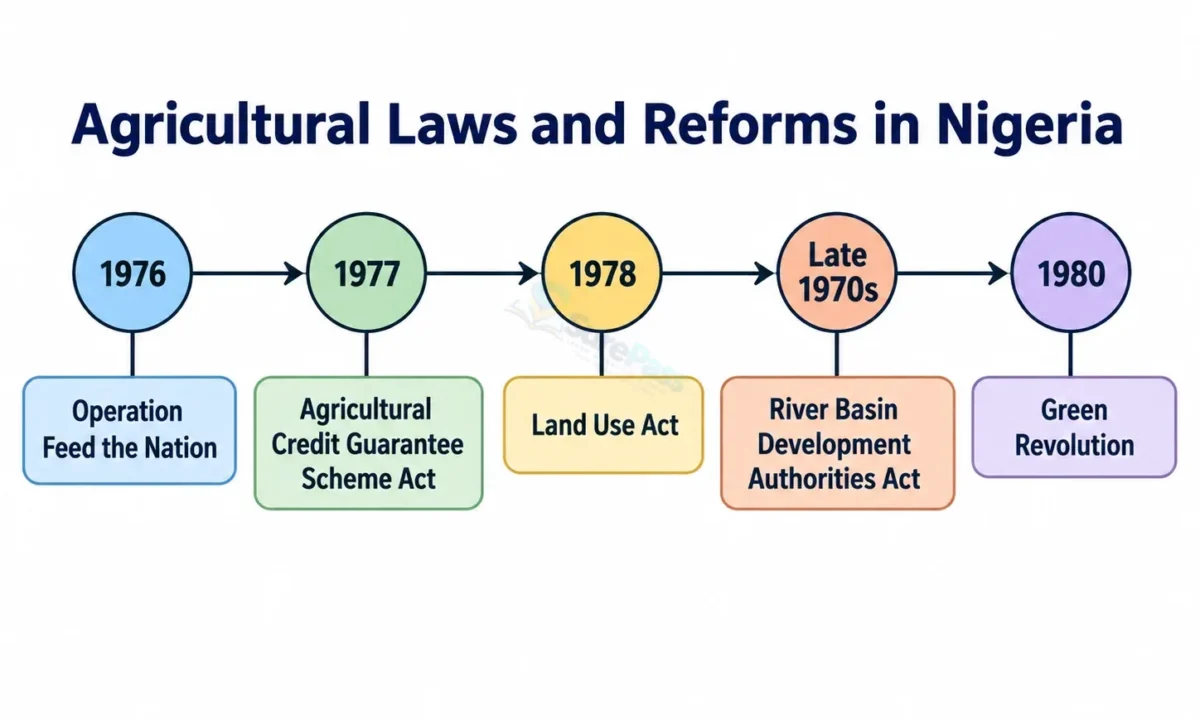
The Land Use Act of 1978 is a major law that vested all land in each state of the Federation in the Governor of that state. The Act aimed to simplify land acquisition, reduce land speculation, and make land more accessible for development, including agriculture. It introduced the concept of a Right of Occupancy, which grants individuals or organisations the right to use land for a specific period.
Benefits of the Land Use Act include:
- It aimed to ensure more equitable distribution of land, making it easier for farmers to acquire land for agricultural purposes.
- It sought to reduce land disputes and conflicts by centralising land administration.
- It encouraged investment in agriculture by providing a more structured framework for land ownership and use.
-
Operation Feed the Nation (OFN) (1976)
Operation Feed the Nation (OFN) was a national agricultural programme launched in 1976 by the Federal Government. Its primary goal was to encourage all Nigerians, especially students and civil servants, to engage in food production to boost national food supply and reduce reliance on food imports.
Benefits of Operation Feed the Nation include:
- It raised awareness about the importance of agriculture and food production among the general public.
- It encouraged individuals and communities to cultivate available land, leading to increased food output.
- It aimed to foster a sense of self-reliance in food production across the country.
-
Green Revolution (1980)
The Green Revolution programme was introduced in 1980, building on the objectives of OFN. It was a more comprehensive and technology-driven approach to agricultural development. The programme focused on increasing food production through the adoption of modern farming techniques, improved seeds, fertilisers, and irrigation systems.
Benefits of the Green Revolution include:
- It promoted the use of high-yielding crop varieties and modern farming inputs, leading to higher yields.
- It encouraged the development of irrigation facilities to support year-round farming.
- It aimed to achieve self-sufficiency in food production and reduce poverty in rural areas.
-
River Basin Development Authorities (RBDA) Act
The River Basin Development Authorities (RBDAs) were established to develop and manage water resources for agricultural purposes, particularly irrigation. They are responsible for constructing dams, boreholes, and irrigation channels to provide water to farmlands, especially in arid and semi-arid regions.
Benefits of the RBDA Act include:
- It facilitated the provision of water for irrigation, enabling farmers to cultivate crops during dry seasons.
- It supported the development of large-scale agricultural projects and increased food production.
- It helped in flood control and the generation of hydroelectric power, which also benefits agriculture.
-
Agricultural Credit Guarantee Scheme (ACGS) Act
The Agricultural Credit Guarantee Scheme (ACGS) Act was established to encourage banks to lend money to farmers and agricultural enterprises. Under this scheme, the government guarantees a portion of the loans given to farmers, reducing the risk for banks and making it easier for farmers to access credit.
Benefits of the ACGS Act include:
- It increased access to credit facilities for farmers, enabling them to purchase inputs, equipment, and expand their operations.
- It reduced the financial risk for banks lending to the agricultural sector.
- It stimulated investment and growth in the agricultural sector by providing necessary capital.
Land Ownership in Nigeria
Land ownership refers to the legal right to possess, use, and control a piece of land. In Nigeria, various systems of land ownership exist, each with its own characteristics regarding acquisition, duration, and rights of the owner.
Types of Land Ownership in Nigeria
The main types of land ownership in Nigeria include:
-
Communal Land Ownership
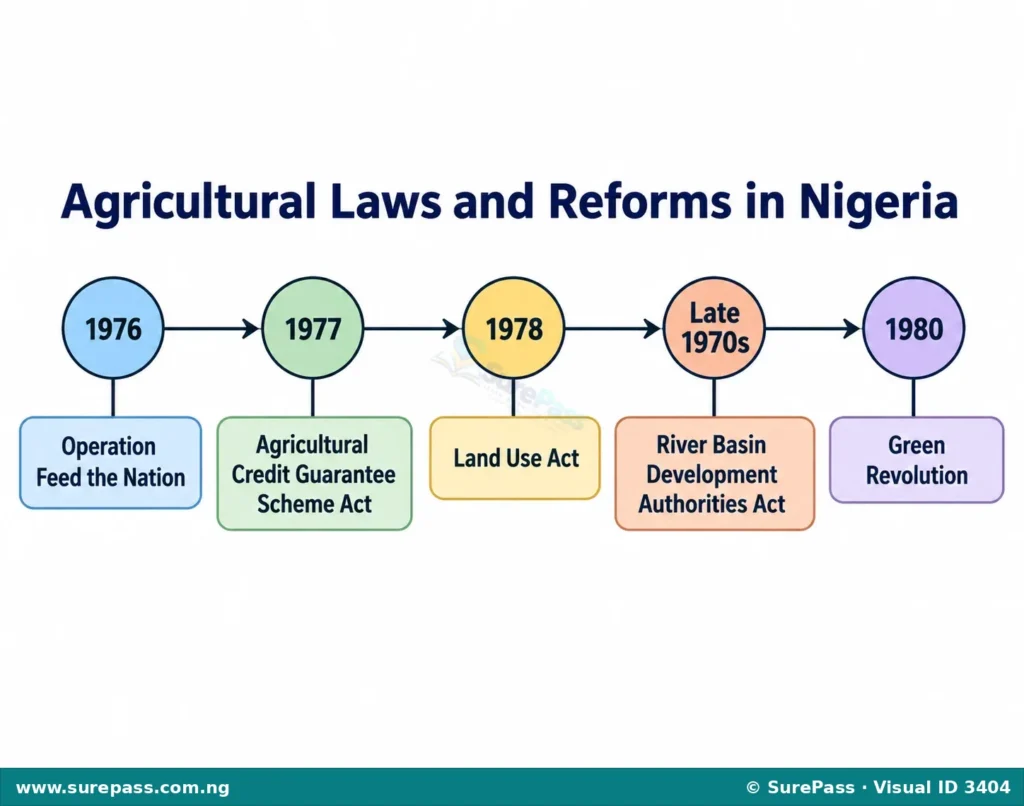
Communal land ownership is a system where land is owned collectively by a community, clan, or family. It is not owned by any single individual but by the entire group. Traditional rulers, family heads, or community elders usually manage and allocate communal land on behalf of the community members. Members of the community have rights to use the land for farming or building, but they cannot sell it without the consent of the entire community.
-
Individual Land Ownership
Individual land ownership means that a specific person or a small group of people (like a nuclear family) holds exclusive rights to a piece of land. This type of ownership is acquired through purchase, inheritance, gift, or direct allocation from the government or a community. The individual owner has the right to use, develop, lease, or sell the land, subject to the provisions of the Land Use Act.
-
Leasehold Land Ownership
Leasehold ownership involves the right to use a piece of land for a specific period, granted by the owner (lessor) to another party (lessee) in exchange for rent. The lessee does not own the land permanently but has the right to occupy and use it for the duration of the lease agreement. Once the lease period expires, the land reverts to the original owner, unless the lease is renewed. This is common for commercial farming or urban development.
-
Freehold Land Ownership
Freehold ownership implies permanent and absolute ownership of land. In the context of the Land Use Act (1978) in Nigeria, what was traditionally known as freehold has largely been converted into a Right of Occupancy granted by the state governor. However, the term “freehold” is still used to describe a situation where an individual or entity holds the most extensive possible rights over a piece of land, including the right to use, sell, or transfer it indefinitely, subject to government regulations and the terms of the Right of Occupancy.
Differentiating Land Ownership Types
The key differences between these land ownership types lie in who holds the ultimate right to the land, how it is acquired, and the duration of the ownership:
- Communal vs. Individual: Communal land is owned by a group, with usage rights granted to members, while individual land is owned by a single person or small family unit with exclusive rights.
- Leasehold vs. Freehold: Leasehold grants temporary usage rights for a fixed period, with rent paid to the owner. Freehold (or Right of Occupancy in the Nigerian context) grants more permanent and extensive rights over the land, often for a very long or indefinite period, with the possibility of transfer or sale.
- Acquisition: Communal land is inherited or allocated by community leaders. Individual land can be bought, inherited, or allocated. Leasehold is acquired through a rental agreement. Freehold (Right of Occupancy) is granted by the state or acquired through purchase from a holder of such rights.
Land Use in Agriculture
Land use in agriculture refers to the various ways land is utilised to produce food, fibre, and other agricultural products. The choice of land use depends on factors such as soil type, climate, available resources, and the specific needs of the farmer or community.
Outline of Land Use in Agriculture
Common ways land is used in agriculture include:
-
Crop Farming (Arable Farming)
Crop farming involves cultivating plants for food, feed, fibre, or other economic purposes. This is one of the most widespread forms of land use in agriculture. Land is prepared, seeds are planted, and crops are tended until harvest. Examples of crops grown include maize, cassava, yam, rice, millet, cocoa, oil palm, and various vegetables.
-
Animal Rearing (Livestock Farming)
Animal rearing, also known as livestock farming, involves raising animals for meat, milk, eggs, wool, hides, or labour. Land used for animal rearing can include pastures for grazing, enclosures for housing animals, and areas for growing feed crops. Common livestock in Nigeria include cattle, goats, sheep, pigs, and poultry.
-
Forestry
Forestry, in an agricultural context, involves the management of forests and woodlands for the production of timber, fuelwood, and other forest products. It also includes the conservation of forest ecosystems. While not directly food production, forestry is crucial for sustainable agriculture as forests help in soil conservation, water regulation, and providing habitats for wildlife. Agroforestry, a system combining trees with crops and/or livestock, is a specific type of land use that integrates forestry with other agricultural activities.



0 comments
Open the discussion when you need it. Comments stay collapsed until requested so the initial article remains light.