


ARTICLE CONTENTSOn this page 10 sections
Elements and Principles of Garment Design
Performance Objectives
By the end of the lesson, students should be able to:
- explain the concept of garment design;
- state the principles of design;
- enumerate elements of design;
- discuss factors that influence fashion and garment design;
- draw lines, shapes, colour wheel and colour triangular.
Concept of Garment Design
Garment design is the creative process of planning, sketching, selecting materials, and structuring clothing to achieve both aesthetic beauty and functional utility.
The process of garment design combines artistic expression with technical skill. A designer translates an abstract idea into a physical, wearable piece of clothing. This requires a deep understanding of how fabrics behave, how different body types are structured, and how visual components work together to create a pleasing appearance.
Features of Quality Garments
To evaluate the success of a garment design, the finished product must be assessed for quality. High-quality garments are not only visually appealing but also durable and comfortable to wear.
The key features of quality garments include:
- Proper Fit: The garment conforms comfortably to the body of the wearer without pulling, sagging, or restricting movement.
- Durable Seams and Stitching: The stitches are neat, even, and strong, with no loose threads or puckered fabric along the seams.
- Pattern Alignment: Fabric patterns, such as stripes, checks, or floral motifs, match perfectly at the seams and closures.
- Appropriate Fabric Choice: The selected fabric suits the style, purpose, and structure of the garment.
- Excellent Finishing: Hems, necklines, armholes, and closures (such as zippers, buttons, and hooks) are neatly finished and securely attached.
Elements of Design
Elements of design are the basic visual tools or building blocks used to create a garment.
These elements are the concrete, physical components that can be seen, felt, and manipulated on a garment. Designers combine these elements in various ways to produce different styles and visual effects.
The primary elements of garment design are:
- Line
- Colour
- Texture
- Shape
Line
Line is a continuous mark made on a surface, or the edge created where two shapes meet.
In garment design, lines direct the eye of the observer, create visual illusions of height or width, and define the outer silhouette of the clothing. Lines can be structural (created by seams, darts, pleats, and hems) or decorative (created by patterns, stripes, ribbons, or topstitching).
The main types of lines used in garment design include:
- Vertical Lines: These run up and down, drawing the eye upward to create an illusion of height and a slimmer appearance.
- Horizontal Lines: These run from side to side, drawing the eye across and creating an illusion of width or shortness.
- Diagonal Lines: These run at an angle, adding a sense of movement, drama, and energy to the garment.
- Curved Lines: These are rounded and gentle, softening the overall look of the garment and emphasizing natural body curves.
Observe the diagram below showing how different lines affect the appearance of a garment.
Colour
Colour is the visual sensation produced by light rays reflecting off a surface.
Colour is often the first element noticed in a garment. It has a powerful effect on the emotions of the wearer and the observer. Colour can be used to draw attention to specific body features, set a mood, or create illusions of size. Darker colours generally make a figure appear smaller, while lighter and brighter colours make a figure appear larger.
Texture
Texture is the surface quality or feel of a fabric.
Texture determines how a fabric looks and behaves when it is draped over the body. It can be felt by touching the fabric (tactile texture) or perceived by looking at it (visual texture). Examples of fabric textures include smooth, rough, soft, stiff, shiny, dull, bulky, and lightweight.
The choice of texture affects the overall design in the following ways:
- Shiny and Bulky Textures: Fabrics like satin, velvet, or heavy wool reflect light or add physical bulk, making the wearer appear larger.
- Dull and Smooth Textures: Fabrics like matte cotton, crepe, or linen absorb light and drape smoothly, making the wearer appear smaller and more slender.
- Stiff Textures: Fabrics like organza or brocade stand away from the body, hiding body shapes but creating structured silhouettes.
Shape
Shape is the outer outline or contour of a garment.
Also known as the silhouette, shape defines the overall form of the clothing when seen from a distance. The silhouette is created by the cut and construction of the garment. It determines how the clothing fits the human frame.
Common garment shapes include:
- A-Line: Narrow at the top and gradually widening toward the hem, resembling the letter A.
- Hourglass: Fitted at the waist with wider shoulders and hips, emphasizing a balanced figure.
- Tubular (or Rectangular): Straight from the shoulders to the hem, with little to no waist definition.
- Bell (or Ballgown): Fitted at the bodice with a very full, flared skirt.
Observe the diagram below showing common garment silhouettes.
Principles of Design
Principles of design are the rules or guidelines that govern how the elements of design are arranged to create an attractive garment.
While the elements of design are the raw materials, the principles of design dictate how to combine those materials to achieve a balanced, harmonious, and beautiful finished product. Applying these principles ensures that a garment looks professional and visually pleasing.
The primary principles of garment design are:
- Emphasis
- Harmony
- Balance
- Proportion
Emphasis
Emphasis is the creation of a center of interest in a garment to draw the eye of the observer to a specific area.
Also known as the focal point, emphasis is used to highlight a desirable feature or distract attention from a less desirable one. A designer can create emphasis by using contrasting colours, unique buttons, ruffles, embroidery, a dramatic collar, or a decorative belt.
Harmony
Harmony is the pleasing arrangement of all parts of a garment to create a sense of completeness and unity.
Harmony is achieved when all the elements (line, colour, texture, and shape) and principles work together beautifully. A harmonious design looks complete, as if all parts belong together. If a garment lacks harmony, it may look chaotic, cluttered, or poorly planned.
Balance
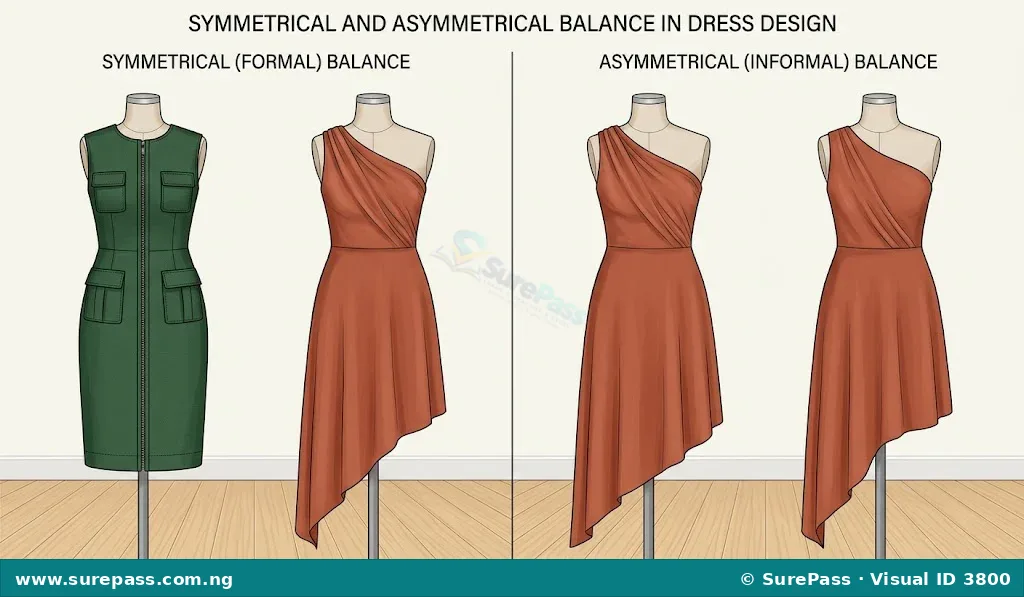
Balance is the distribution of visual weight in a garment to create stability.
A balanced garment feels visually stable and comfortable to look at. Balance can be achieved in two main ways:
- Symmetrical (Formal) Balance: Both sides of the garment are identical when divided vertically down the center. For example, a shirt with identical pockets on both sides of the chest has symmetrical balance.
- Asymmetrical (Informal) Balance: The two sides of the garment are different, but they still carry equal visual weight. For example, a dress with a single shoulder strap on one side and a decorative drape on the opposite hip has asymmetrical balance.
Observe the illustration below showing the difference between symmetrical and asymmetrical balance in garment design.
Proportion
Proportion is the spatial relationship between different parts of a garment, and between the garment and the human body.
Proportion involves the size, scale, and ratio of garment parts. For example, the size of a collar, pocket, or cuff must be in proportion to the rest of the garment and the size of the wearer. A very large pocket on a small child’s shirt would look out of proportion. Designers often use standard ratios, such as the rule of thirds, to divide garments into pleasing proportions (e.g., a short jacket paired with long trousers).
Differences Between Elements and Principles of Design
Understanding the distinction between elements and principles is essential for every garment designer. The table below outlines the key differences between these two concepts.
| Feature | Elements of Design | Principles of Design |
|---|---|---|
| Definition | The basic visual tools or building blocks of design. | The rules and guidelines for arranging the visual tools. |
| Nature | Physical, concrete, and directly visible components. | Abstract concepts and structural relationships. |
| Examples | Line, colour, texture, and shape. | Emphasis, harmony, balance, and proportion. |
| Role | They represent the “what” of the design (the materials used). | They represent the “how” of the design (how the materials are organized). |
Factors Influencing Garment Design
Designers do not create clothing at random. They must consider several practical, social, and economic factors before deciding what type of garment to create.
The main factors that influence garment design include:
- Occasion or Purpose: The event or activity for which the garment is intended. A school uniform must be simple and durable, sportswear must be flexible and breathable, and evening wear must be elegant and decorative.
- Climate and Weather: The environmental conditions of the region. Lightweight, breathable fabrics like cotton are designed for hot, humid climates like Nigeria, while thick, insulating fabrics are designed for cold climates.
- Body Shape and Size: The physical structure of the target wearer. Designers create styles that flatter different body types, ensuring comfort and confidence.
- Culture and Tradition: Cultural values, modesty standards, and traditional attire styles. In Nigeria, cultural events heavily influence the design of traditional garments like Agbada, Buba, and Ankara styles.
- Current Fashion Trends: Popular styles, colours, and patterns in the market at a given time. Designers often adapt their creations to match modern consumer preferences.
- Cost and Budget: The financial resources available for purchasing fabrics, trims, and production labor. The final selling price of the garment must align with the target market’s purchasing power.
- Fabric Properties: The physical characteristics of the chosen material, such as its drape, stretch, durability, and ease of care.
Practical Skills: Drawing Lines, Shapes, and Colour Guides
Developing drawing skills is essential for expressing design ideas on paper. This section provides step-by-step procedures for drawing basic lines, shapes, the colour wheel, and the colour triangle.
How to Draw Lines and Shapes
This activity helps develop hand-eye coordination and precision in sketching garment details.
The required materials are:
- Drawing paper or sketchbook
- Pencil (HB or 2B)
- Ruler
- Eraser
The procedure involves the following steps:
- Place the drawing paper flat on a clean, hard table.
- Hold the pencil comfortably near the tip, but not too tightly.
- Use the ruler to draw straight vertical, horizontal, and diagonal lines across the paper. Keep the lines light and clean.
- Practice drawing curved lines freehand. Move the wrist smoothly in a continuous sweep to create waves, spirals, and C-curves.
- Combine straight lines to draw geometric shapes, including a square, a rectangle, and a triangle. Use the ruler to ensure the edges are straight and the corners are sharp.
- Draw organic and curved shapes freehand, including a perfect circle and an oval.
How to Draw the Colour Wheel
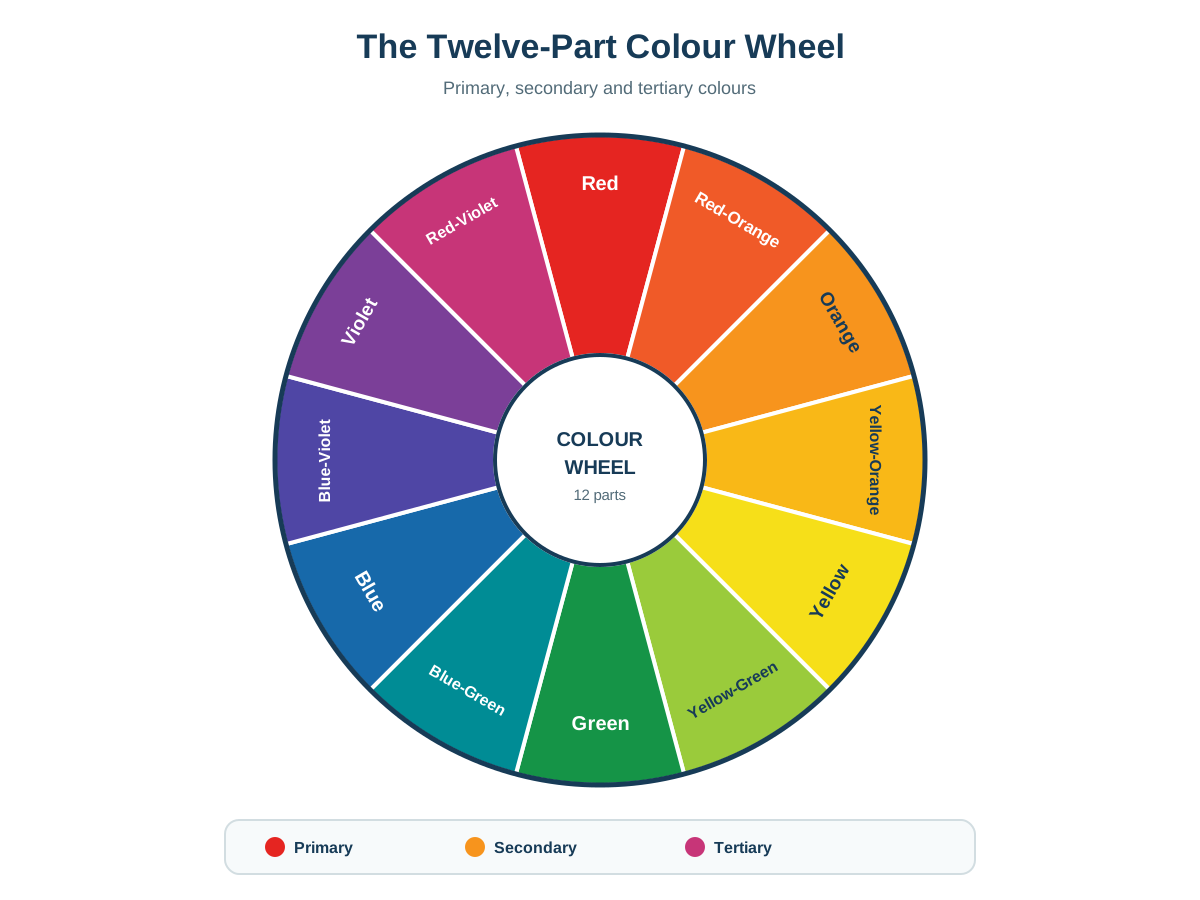
The colour wheel is a circular diagram that shows the relationships between primary, secondary, and tertiary colours.
The required materials are:
- Cardboard paper
- Compass or a circular object (like a plate)
- Pencil and ruler
- Poster colours or watercolours (Red, Yellow, Blue)
- Paintbrushes and water
The procedure involves the following steps:
- Use a compass or a circular object to draw a large circle in the center of the cardboard paper.
- Draw a slightly smaller circle inside the first one to create a ring.
- Use a ruler and pencil to divide the ring into twelve equal segments.
- Identify three equidistant segments to represent the primary colours: Red, Yellow, and Blue. Paint these segments with their respective pure colours.
- Mix equal parts of Red and Yellow to make Orange. Paint the segment halfway between Red and Yellow.
- Mix equal parts of Yellow and Blue to make Green. Paint the segment halfway between Yellow and Blue.
- Mix equal parts of Blue and Red to make Violet (Purple). Paint the segment halfway between Blue and Red. (Orange, Green, and Violet are the secondary colours).
- Mix adjacent primary and secondary colours to create the six tertiary colours (e.g., Red-Orange, Yellow-Green, Blue-Violet) and paint them in the remaining empty segments.
- Label each segment clearly with its colour name.
Observe the diagram below showing a completed twelve-part colour wheel.
How to Draw the Colour Triangle
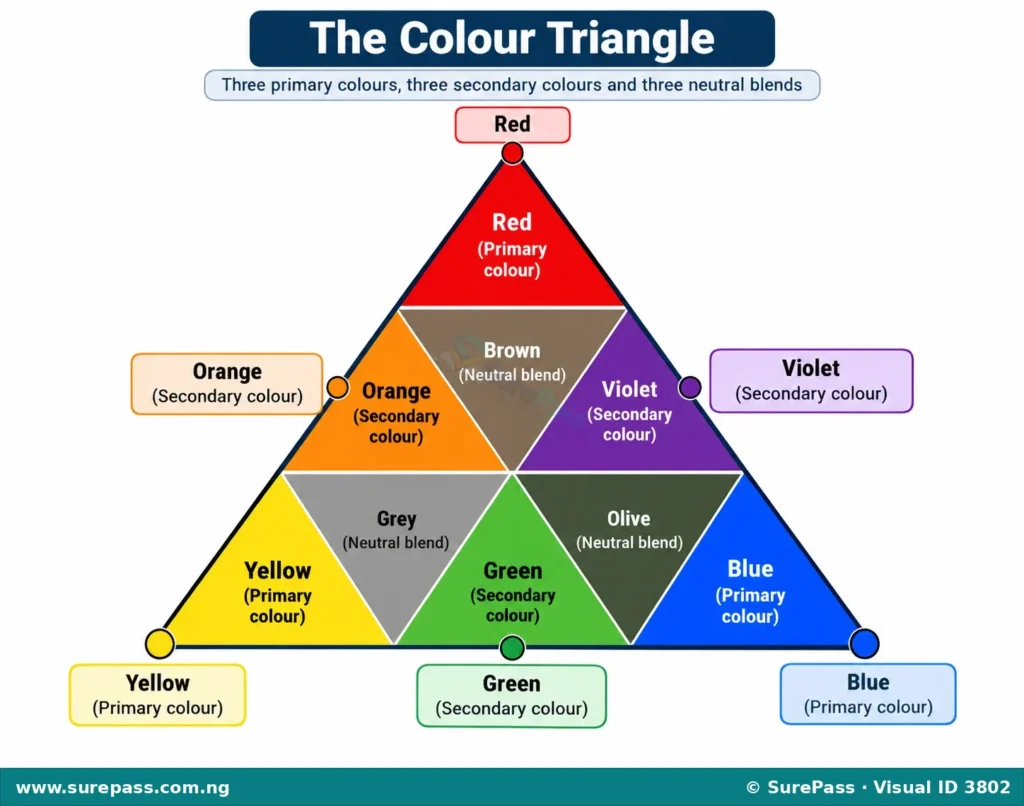
The colour triangle is a simplified triangular diagram used to illustrate the relationships between primary and secondary colours, or the transition of a colour from its pure hue to tints and shades.
The required materials are:
- Cardboard paper
- Pencil and ruler
- Poster colours or watercolours
- Paintbrushes
The procedure involves the following steps:
- Use a ruler and pencil to draw a large equilateral triangle on the cardboard paper.
- Divide the large triangle into nine smaller, equal-sized triangles (three rows of triangles).
- Paint the three outer corner triangles with the primary colours: Red at the top corner, Yellow at the bottom-left corner, and Blue at the bottom-right corner.
- Mix Red and Yellow to create Orange, and paint the triangle along the left edge between Red and Yellow.
- Mix Yellow and Blue to create Green, and paint the triangle along the bottom edge between Yellow and Blue.
- Mix Blue and Red to create Violet, and paint the triangle along the right edge between Blue and Red.
- Fill the center triangle with a neutral blend of all three primary colours (a neutral brown or grey) to show the transition of mixed hues.
- Allow the paint to dry completely, then outline the triangles neatly with a black pen or marker.
Observe the diagram below showing a completed colour triangle.
Summary
Garment design is a structured process that relies on elements and principles to create beautiful, functional clothing. The elements of design (line, colour, texture, and shape) serve as the physical building blocks, while the principles of design (emphasis, harmony, balance, and proportion) act as the rules for arranging those blocks. By understanding these concepts and considering external factors like climate, culture, and body shape, designers can create high-quality garments that meet the needs of their wearers.
Review Questions
Answer the following questions to test your understanding of the lesson:
- Explain the concept of garment design.
- Identify five features of a quality garment.
- Explain how design principles can be used to improve the appearance of a garment.
- Differentiate between elements of design and principles of design, giving two examples of each.
- Explain how designers decide what type of garment to create.




0 comments
Open the discussion when you need it. Comments stay collapsed until requested so the initial article remains light.