



ARTICLE CONTENTSOn this page 8 sections
Sources, Classification and Types of Fabric
Performance Objectives
By the end of the lesson, students should be able to:
- identify different sources of fabrics;
- explain the meaning of terms related to fabrics;
- classify fabrics based on the sources;
- perform simple fabric test.
Meaning of Terms Related to Fabric
In fashion design and garment making, understanding the basic building blocks of textiles is essential. Two fundamental terms used are fibre and fabric.
Fibre
A fibre is a hair-like strand or filament that forms the basic unit used in making yarns and fabrics.
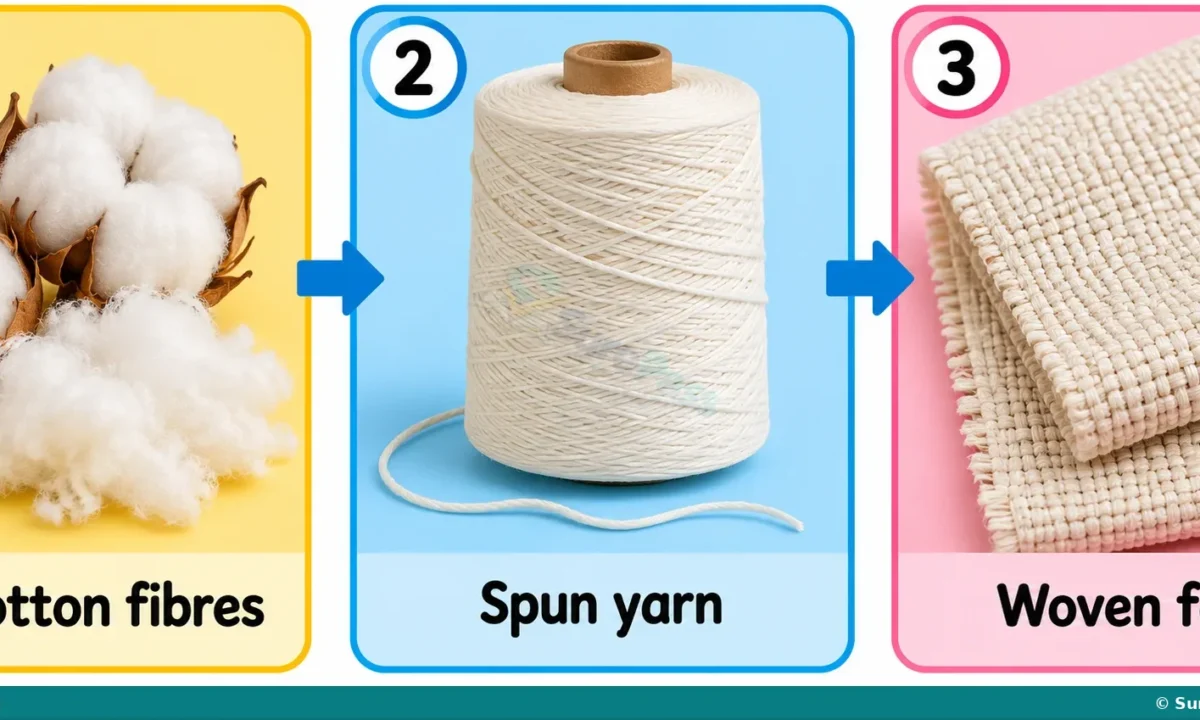
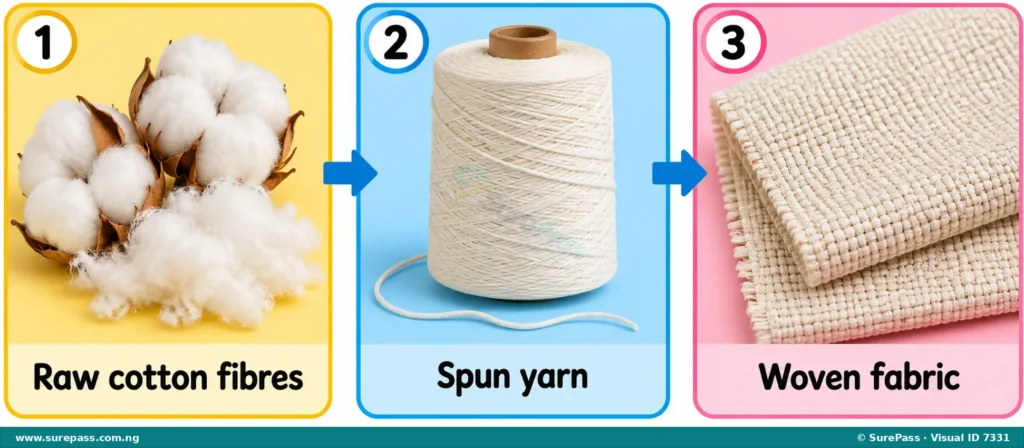
Fibres can be obtained from natural sources, such as plants and animals, or produced artificially through chemical processes. They are spun or twisted together to form yarns, which are then used to construct fabrics.
Fabric
A fabric is a pliable, cloth-like material made by weaving, knitting, or bonding fibres or yarns together.
Fabric is the actual material used to cut and sew garments, household linens, and other textile products. The characteristics of any fabric depend heavily on the type of fibres used and the method of construction.
Sources of Fabrics
Fibres, which are processed to make fabrics, are obtained from two primary sources. These sources are:
- Natural sources
- Man-made sources
Natural Sources
Natural sources refer to materials obtained directly from nature, specifically from plants and animals. These materials require physical processing to be spun into yarn, but their chemical structure is not altered. Examples of natural sources include cotton bolls from cotton plants, flax stems, sheep fleece, and silkworm cocoons.
Man-Made Sources
Man-made sources refer to materials produced through industrial and chemical processes. These are not harvested directly from nature in a ready-to-spin form. Instead, they are manufactured either by chemically modifying natural materials like wood pulp or by synthesizing polymers from petrochemicals. Examples of man-made sources include coal, petroleum, and wood pulp processed with chemicals.
Classification of Fabrics
Fabrics are classified based on the origin and chemical nature of the fibres from which they are made. The four main classes are:
- Animal fabrics (Protein fibres)
- Vegetable or Plant fabrics (Cellulosic fibres)
- Regenerated fabrics (Modified natural fibres)
- Synthetic fabrics (Purely chemical fibres)
Animal Fabrics
Animal fabrics are made from protein fibres obtained from animal sources. The two primary types are:
- Wool: This is obtained from the fleece of sheep, goats, or camels. Wool fabrics are warm, highly absorbent, resilient, and have a naturally soft, crimped texture.
- Silk: This is a fine, continuous filament produced by silkworms when spinning their cocoons. Silk fabrics are highly valued for their natural lustre, smoothness, strength, and light weight.
Vegetable or Plant Fabrics
Vegetable fabrics are made from cellulose fibres obtained from various parts of plants. The two primary types are:
- Cotton: This is obtained from the seed pod (boll) of the cotton plant. Cotton fabrics are highly absorbent, breathable, durable, easy to wash, and comfortable to wear in warm climates. Cotton is widely used in Nigeria for making traditional Ankara prints and daily wear.
- Flax: This is obtained from the stem of the flax plant. Flax fibres are used to make linen fabric. Linen is exceptionally strong, highly absorbent, dries quickly, and has a crisp texture, though it wrinkles easily.
Regenerated Fabrics
Regenerated fabrics are made from natural cellulose (usually wood pulp or cotton linters) that is chemically dissolved and then reconstituted into solid filaments. The primary type is:
- Rayon: Often referred to as viscose, rayon has properties similar to natural fibres like cotton and silk. It is highly absorbent, soft, drapes well, and is comfortable, but it loses strength when wet.
Synthetic Fabrics
Synthetic fabrics are made entirely from chemical substances, mostly derived from coal, petroleum, and natural gas. These fibres are created through polymerization. The three primary types are:
- Nylon: This is an exceptionally strong, lightweight, and elastic synthetic fabric. It resists abrasion, dries quickly, and is used for activewear, stockings, and ropes.
- Polyester: This is a highly durable, wrinkle-resistant, and quick-drying fabric. It is often blended with cotton to improve durability and ease of care.
- Acrylic: This is a lightweight, warm synthetic fabric that closely resembles wool. It is resistant to moths, sunlight, and chemicals, making it common in sweaters and blankets.
Table of Sources and Classes of Fabrics
The table below provides a structured classification of fabrics based on their sources, classes, and specific fibre types:
| Source | Class | Fibre Type | Fabric Examples |
|---|---|---|---|
| Natural | Animal (Protein) | Wool, Silk | Woolen sweaters, Silk satin, Silk chiffon |
| Vegetable / Plant (Cellulosic) | Cotton, Flax | Cotton Ankara, Linen shirts, Linen trousers | |
| Man-made | Regenerated (Semi-synthetic) | Rayon (Viscose) | Rayon dresses, linings, blouses |
| Synthetic (Chemical) | Nylon, Polyester, Acrylic | Nylon stockings, Polyester jerseys, Acrylic knits |
Reasons for Testing Fabrics
Before cutting and sewing garments, fashion designers and garment makers often perform tests on fabric samples. The main reasons for testing fabrics include:
- Identifying Fibre Content: Testing helps to determine whether a fabric is natural, synthetic, or a blend, especially when there is no manufacturer label.
- Determining Care and Maintenance: Different fibres react differently to water, detergents, and heat. Testing helps identify whether a fabric should be dry-cleaned, hand-washed, or ironed at low or high temperatures.
- Selecting Sewing Tools and Techniques: Knowing the fabric type guides the choice of sewing machine needles, thread types, stitch length, and tension settings.
- Verifying Authenticity and Quality: Testing prevents garment makers from purchasing low-quality imitations, such as synthetic polyester sold as pure silk or cotton.
- Predicting Fabric Behaviour: Tests reveal how a fabric reacts to heat, moisture, and tension, preventing damage to the final garment during pressing or laundering.
Performing Fabric Tests
Fabric testing can be done using simple methods in the workshop or laboratory. The two primary tests are the feeling test and the burning test.
The Feeling Test (Texture Test)
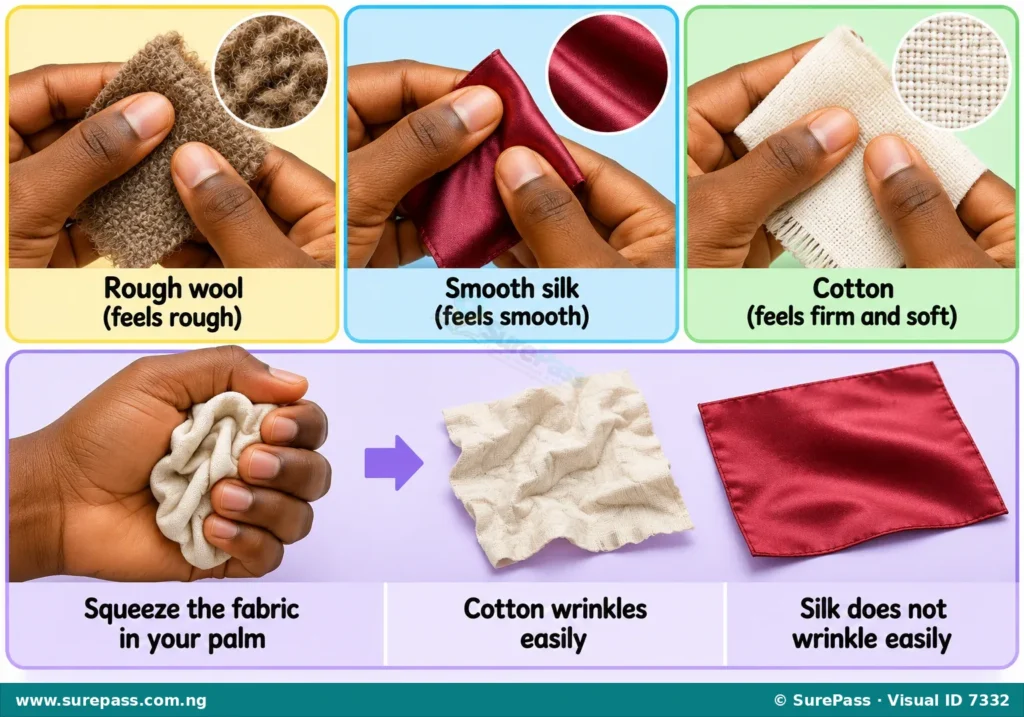
The feeling test involves touching and rubbing a fabric sample between the fingers to assess its texture, warmth, elasticity, and weight. This test relies on tactile observation.
The procedure for performing the feeling test involves the following steps:
- Cut a small sample of the fabric, approximately 5 centimetres by 5 centimetres.
- Hold the fabric sample between the thumb and index finger.
- Rub the fabric gently to feel its surface smoothness or roughness.
- Squeeze the fabric in the palm of the hand to check for resilience and wrinkle resistance.
- Observe the tactile characteristics of the fabric sample based on the following guidelines:
Common tactile characteristics of fabrics include:
- Cotton: Feels soft, cool, slightly stiff, and wrinkles easily when squeezed.
- Flax (Linen): Feels stiff, cool, smooth, and has a distinct crispness.
- Wool: Feels warm, springy, dry, and slightly rough or scratchy.
- Silk: Feels exceptionally smooth, slippery, soft, and warm.
- Rayon: Feels smooth, limp, cool, and soft.
- Synthetic Fabrics (Nylon/Polyester): Feel smooth, slippery, warm, and highly resilient (do not wrinkle easily when squeezed).
The Burning Test
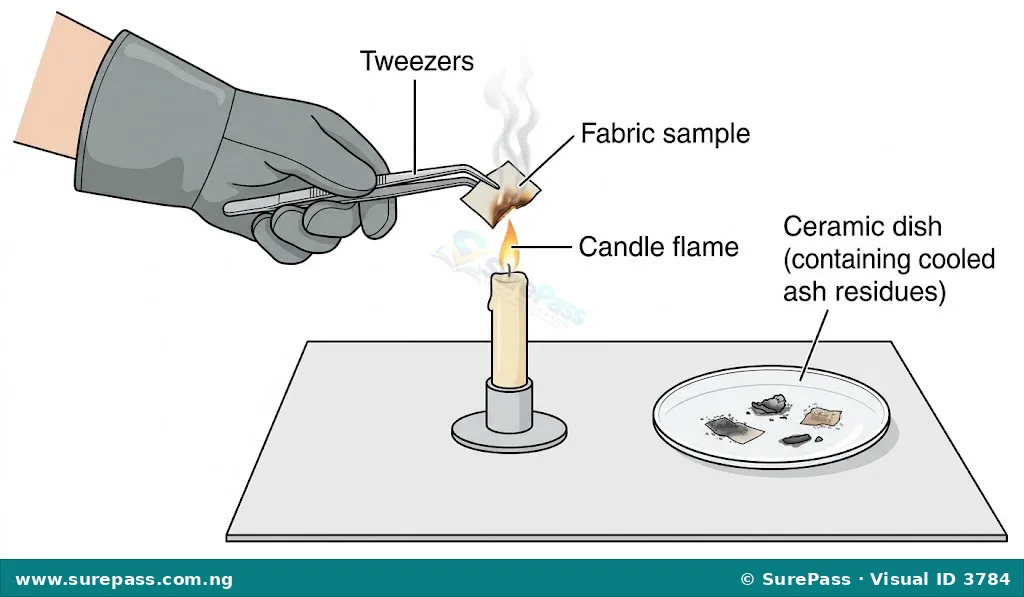
The burning test is a reliable chemical identification method. It involves exposing a small yarn or fabric sample to an open flame and observing its reaction to heat, the smell of the smoke, and the nature of the remaining ash or bead.
The required materials and equipment are:
- Small fabric samples (cotton, wool, silk, rayon, nylon, polyester)
- A laboratory burner or a candle
- Matches or a lighter
- A pair of metal tweezers or tongs
- A fireproof dish or ceramic plate
- A cup of water for safety
The procedure for performing the burning test involves the following steps:
- Set up the laboratory burner or candle on a flat, stable surface away from flammable materials.
- Grip a small strip of the fabric sample firmly using the metal tweezers.
- Bring the fabric sample slowly toward the edge of the flame.
- Observe how the fabric behaves as it approaches the flame, while it is in the flame, and after it is removed from the flame.
- Note the odour produced by the burning fabric.
- Allow the residue to cool on the fireproof dish, then examine the texture of the ash or bead.
- Extinguish any remaining embers immediately in the cup of water.
The reactions of different fabrics to the burning test are detailed in the table below:
| Fabric Class / Type | Reaction to Flame | Odour Produced | Residue Left |
|---|---|---|---|
| Cotton / Flax (Vegetable) | Burns quickly with a yellow flame; continues to burn without melting. | Smells like burning paper. | Light, fluffy grey ash. |
| Wool / Silk (Animal) | Burns slowly; self-extinguishes when removed from the flame. | Smells like burning hair or feathers. | Dark, crushable, irregular black ash. |
| Rayon (Regenerated) | Burns rapidly with a bright flame; does not melt. | Smells like burning paper. | Very little light grey ash. |
| Nylon / Polyester (Synthetic) | Melts and shrinks away from the flame; burns slowly with chemical dripping. | Smells sweet, chemical, or celery-like. | Hard, round, uncrushable grey or black bead. |
| Acrylic (Synthetic) | Melts and burns rapidly with sputtering; produces black smoke. | Smells sharp, acrid, and chemical. | Hard, irregular, black crusty bead. |
Important safety tips for the burning test include:
- Perform the test in a well-ventilated room to avoid inhaling toxic chemical fumes from synthetic fabrics.
- Always hold the fabric sample with metal tweezers, never with bare fingers.
- Keep a container of water nearby to extinguish flames quickly if necessary.
- Do not touch the melted residue of synthetic fabrics while hot, as it can stick to the skin and cause severe burns.


0 comments
Open the discussion when you need it. Comments stay collapsed until requested so the initial article remains light.