


ARTICLE CONTENTSOn this page 9 sections
Facings and Interfacing
Performance Objectives
By the end of the lesson, students should be able to:
- explain the terms:
- Facing
- Interfacing;
- enumerate the functions of facing and interfacing in garments;
- identify different types of facings and interfacing use in garments;
- state factors to consider when choosing facing and interfacing;
- practice how to cut and apply facing and inter-facing on parts of garments.
Meaning of Facing and Interfacing
In garment making, achieving a neat, professional finish on raw edges and maintaining the structural shape of a garment are essential skills. Facings and interfacings are two critical components used to achieve these results.
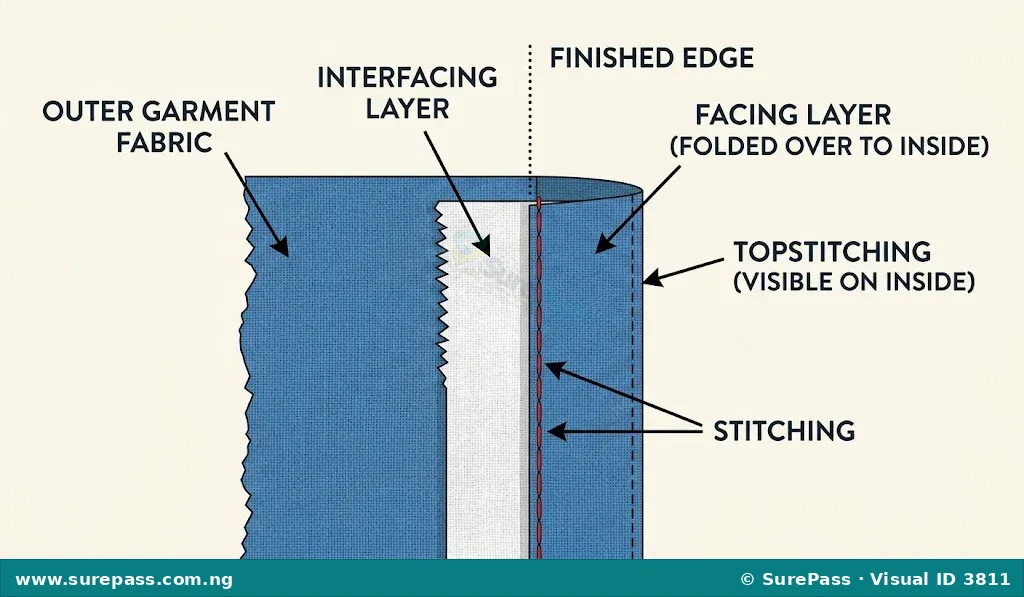
Facing is a piece of fabric used to finish the raw edges of a garment at openings such as necklines, armholes, collars, and cuffs.
Facings are usually turned to the inside of the garment so that they are not visible from the outside, though they can occasionally be turned to the outside to serve as a decorative feature.
Interfacing is an extra layer of fabric applied to the inside of a garment between the facing and the outer fabric to provide support, strength, shape, and stability.
Interfacing is hidden from view in the finished garment. It is applied to areas that require extra reinforcement, such as collars, cuffs, waistbands, pocket openings, and button plackets.
Functions of Facings and Interfacing
Both facings and interfacings play distinct but complementary roles in garment construction. Understanding these functions helps the garment maker produce durable and high-quality clothing.
Functions of Facings
The primary functions of facings in garments include:
- Finishing raw edges neatly to prevent fraying and unraveling of the fabric.
- Providing a clean, smooth, and comfortable edge against the skin at garment openings.
- Preventing curved edges, such as necklines and armholes, from stretching out of shape during wear and laundering.
- Enhancing the appearance of the garment by keeping the inside construction neat.
- Serving as a decorative trim when turned to the right side of the garment using contrasting fabric.
Functions of Interfacing
The primary functions of interfacing in garments include:
- Adding body, crispness, and stiffness to specific areas of the garment, such as shirt collars and cuffs.
- Reinforcing areas of stress, such as buttonholes, buttons, and pocket openings, to prevent the fabric from tearing.
- Maintaining the shape and design structure of the garment throughout its lifetime of wear and washing.
- Preventing the stretching of curved or bias-cut edges during the sewing process.
- Improving the drape and overall hang of the garment on the body.
Types of Facings and Interfacing
Different styles of garments and fabric types require specific types of facings and interfacings to achieve the desired finish.
Types of Facings
The main types of facings used in garment construction are:
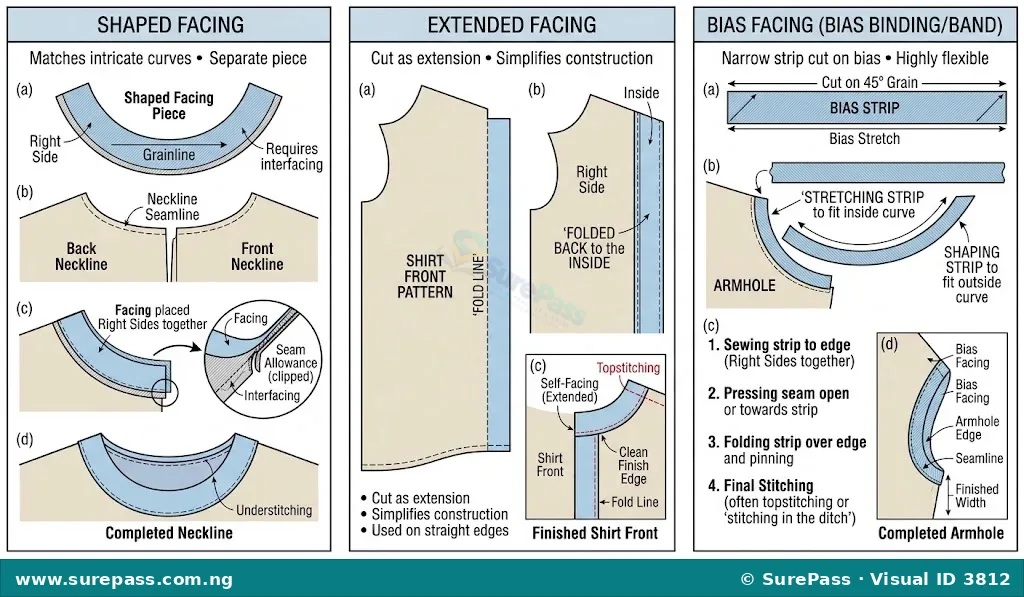
- Shaped Facing: This is cut in the exact same shape and on the same grainline as the garment edge it is designed to finish. It is commonly used for curved edges such as round necklines, V-necklines, and armholes.
- Extended Facing (Cut-on Facing): This is cut as an extension of the garment pattern piece and then folded back to the inside. It is used on straight edges, such as front button closures, jacket openings, and straight cuffs.
- Bias Facing: This is a narrow strip of fabric cut on the true bias (a 45-degree angle to the selvage). Because of its elasticity, it easily conforms to curved edges. It is applied to finish necklines and armholes without adding bulk.
Types of Interfacing
Interfacing is classified either by its application method or by its structural construction.
The types of interfacing classified by application method are:
- Fusible Interfacing: This type has a heat-sensitive adhesive backing on one side. It is bonded permanently to the wrong side of the fabric using a hot iron and steam. It is quick to apply and provides excellent stability.
- Sew-in Interfacing: This type does not have adhesive. It is basted or stitched directly to the wrong side of the garment fabric or facing during construction. It is preferred for fabrics that cannot tolerate heat, highly textured fabrics, or when a soft, natural drape is desired.
The types of interfacing classified by structure are:
- Woven Interfacing: This is constructed like regular woven fabric with warp and weft threads. It has a distinct grainline and must be cut in the same grain direction as the garment piece to prevent distorting the drape.
- Non-woven Interfacing: This is made by bonding fibers together chemically, thermally, or mechanically. It has no grainline, does not ravel, and can be cut in any direction, making it highly economical.
- Knit Interfacing: This is a stretchy interfacing used primarily with knit fabrics. It preserves the elasticity of the main fabric while providing gentle support.
Factors to Consider When Choosing Facing and Interfacing
Selecting the wrong facing or interfacing can ruin the appearance, drape, and durability of a garment. Careful consideration must be given to several factors before selection.
Factors for Choosing Facing
Factors to consider when selecting facing fabric include:
- Fabric Weight: The facing fabric should be of the same weight or slightly lighter than the garment fabric. Facing that is too heavy will create unsightly ridges on the outside of the garment.
- Colour Compatibility: The facing should match the garment fabric colour. For sheer or light-coloured fabrics, the facing must match exactly to prevent it from showing through as a dark shadow.
- Garment Design: The shape of the opening dictates the type of facing. Highly curved necklines require shaped or bias facings, while straight front openings are best finished with extended facings.
- Care Requirements: The facing fabric must have the same washing, drying, and ironing requirements as the main garment fabric to prevent uneven shrinkage.
Factors for Choosing Interfacing
Factors to consider when selecting interfacing include:
- Weight of the Garment Fabric: The interfacing must always be lighter than, or equal to, the weight of the garment fabric. Heavy interfacing on lightweight fabric makes the garment stiff and unnatural.
- Fabric Texture and Heat Sensitivity: Heat-sensitive fabrics like velvet, silk, vinyl, and some synthetics cannot withstand the heat required for fusible interfacing. These fabrics require sew-in interfacing.
- Garment Style and Desired Stiffness: A crisp shirt collar requires a firm, heavy-weight interfacing, whereas a soft jacket lapel requires a lightweight, flexible interfacing.
- Fabric Stretch: Knit fabrics require knit or stretch interfacing to maintain their elasticity, while stable woven fabrics require woven or non-woven interfacing.
- Colour: Interfacing is generally available in white, black, and grey. The colour chosen should not show through to the right side of the garment fabric.
How to Cut and Apply Facing with Interfacing
This practical guide outlines the steps required to cut and apply a shaped neckline facing reinforced with fusible interfacing.
The required tools and materials for this practical exercise are:
- Garment fabric (cotton or poly-cotton blend)
- Fusible interfacing (lightweight)
- Neckline pattern pieces (garment front and facing front)
- Sewing shears
- Pins
- Tailor’s chalk
- Steam iron and ironing board
- Sewing machine and matching thread
The step-by-step procedure for cutting and applying facing with interfacing is:
- Prepare and Cut the Fabric: Place the garment front pattern on the folded fabric, trace, and cut. Repeat this process using the shaped facing pattern to cut the facing piece from the fabric.
- Cut the Interfacing: Place the shaped facing pattern on the fusible interfacing. Trace and cut out the interfacing piece. To reduce bulk in the seams, trim 6 millimetres off the outer seam allowances of the interfacing piece.
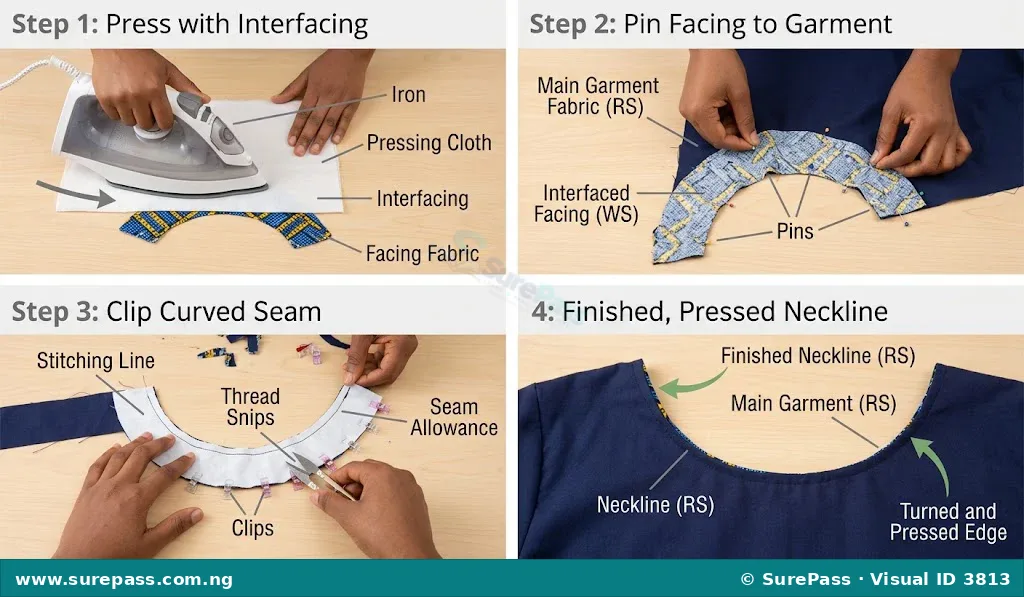
- Fuse the Interfacing to the Facing: Place the facing fabric on the ironing board with the wrong side facing up. Place the fusible side (the rough, shiny side with adhesive dots) of the interfacing against the wrong side of the facing fabric. Align the edges carefully.
- Press to Bond: Cover the interfacing with a damp pressing cloth to protect the fabric. Press down firmly with a hot steam iron for 10 to 15 seconds without sliding the iron. Lift the iron and move to the next section until the entire interfacing is bonded. Allow the fabric to cool completely.
- Finish the Outer Edge of the Facing: Neaten the outer, unnotched curved edge of the facing using a zigzag stitch, an overlocking stitch, or by turning under 6 millimetres and stitching.
- Pin Facing to Garment: Place the garment front on a flat surface with the right side facing up. Place the interfaced facing on top of the garment, with the right sides facing together. Align the neckline curves and shoulder edges. Pin the pieces together securely.
- Stitch the Neckline: Sew along the neckline curve using the specified seam allowance (usually 1.5 centimetres). Remove pins as sewing progresses.
- Clip and Notch the Curve: Cut small V-shaped notches into the seam allowance along the curved neckline. Be careful not to cut through the stitching line. This releases tension and allows the seam to lay flat when turned.
- Understitch the Seam: Press the seam allowance toward the facing. On the right side of the facing, sew a line of stitching 2 millimetres away from the seam line, catching the seam allowance underneath. This prevents the facing from rolling to the outside of the garment.
- Final Press: Turn the facing completely to the inside of the garment. Press the neckline edge flat from the right side of the garment. Secure the facing at the shoulder seams with a few hand stitches (tacking) to keep it in place.
Summary of Differences Between Facing and Interfacing
The table below highlights the key distinctions between facing and interfacing:
| Feature | Facing | Interfacing |
|---|---|---|
| Primary Purpose | To finish raw edges neatly. | To provide support, strength, and shape. |
| Visibility | Turned to the inside (hidden) or outside (decorative). | Always hidden inside the garment layers. |
| Fabric Used | Usually the same fabric as the garment. | Specialised interfacing fabric (woven, non-woven, or knit). |
| Location | Applied directly to the raw edges of openings. | Sandwiched between the garment and the facing. |
Review Questions
The following questions are designed to test the understanding of the concepts covered in this unit:
- Define the term ‘facing’ as used in garment construction.
- Explain the difference between fusible interfacing and sew-in interfacing.
- State three functions of interfacing in a tailored shirt.
- List three types of facings and describe where each is best applied.
- Identify four factors that must be considered when choosing interfacing for a lightweight silk blouse.
- Why is understitching important when finishing a neckline with a shaped facing?




0 comments
Open the discussion when you need it. Comments stay collapsed until requested so the initial article remains light.