



ARTICLE CONTENTSOn this page 7 sections
Qualities of a Good Business Opportunity
Performance Objectives
By the end of the lesson, students should be able to:
- describe the qualities of a good business opportunity;
- access and rank business opportunities in crop production and horticulture.
Meaning of an Agricultural Business Opportunity
An agricultural business opportunity is a favorable economic chance or opening in the agricultural sector that can be exploited to start a profitable enterprise.
In crop production and horticulture, opportunities exist across various value chains. These include seed production, crop cultivation, produce processing, packaging, marketing, and the establishment of ornamental nurseries. Identifying a viable opportunity requires a systematic evaluation of the agricultural environment, market conditions, and resource availability.
Qualities of a Good Business Opportunity
Not every agricultural idea is a viable business opportunity. A good business opportunity must possess specific characteristics that guarantee its long-term survival and profitability.
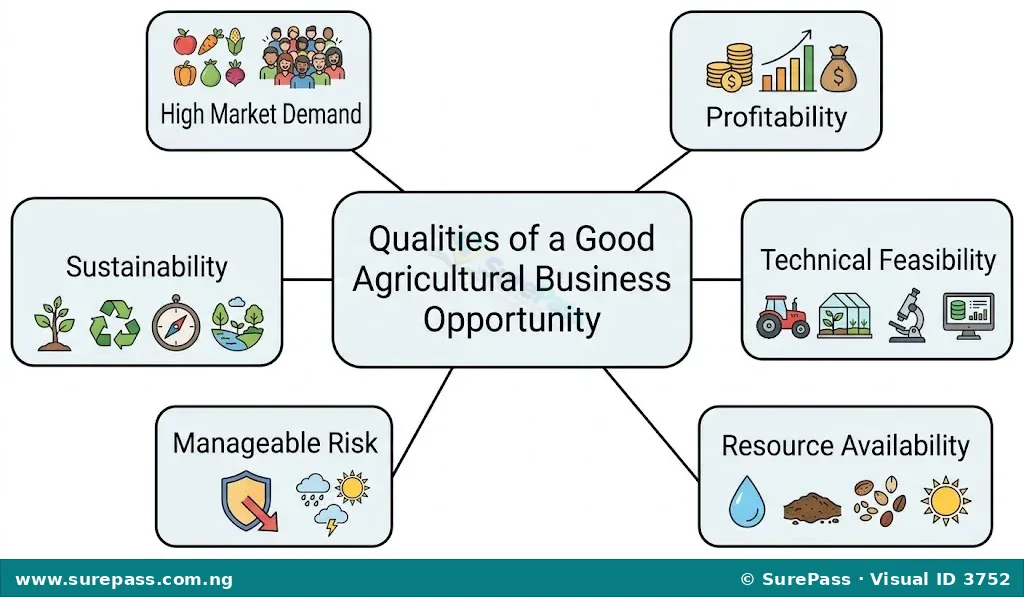
The essential qualities of a good business opportunity in crop production and horticulture include:
- High Market Demand: There must be an existing, growing, or underserved market for the crop or horticultural product. A business cannot survive without customers who are willing and able to buy the produce regularly.
- Profitability: The opportunity must have the potential to generate returns that are significantly higher than the cost of production. The profit margin must justify the capital, time, and labor invested.
- Feasibility and Technical Viability: The crop must be suitable for cultivation under local climatic conditions, soil types, and water availability. Additionally, the technical knowledge required to cultivate, manage, and harvest the crop must be accessible to the entrepreneur.
- Resource Availability: Essential inputs such as fertile land, quality seeds or planting materials, fertilizers, water, labor, and capital must be readily available and affordable.
- Manageable Risk: Every agricultural venture carries risks such as pests, diseases, adverse weather, and price fluctuations. A good business opportunity has risks that can be anticipated, mitigated, or managed through insurance, good agronomic practices, or diversification.
- Scalability: The business should have the capacity to grow and expand over time. A scalable crop production business can increase its output and revenue as market demand grows without a disproportionate increase in production costs.
- Sustainability: The enterprise must be environmentally friendly and socially acceptable. It should not deplete natural resources, degrade the soil, or pollute water bodies, as these actions would jeopardize future production.
Assessing Business Opportunities in Crop Production and Horticulture
Assessment is the process of evaluating different agricultural ideas to determine their viability, strengths, weaknesses, and suitability for implementation. Before investing capital, an entrepreneur must systematically analyze each potential crop or horticultural enterprise.
The key criteria used to assess agricultural business opportunities are:
- Market Analysis: This involves investigating the target customers, competitors, pricing trends, and distribution channels. For example, cultivating leafy vegetables like fluted pumpkin (ugu) near an urban center often guarantees a ready market due to daily household consumption.
- Technical Assessment: This evaluates the soil quality, topography, climate, water source, and the specific agronomic requirements of the crop. For instance, establishing a floriculture business requires a reliable year-round water supply for irrigation.
- Financial Assessment: This estimates the start-up capital, operational costs, projected revenue, and cash flow. It helps determine how long it will take for the crop production business to break even and start making a profit.
- Risk Assessment: This identifies potential threats such as pest outbreaks, drought, post-harvest losses, and market price drops, and outlines strategies to handle them.
Ranking Business Opportunities
Ranking is the process of prioritizing assessed business opportunities based on a set of standardized criteria to select the most viable option for investment.
Since resources such as land, labor, and capital are limited, an agricultural entrepreneur cannot undertake all identified opportunities at once. Ranking helps in making an objective decision rather than relying on guesswork or emotions.
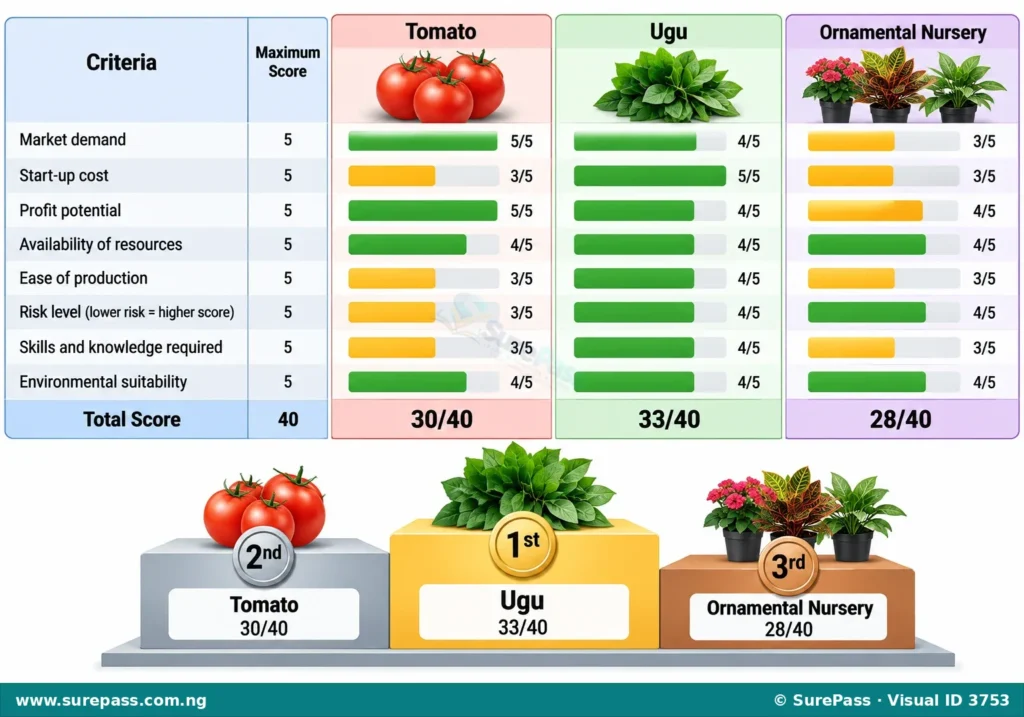
To rank business opportunities, a decision matrix or scoring table is used. Each opportunity is scored against key criteria on a scale (for example, 1 to 5, where 1 represents “Very Poor” and 5 represents “Excellent”). The scores are then totaled, and the opportunity with the highest score is ranked first.
The following table illustrates a scoring matrix used to rank three potential horticultural business opportunities in Nigeria:
| Assessment Criteria | Opportunity A: Tomato Cultivation | Opportunity B: Fluted Pumpkin (Ugu) Production | Opportunity C: Ornamental Plant Nursery |
|---|---|---|---|
| Market Demand | 5 (Very High) | 5 (Very High) | 3 (Moderate) |
| Profitability | 4 (High) | 4 (High) | 4 (High) |
| Technical Feasibility | 3 (Moderate – high pest risk) | 5 (Very Easy) | 4 (Easy) |
| Resource Availability | 4 (High) | 5 (Very High) | 3 (Moderate) |
| Risk Level (Lower risk = Higher score) | 2 (High risk of spoilage) | 4 (Low risk) | 3 (Moderate risk) |
| Total Score | 18 | 23 | 17 |
| Rank | 2nd | 1st | 3rd |
Based on the scoring matrix above, Fluted Pumpkin (Ugu) Production ranks first because it has the highest total score of 23. It presents the best combination of high market demand, low technical difficulty, high resource availability, and manageable risk. Tomato Cultivation ranks second, primarily limited by high perishability and pest risks. The Ornamental Plant Nursery ranks third due to a more specialized, moderate market demand.
How to Assess and Rank Agricultural Business Opportunities
This section outlines the practical procedure for identifying, assessing, and ranking business opportunities in crop production and horticulture.
The required materials for this exercise are:
- Cardboard sheets
- Writing markers
- Rulers
- Notebooks for field observations
The procedure involves the following steps:
- Identify Potential Ideas: Observe the local community and list three to four crop production or horticultural products that are in demand but not sufficiently supplied. Examples include fresh pepper, plantain suckers, leafy vegetables, or potted flowers.
- Conduct Preliminary Research: Interview local farmers, market traders, and consumers to gather information on market prices, seasonal availability, and common production challenges for each identified crop.
- Draw the Assessment Table: Use a ruler and marker to draw an assessment matrix on a sheet of cardboard. Create columns for the criteria (Market Demand, Profitability, Technical Feasibility, Resource Availability, and Risk Level) and rows for each business opportunity.
- Assign Scores: Discuss the findings for each crop and assign a score from 1 to 5 for each criterion based on the gathered facts. Ensure that for the “Risk Level” criterion, a higher score represents lower, more manageable risk.
- Calculate Total Scores: Add up the scores across the rows for each business opportunity to find the total score.
- Determine the Ranks: Assign ranks (1st, 2nd, 3rd, etc.) based on the total scores, with the highest score receiving the first rank.
- Write a Justification: Write a brief summary explaining why the highest-ranking opportunity is the most suitable business to start in the local area.




0 comments
Open the discussion when you need it. Comments stay collapsed until requested so the initial article remains light.