



ARTICLE CONTENTSOn this page 7 sections
Cropping systems
Performance Objectives
By the end of the lesson, students should be able to:
- explain the meaning and importance of cropping system;
- explain different types of cropping system;
- carry out different sole and multiple cropping.
Meaning of Cropping System
A cropping system refers to the pattern of crops grown on a given piece of land, the order of their cultivation, and the management practices used to grow them over a specific period.
It represents the spatial and temporal arrangement of crops on a farm. This system is determined by environmental factors such as rainfall, temperature, and soil type, as well as economic factors like market demand, available farm labour, and technology.
Importance of Cropping Systems
The choice of a cropping system is critical to the success of any agricultural enterprise. The main reasons why farmers adopt specific cropping systems include:
- Maximisation of Land Use: Efficient cropping systems allow farmers to utilise available land resources to the fullest, which is highly beneficial in areas with high population density and limited arable land.
- Soil Fertility Management: Certain systems, such as those involving crop rotation or leguminous crops, help maintain and restore soil nutrients naturally.
- Pest and Disease Control: Alternating crops or growing diverse crop species breaks the life cycles of pests and pathogens, reducing the need for chemical pesticides.
- Erosion Control: Systems that maintain continuous soil cover, such as multiple cropping, protect the soil surface from the erosive impact of heavy rainfall and wind.
- Risk Minimisation: Cultivating multiple crop species ensures that if one crop fails due to unfavourable weather or pest outbreaks, the farmer can still harvest other crops.
- Weed Suppression: Dense crop canopy cover in mixed cropping systems shades out weeds, reducing the labour and cost required for weed control.
- Balanced Nutrient Utilisation: Different crops have different root depths and nutrient requirements. A well-planned cropping system ensures that nutrients are absorbed from various soil depths, preventing rapid depletion of specific minerals.
Types of Cropping Systems
Cropping systems are broadly classified based on the number of crops grown and their arrangement on the field. The major types of cropping systems are detailed below.
Sole Cropping (Monocropping)
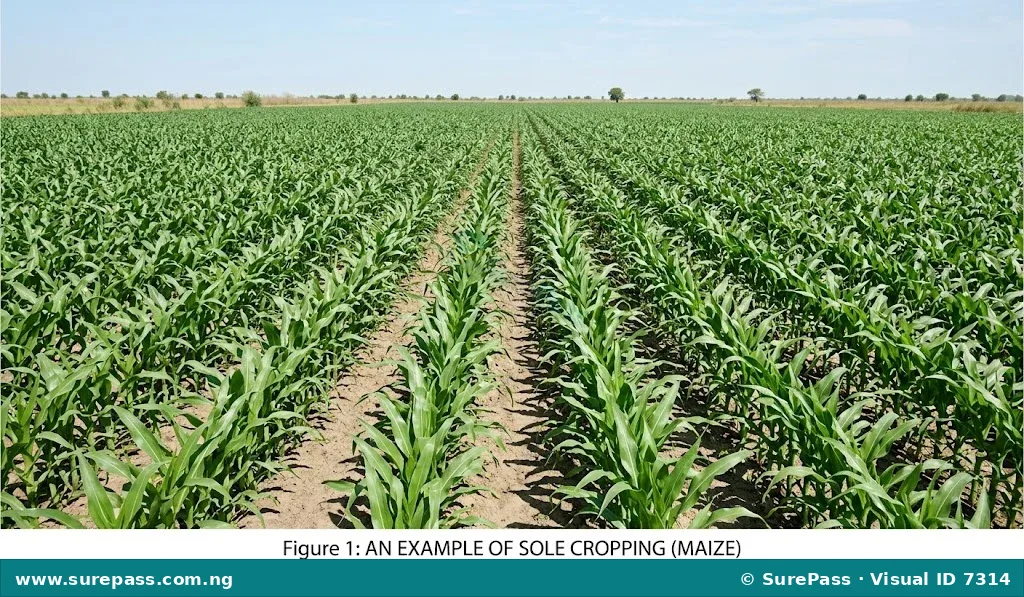
Sole cropping, also known as monocropping, is the practice of growing only one type of crop on a piece of land at any given time.
For example, a farmer may plant an entire field with only maize, cassava, or rice during a growing season. This system is common in commercial agriculture where mechanisation is highly utilised.
The advantages of sole cropping include:
- It simplifies farm operations such as planting, weeding, fertilizer application, and harvesting.
- It allows for the efficient use of machinery and specialized farm implements.
- It makes it easier to apply specific pest and disease control measures.
The disadvantages of sole cropping include:
- It carries a high risk of total crop failure if there is a severe pest outbreak or drought.
- It leads to rapid depletion of specific soil nutrients, requiring heavy application of chemical fertilizers.
- It can lead to soil erosion as the soil is often left bare after harvest.
Observe the image below.
Multiple Cropping
Multiple cropping is the practice of growing two or more crops on the same piece of land during a single growing season.
This system is widely practiced by smallholder farmers in Nigeria to maximise food production and reduce the risk of total crop failure. It includes several sub-types such as intercropping, sequential cropping, relay cropping, and alley cropping.
The advantages of multiple cropping include:
- It provides a diverse range of food crops and income sources for the farmer.
- It reduces the risk of total crop loss.
- It improves soil cover, which minimises soil erosion and weed growth.
The disadvantages of multiple cropping include:
- It makes the use of farm machinery difficult due to different crop spacings and growth habits.
- Crops may compete with one another for sunlight, water, and soil nutrients.
- It requires high labour inputs for manual planting, weeding, and harvesting.
Intercropping
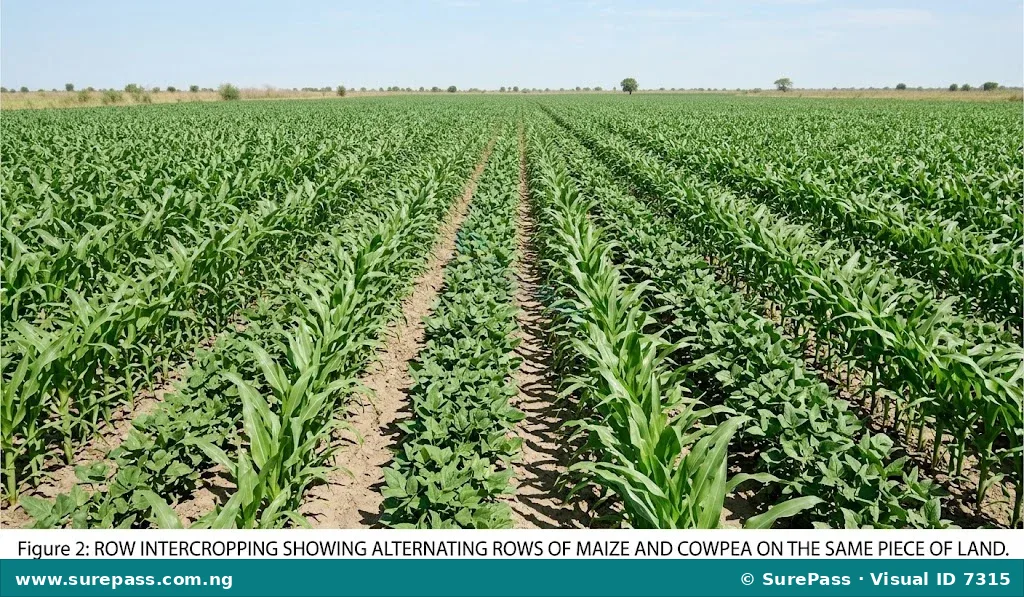
Intercropping is the practice of growing two or more crops simultaneously on the same piece of land.
In this system, the crops do not necessarily need to be planted or harvested at the exact same time, but they must co-exist on the field for a significant portion of their growth cycles. An example is growing maize and cowpea together in alternating rows.
Observe the image below.
Sequential Cropping
Sequential cropping is the practice of growing two or more crops in sequence on the same piece of land within a single farming year, where the second crop is planted only after the first crop has been harvested.
This system is highly dependent on the availability of moisture, either through a long rainy season or irrigation. For example, a farmer may plant and harvest early maize, and immediately follow it with a crop of cowpea or sweet potato on the same ridges.
Relay Cropping
Relay cropping is a form of multiple cropping where a second crop is planted into an existing standing crop before the first crop is harvested.
The second crop is introduced when the first crop has reached reproductive maturity but is not yet ready for harvest. This minimises the time the land remains idle. For example, planting cassava into a standing field of maize that is drying up and nearing harvest.
Alley Cropping
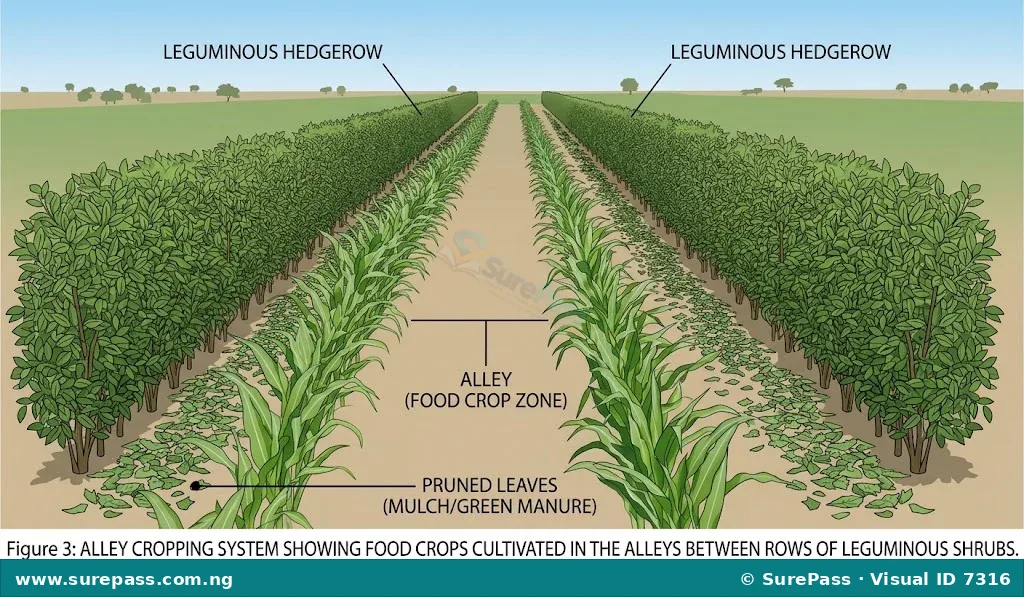
Alley cropping is an agroforestry practice where food crops are grown in the alleys formed by rows of trees or shrubs.
The trees or shrubs, often fast-growing leguminous species like Gliricidia sepium or Leucaena leucocephala, are regularly pruned to prevent them from shading the food crops. The prunings are applied to the soil as green manure to improve soil fertility. Food crops such as maize, yam, or cassava are grown in the spaces (alleys) between the tree rows.
Observe the diagram below.
How to Carry Out Sole Cropping
This practical activity guides learners through the process of establishing a sole crop of maize on a school farm or home garden.
The required tools and materials are:
- Maize seeds (improved variety)
- Cutlass and hoe
- Measuring tape and garden line
- Wooden pegs
- NPK 15:15:15 fertilizer
The procedure involves the following steps:
- Clear the selected plot of land using a cutlass and remove all debris.
- Use a hoe to loosen the soil and construct uniform ridges or seedbeds.
- Use the measuring tape and garden line to mark out planting rows with a spacing of 75 cm between rows.
- Mark out planting points along each row at a spacing of 25 cm.
- Plant 2 maize seeds per hole at a depth of about 3 cm to 5 cm.
- Firm the soil gently over the seeds to ensure good soil-to-seed contact.
- Apply water if the soil is dry, and monitor for germination within 5 to 7 days.
- Thin the seedlings to one strong plant per stand two weeks after germination.
- Apply NPK fertilizer in a ring or band about 10 cm away from the base of each plant.
- Keep the plot free of weeds by manual weeding with a hoe.
How to Carry Out Multiple Cropping
This practical activity demonstrates multiple cropping using an intercropping system of maize and cowpea.
The required tools and materials are:
- Maize seeds
- Cowpea seeds
- Hoe and cutlass
- Measuring tape and garden line
- Wooden pegs
- NPK 15:15:15 fertilizer
The procedure involves the following steps:
- Clear the land and prepare ridges spaced 75 cm apart.
- Plant the maize seeds on top of the ridges at a spacing of 75 cm between stands along the ridge.
- Plant the cowpea seeds on the sides of the same ridges, alternating with the maize stands, at a spacing of 25 cm.
- Apply NPK fertilizer to the maize stands two weeks after planting, ensuring the fertilizer does not touch the cowpea plants directly.
- Weed the plot regularly using a hand hoe, taking care not to damage the shallow roots of the cowpea plants.
- Harvest the maize cobs when they are mature and dry.
- Allow the cowpea plants to continue growing to cover the soil until their pods are mature, dry, and ready for harvest.




0 comments
Open the discussion when you need it. Comments stay collapsed until requested so the initial article remains light.